The wind in the South Atlantic does not just blow. It screams. It tears at the volcanic cliffs of Tristan da Cunha, a speck of basalt and green grass anchored in two million square miles of empty, churning blue. There is no airstrip here. No neon lights. No easy way out. When the sun dips below the horizon, the 230 souls living in the Settlement of Edinburgh of the Seven Seas are more isolated than the astronauts orbiting on the International Space Station.
Then, the coughing started.
It began as a whisper of a medical concern, the kind that usually resolves with bed rest and tea. But on an island six days’ sailing from the nearest hospital in Cape Town, "usual" is a luxury no one can afford. When a patient began to show symptoms consistent with Hantavirus—a rare, aggressive pathogen often carried by rodents that can liquefy the lungs into a fluid-filled trap—the isolation of Tristan da Cunha stopped being a poetic quirk. It became a death sentence.
The descent into the void
Imagine standing on a pier, watching the horizon for a ship that won't arrive for a week, while your breath grows shallow. This is the reality of the islanders. They are resilient, hardy people descended from shipwrecked sailors and adventurous stonemasons, but they cannot fight a viral shadow with grit alone.
The call for help traveled thousands of miles, bouncing through satellite relays until it reached the Ministry of Defence in London. The logistics were a nightmare. You cannot simply fly a helicopter to Tristan; it would run out of fuel long before the shadow of the volcano appeared. You cannot wait for a commercial vessel; the clock was ticking too fast.
The solution was a feat of precision that felt more like a wartime insertion than a medical evacuation.
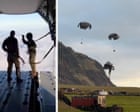
A Royal Air Force A400M Atlas aircraft took off from the Falkland Islands, banking into the grey soup of the southern latitudes. On board were members of the 16 Air Assault Brigade—the British Army’s global response force. These are men and women trained to drop into hostile territory under fire. This time, the enemy was microscopic, and the drop zone was a tiny patch of grass surrounded by vertical rock.
Gravity and the ghost virus
The paratroopers stepped into the open air thousands of feet above the churning ocean.
Think about the physics of that moment. A human being, strapped to medical supplies and specialized diagnostic equipment, falling toward the remotest inhabited archipelago on the planet. The margin for error was zero. A shift in the wind could send a medic into the freezing surf, where the currents would sweep them away before a rescue boat could even be launched.
They landed. Boots hit the damp soil. Within minutes, the "dry facts" of a news ticker became a frantic, human struggle. The soldiers weren't there to fight a war; they were there to build a bridge of science in a place where technology usually goes to die.
The suspected culprit, Hantavirus, is a terrifying guest. It typically enters the human story through the inhalation of aerosolized dust contaminated by the waste of infected mice or rats. In the cramped, cozy homes of the settlement, an outbreak would be catastrophic. The island has one small hospital, the Camogli Healthcare Centre, which is expertly run but lacks the intensive care infrastructure required to manage a full-blown hemorrhagic fever outbreak.
The paratroopers brought more than just medicine; they brought certainty. They carried portable testing kits and high-grade PPE, transforming a quiet island living room into a frontline bio-containment zone.
The weight of two hundred lives
To understand why this matters, you have to look past the military hardware. Consider the perspective of an islander. For generations, your safety has been tied to the community. If a house catches fire, everyone grabs a bucket. If the potato crop fails, everyone shares their stores. But how do you fight something you cannot see? How do you maintain the "Longhouse" spirit of togetherness when the very act of breathing near a neighbor might be lethal?
The arrival of the paratroopers was a jarring collision of worlds. Camouflage gear and high-tech respirators moved through a village where the primary mode of transport is often a tractor or a sturdy pair of walking boots.
But the tension on the island wasn't just about the virus. It was about the fragility of their existence. Every person on Tristan da Cunha knows that they live by the grace of the sea and the stability of their own bodies. A broken leg is a crisis. A suspected viral surge is an existential threat.
The medics worked through the night. They weren't just checking pulses; they were calming a community that suddenly felt every mile of the distance between themselves and the rest of humanity. They were there to determine if the "ghost virus" had truly made landfall, or if this was a different, more manageable shadow.
The silence after the storm
As the diagnostic tests were processed, the island held its breath. If the result was positive, the mission would shift from a medical assessment to a desperate evacuation—a race against pulmonary edema in the middle of a gale.
Logistics in the South Atlantic are a cruel master. Even with the RAF involved, getting a critically ill patient off the island involves a complex "daisy chain" of assets. It might mean a ship meeting a long-range helicopter, which then meets a specialized medical jet in South Africa or the Ascension Islands. It is a ballet of millions of pounds of equipment, all focused on the survival of a single person.
In the end, the mission served as a stark reminder of a truth we often forget in our hyper-connected cities: we are only as safe as our ability to reach one another.
The paratroopers eventually packed their chutes. The Atlas aircraft returned to the horizon. The island returned to its rhythmic, wind-swept solitude. But the grass where the boots hit the ground remains pressed down, a temporary monument to the moment the world's most remote neighbors were reminded they hadn't been forgotten.
The "suspected case" eventually became a data point in a medical file, but for the 230 people in the shadow of the volcano, it was the week the sky opened up and dropped hope into their backyard. They are back to fishing for crawfish and tending their patches now. They watch the horizon, not with fear, but with the quiet knowledge that even at the edge of the map, someone is listening to the radio.
The wind still screams across the cliffs of Tristan. But for now, the breathing in the village is steady, rhythmic, and deep.