Bread.
It is the most ordinary thing on earth, a humble alchemy of crushed grain, tepid water, a pinch of salt, and wild yeast coaxed out of the air, baked every single morning by calloused hands before the rest of the world bothers to wake up. We tear it apart absentmindedly while reading the morning news, dip it into olive oil without thinking, and toss the stale heels to the birds. Yet when archaeologists pried open the heavy iron door of a brick oven in the buried Roman city of Pompeii, they did not find gold crowns, marble statues, or the glittering war chests of emperors. They found eighty-one loaves of carbonized bread, sitting in neat rows exactly where a baker had slid them onto the hot stone floor nearly two thousand years ago.
To understand why a blackened hunk of ancient dough can stop a grown person dead in their tracks inside the Naples National Archaeological Museum, you have to strip away the marble-column grandeur of standard history books. History usually remembers the loud people. It remembers generals screaming orders across muddy fields, senators plotting assassinations on the steps of the Curia, and emperors commissioning towering arches to celebrate their own vanity. History rarely bothers to record the quiet, rhythmic labor of the person who fed them all.
Consider a hypothetical morning in the late autumn of 79 AD—a date scholars now widely place in October rather than the traditional August, based on the heavier woolen cloaks worn by victims, the presence of autumnal fruits like pomegranates and walnuts, and freshly sealed wine amphorae. Let us call our baker Marcus, though history never preserved the name of the man working the ovens at the Bakery of Modestus in Pompeii’s Region VII.
Marcus would have started his shift in the pitch dark. Down in the narrow, soot-stained courtyard behind the shop, four heavy volcanic-stone mills stood waiting, their hourglass shapes worn smooth by years of friction. Blindfolded donkeys—or enslaved laborers whose names were never chiseled into stone—walked endless, dizzying circles to grind emmer wheat and barley into coarse flour. The air in the bakery would have been thick, warm, and overwhelmingly alive with the sharp, sour tang of fermenting starter and the sweet, nutty aroma of woodsmoke drifting from the praefurnium, the arched brick furnace.
By mid-morning, the town outside was humming with ordinary Roman life. Cart wheels clattered over the deep ruts in the basalt paving stones. Politicians had plastered fresh red-ochre campaign slogans onto the stucco walls just down the street, urging neighbors to vote for local magistrates. Children darted past thermopolia—the bustling street-food counters where spiced wine and hot chickpea stew simmered in sunken clay jars. Inside the bakery, Marcus was focused on one thing only: timing.
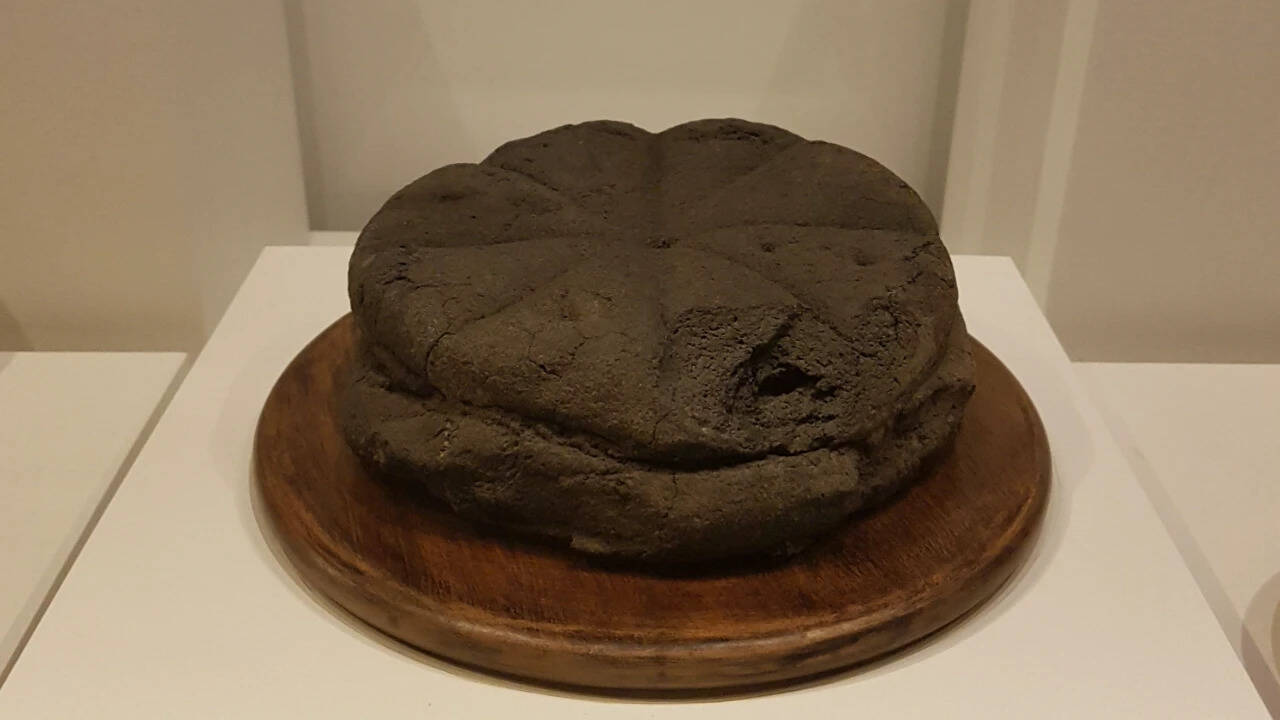
He shaped the dough into round, squat loaves, roughly eight inches across. Then, using a piece of twine tied tightly around the circumference and a sharp blade across the top, he scored each loaf into eight neat wedges. This was not decoration. In a city where forks did not exist and most people ate with their fingers, those eight pre-cut segments—known as panis quadratus—made the bread easy to snap apart and share around a crowded table. Before sliding the batch into the roaring oven with a long wooden peel, Marcus pressed a bronze stamp firmly into the center of the dough. The imprint read: Celeris Q. Grani Veri ser.—"Celer, slave of Quintus Granius Verus."
Why stamp a loaf of bread with a slave’s name? Because in Rome, bread was politics, commerce, and survival rolled into one. If a batch came out underweight, adulterated with chalk, or burned to a crisp, municipal inspectors needed to know whose back to lash or whose purse to fine. That bronze stamp was a signature of accountability, a tiny mark of human pride pressed into soft dough on an ordinary Tuesday morning.
Then the mountain cleared its throat.
When I first stood in front of the glass display case in Naples, staring at one of those surviving loaves, my immediate reaction wasn't academic awe. It was an unexpected, visceral lump in my throat. You can see every finger indentation where the baker pressed the dough down. You can see the crisp, geometric lines of the eight wedges, puffed slightly from the initial blast of oven heat before the baking stopped forever. Even the faint depression of the bronze stamp remains visible on the crust, frozen mid-rise like a photograph taken at a shutter speed of two millennia.
We tend to think of disaster as something cinematic, a sudden wall of fire that vaporizes everything in an instant. The reality of Mount Vesuvius was slower, heavier, and infinitely more suffocating. Around one o'clock in the afternoon, a colossal column of pumice, ash, and superheated gas punched twelve miles into the stratosphere, blotting out the Mediterranean sun and turning midday into a suffocating midnight. For hours, fist-sized stones rained down on Pompeii like lethal hail, caving in tiled roofs under sheer dead weight.
Think about what happened inside that brick oven while the sky fell apart outside.
Marcus closed the iron door. Perhaps he closed it out of pure muscle memory, the deeply ingrained habit of a craftsman who refuses to let a batch ruin while he steps outside to see why the horses are screaming and the ground won't stop trembling. Or perhaps he locked the heavy iron hatch hoping to protect his livelihood until the strange storm passed. Either way, that mundane act created an unintentional time capsule.
As the roof of the bakery collapsed under tons of gray pumice, sealing the oven beneath a dense blanket of volcanic debris, the trapped heat inside slowly cooked the loaves past golden brown, past dark amber, straight into pure carbon. Deprived of oxygen by the sealed iron door and buried beneath twenty feet of ash, the bread did not rot. Mold could not touch it. Beetles could not bore into it. Time simply hit pause.
The Anatomy of an Everyday Miracle
When people first hear about 2,000-year-old Roman bread surviving a volcanic eruption, they usually ask the same skeptical question: How on earth didn't it turn to dust?
To understand the preservation of Pompeii’s bread, picture what happens when you forget a potato in the back of a hot campfire. If the potato sits directly in the open flames, oxygen feeds the fire and reduces the skin and starch to weightless gray ash that blows away in the breeze. But if you bury that potato deep under hot coals where no air can reach it, the intense heat drives out every drop of moisture while leaving the physical architecture of the plant cells completely intact. You end up with a black, lightweight charcoal replica of the original potato—every ridge, eye, and curve preserved in carbon.
That is precisely what Vesuvius did to the Bakery of Modestus. The iron oven door acted as an airtight shield against the pyroclastic surges—those fast-moving avalanches of 700-degree gas and volcanic debris that swept down the slopes of the mountain the following morning, instantly killing anyone who had stayed behind in the city. While the wooden beams of the bakery turned to charcoal and the limestone walls cracked from the thermal shock, the eighty-one loaves inside the sealed masonry chamber underwent slow, uniform carbonization.
Archaeologists uncovered the oven in 1862 during the excavations led by Giuseppe Fiorelli, the visionary Italian scholar who pioneered the technique of pouring liquid plaster into the hollow cavities left by decomposed bodies in the ash. When workers cleared the debris from the bakery floor and pried open that corroded iron door, they expected charred rubble. Instead, they stared into a pristine bakery shelf from the first century AD, complete with eighty-one intact loaves lined up in rows.
Modern food historians and bakers have spent years reverse-engineering those loaves, treating them not as museum relics, but as culinary blueprints. By scanning the carbonized crumb under microscopes and cross-referencing the shapes with ancient Roman agricultural texts by Pliny the Elder and Cato the Elder, researchers have pieced together exactly what that bread tasted like before the ash fell.
It was nothing like the pillowy, sugar-laced white sandwich bread sitting on modern grocery shelves. Roman panis quadratus was dense, hearty, and complex. Bakers used siligo—a fine white wheat flour reserved for wealthier customers—or far, a rustic, high-protein emmer wheat that gave the loaf a nutty, earthy chew. Instead of commercial instant yeast, they relied on fermentum, a living sourdough starter cultivated from wild yeasts and lactic acid bacteria, often boosted with leftover grape must from the autumn wine harvest. The result was a loaf with a crackling, blistered crust, a tangy, slightly sour crumb, and enough structural integrity to mop up rich sauces of fermented fish (garum), olive oil, and stewed lentils without falling apart.
What We Lose When We Only Look at Marble
There is a strange psychological distance we create when we study the ancient world. We put Romans on pedestals—literally and figuratively. When we walk through ruined forums or stare at busts of Augustus and Seneca, we subconsciously view them as alien creatures draped in white sheets, speaking in dramatic epigrams and obsessed with conquest. It is hard to feel kinship with a marble statue. It is impossible not to feel kinship with a half-baked loaf of bread.
Consider the invisible stakes sitting inside that oven. In the Roman Empire, bread was not merely food; it was the bedrock of social stability. The satirist Juvenal famously mocked the Roman populace for caring only about panem et circenses—bread and circuses—yet beneath his aristocratic sneer lay a stark biological truth. Roughly seventy percent of an average Roman citizen's daily calories came from grain. When grain ships from Egypt were delayed by winter storms, riots broke out in the streets of Rome within days. Emperors lived in perpetual terror of an empty grain warehouse.
Every morning, across hundreds of cities from Britain to Syria, thousands of anonymous bakers performed the exact same physical choreography as the man in Pompeii. They hauled sacks of flour, tended sourdough starters like fragile infants, stoke-fed roaring wood ovens with bundles of brushwood and olive prunings, and pulled blisteringly hot loaves from the stone hearth before dawn. They suffered from chronic lung disease from inhaling fine flour dust, burned their forearms on iron oven doors, and wore down their joints kneading heavy batches of stiff dough by hand.
Yet almost none of them ever wrote a book. None of them commanded a legion. If Mount Vesuvius had never erupted, every single one of those eighty-one loaves would have been eaten by sunset on that autumn day in 79 AD. A dockworker would have snapped off two wedges to eat with salty sheep's cheese; a mother would have torn off pieces for her children; a merchant would have wiped his plate clean with the crust. By the next morning, not a single crumb would have remained, and the baker who stamped his name into the dough would have vanished into the vast, silent ocean of forgotten working people.
Catastrophe, by a cruel twist of irony, granted them immortality.
Holding the Weight of an Ordinary Morning
I used to think travel was about chasing spectacle—standing beneath towering cathedrals, photographing famous paintings behind velvet ropes, ticking landmarks off a checklist. Walking through the quiet, sun-drenched backstreets of Pompeii cures you of that illusion quickly. The grand amphitheater and the Temple of Apollo are impressive, certainly, but they feel like stage sets. It is the small, domestic interruptions that break your heart.
You step over a threshold and see a mosaic floor featuring a snarling watchdog and the warning CAVE CANEM—"Beware of the Dog"—laid down by a homeowner worried about burglars who never came. You walk down a narrow alley and notice deep grooves worn into the stone lip of a public water fountain, carved over decades by thousands of thirsty citizens resting their hands on the exact same spot as they leaned down to drink. You stand in front of a bakery counter and see the stone mills, the kneading room, and the arched brick oven where eighty-one loaves waited for an afternoon rush that never arrived.
We spend so much of our modern lives anxious about legacy, curated profiles, and grand achievements, terrified that if we do not build something monumental, we will leave no trace behind. We forget that human civilization is not held together by monuments. It is held together by ordinary people showing up at four in the morning to knead dough, score eight neat wedges with a piece of string, and slide their work into a hot oven so their neighbors can eat.
Somewhere in a climate-controlled gallery in Naples, a blackened round loaf sits under soft museum lights, cracked slightly along the lines a Roman baker scored nearly two thousand years ago. The empire that minted the coins to buy it has crumbled into dust. The emperor who ruled the world that morning is a footnote in dusty textbooks. The mountain that buried it still looms quietly over the Bay of Naples, wisps of steam occasionally rising from its crater.
And there, resting silently behind glass, is a simple loaf of bread—still waiting for someone to break off a piece and share it.