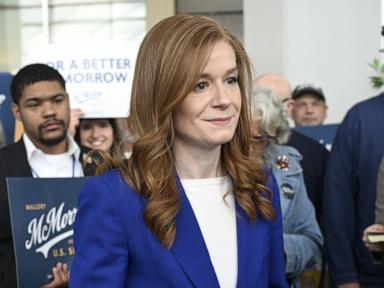
The suspension of State Senator Mallory McMorrow’s campaign for Michigan’s open United States Senate seat illustrates a fundamental law of electoral economics: in high-stakes primaries under asymmetric outside capital insertion, middle-lane strategies face swift structural liquidation. The race to fill the vacancy left by retiring Senator Gary Peters now transitions from a three-way factional squeeze into a stark binary competition between establishment-backed Representative Haley Stevens and progressive challenger Abdul El-Sayed. McMorrow's exit, occurring exactly thirty days before the August 4, 2026 primary election, was not a casual political pivot but the predictable result of an unsustainable cost function. When outside expenditure surges to saturate localized media markets, candidates running without corporate political action committee (PAC) funds face immediate structural marginalization.
To understand why McMorrow’s campaign collapsed despite her considerable national profile and legislative record, analysts must look past conventional media narratives regarding candidate charisma or debate performances. The outcome was driven by hard structural constraints. Her campaign encountered an unyielding resource bottleneck generated by two primary factors: the saturation of the airwaves by highly capitalized independent expenditures and the mathematical polarization of the Democratic primary electorate.
The Resource Allocation Function under Outside Capital Saturation
Modern statewide political campaigns operate under rigid mathematical constraints defined by media market efficiency, polling trajectory, and capital efficiency. In a three-way primary, a candidate positioning themselves as an ideological bridge must maintain an independent fundraising mechanism capable of defending their market share against structural polarization. McMorrow’s campaign operated on an explicit self-imposed constraint: a complete rejection of corporate PAC funding. While this position served as an ideological differentiator, it created a severe capital deficit when independent expenditure groups intervened in the primary.
The primary financial force in this contest was the influx of outside capital. The United Democracy Project, a super PAC associated with the American Israel Public Affairs Committee (AIPAC), injected more than $20 million into television advertising within the Michigan market. Two independent PACs added another $15.5 million. This combined capital injection of $35.5 million was directed toward boosting Stevens and running negative advertisements against El-Sayed.
This massive concentration of independent capital altered the campaign's cost function through specific mechanics:
- Ad Market Saturation: The sudden purchase of millions of dollars in television inventory across the Detroit, Grand Rapids, and Flint media markets drove up the effective cost-per-point for political advertising, rendering grassroots-funded advertising buys increasingly inefficient.
- The Binary Information Filter: The multi-million-dollar ad campaigns framed the primary as a high-stakes, two-sided ideological battle. Voters were presented with a stark choice between Stevens' establishment credentials and El-Sayed’s progressive platforms, completely crowding out the nuanced legislative-results message of a middle-lane candidate.
- Diminishing Returns on Earned Media: Although McMorrow possessed a national brand stemming from a viral 2022 legislative speech and a 2024 Democratic National Convention appearance, earned media could not counter the sheer volume of paid, repetitive television spots.
When paid media spending by outside groups reaches an order of magnitude larger than a candidate’s total cash-on-hand, the candidate’s ability to define their own policy platform drops to near zero. McMorrow’s campaign became financially unviable because the cost of maintaining a competitive share of voice in the state's major media markets exceeded her self-funded and grassroots fundraising capacity.
Ideological Triangulation and the Mechanics of the Squeeze Effect
The political middle lane is frequently praised by commentators as a pragmatic path to broad appeal, yet game theory demonstrates its extreme vulnerability in partisan primary elections. When an electorate is divided into distinct structural factions, a candidate occupying the center-left must pull votes from both the establishment wing and the progressive wing. This positioning creates an unstable equilibrium.
In the Michigan primary, the ideological distribution of voters created a structural squeeze. Haley Stevens captured the institutional center, securing backing from Senate Democratic Leader Chuck Schumer, state party insiders, and eventually Attorney General Dana Nessel. This institutional backing brought reliable, high-turnout primary voters who prioritize general election electability and party alignment. Abdul El-Sayed locked down the ideological left, drawing endorsements from Senator Bernie Sanders and Representative Alexandria Ocasio-Cortez. This progressive faction is highly motivated by systemic policy shifts, such as Medicare for All, and is deeply skeptical of corporate influence.
McMorrow attempted to bridge this divide by emphasizing her operational record, running on the theme that "rhetoric is really nice, but results are better," and pointing to her role in flipping the Michigan State Senate to a Democratic majority. This value proposition failed to gain traction due to distinct psychological barriers within both voter cohorts.
The Institutional Voter Skepticism
Establishment voters viewed McMorrow as an unnecessary electoral risk. Because Stevens already possessed federal legislative experience and an extensive campaign apparatus, institutional voters saw no logical reason to switch their allegiance to a state senator. The massive outside ad campaigns reinforced the narrative that Stevens was the most stable option to challenge Republican nominee Mike Rogers in November.
The Progressive Voter Ideological Purity
Progressive voters viewed McMorrow’s pragmatic, incremental approach as insufficient. El-Sayed’s platform offered a clear ideological alternative, while McMorrow’s platform appeared to be a softer version of the establishment position. Her decision to reject corporate PAC money was matched by El-Sayed, neutralizing what could have been a key differentiator on the left.
The polling data from May and June 2026 captured this structural squeeze. Public polling from firms like Mitchell Research and Lake Research Partners consistently showed El-Sayed holding a lead in the mid-30s or low-40s, with Stevens maintaining a strong second place in the high-20s or low-30s. McMorrow remained pinned in the low teens or single digits. As the primary approached, undecided voters did not consolidate behind McMorrow; instead, they gravitated toward the two dominant poles of the race. The middle lane did not expand; it collapsed under the weight of the two better-funded factions.
Post-Exit Consolidation and the Binary Primary Equilibrium
McMorrow’s exit instantly restructures the electoral mathematics of the Michigan Senate primary, creating an entirely new equilibrium for the final thirty days of the campaign. By removing the third variable from the equation, the race becomes a pure test of factional strength and turnout mechanics. The distribution of her remaining supporters will determine the nominee.
The immediate reaction from both remaining campaigns reveals their respective strategies for absorbing McMorrow's voters. Stevens issued a statement focusing on institutional unity and common ground, praising McMorrow's legislative focus on children and families. This approach assumes that a significant portion of McMorrow's base consists of pragmatic, center-left suburban voters who will naturally transition to Stevens as the establishment alternative.
El-Sayed took a highly aggressive, populist approach. In a public message on X, he framed McMorrow’s exit as proof of institutional hostility, claiming that "party insiders" had been "bullying anyone who opposes their chosen candidate" and pointing to the $30 million spent by outside groups to drown out alternative voices. El-Sayed’s strategy aims to capture McMorrow's grassroots volunteers and anti-corporate donors by framing the remaining race as a battle between grassroots democracy and outside billionaire wealth.
The reallocation of McMorrow's voters is governed by two distinct voter profiles:
- The Suburban Realists: These voters supported McMorrow because of her effectiveness in competitive Michigan legislative districts. Given the high stakes of retaining this Senate seat to preserve any path toward a Democratic majority, these voters are highly likely to shift to Stevens. They view El-Sayed’s progressive positions as a general election liability against Mike Rogers.
- The Anti-Establishment Reformers: These voters were drawn to McMorrow’s corporate PAC ban and her clean-governance profile. El-Sayed’s populist rhetoric directly appeals to this group's skepticism of outside super PAC spending. A meaningful portion of this cohort will likely move to El-Sayed, viewing his campaign as the last remaining vehicle to challenge institutional control.
This realignment creates a critical strategic test during the upcoming televised debates. Without McMorrow acting as a rhetorical buffer, Stevens will be forced to directly answer El-Sayed's attacks regarding outside spending, corporate influence, and policy orthodoxy. In earlier debates, Stevens largely avoided direct conflict, allowing El-Sayed and McMorrow to split the debate time. The new binary format eliminates this defensive option.
Macro-Level Implications for Statewide Electoral Strategy
The disruption of the Michigan primary offers critical insights for statewide campaign design, particularly for candidates attempting to run competitive campaigns without access to unlimited outside capital. The structural realities of this race show that a national media brand and legislative success are no longer enough to offset massive capital disadvantages in compressed timelines.
The primary limitation of McMorrow’s strategy was the assumption that a candidate could maintain a middle-lane ideological position while simultaneously relying on a grassroots funding model. In modern primaries, these two choices are structurally incompatible. A middle-lane strategy requires massive capital to compete with the institutional fundraising power of the establishment. Conversely, a grassroots funding model requires a sharp, highly polarized ideological message to motivate small-dollar donors to give at scale. By choosing a moderate platform and a grassroots funding model, the campaign stranded itself without the institutional money of the right or the intense ideological fervor of the left.
Future statewide strategists must choose a structurally coherent quadrant. If a campaign rejects corporate PAC money, it must adopt a disruptive, highly differentiated ideological profile to maximize small-dollar fundraising efficiency and volunteer mobilization. If a campaign chooses a pragmatic, center-left platform, it must fully embrace institutional fundraising channels and Super PAC support to protect its media share of voice against inevitable polarization. Attempting to blend a moderate platform with a restrictive fundraising model creates an immediate structural vulnerability that sophisticated opponents will exploit through outside capital saturation.
The final phase of the Michigan primary will serve as an indicator for the national party's internal balance of power. If the massive capital deployment by groups like the United Democracy Project successfully carries Stevens to the nomination, it will validate the establishment’s playbook of using heavy independent expenditure to insulate mainstream candidates from progressive challengers. If El-Sayed manages to hold his polling lead and win the nomination despite the financial asymmetry, it will demonstrate that under conditions of intense polarization, a highly motivated grassroots faction can withstand multi-million-dollar media campaigns. The outcome will write the strategic blueprint for the fast-approaching general election cycle.