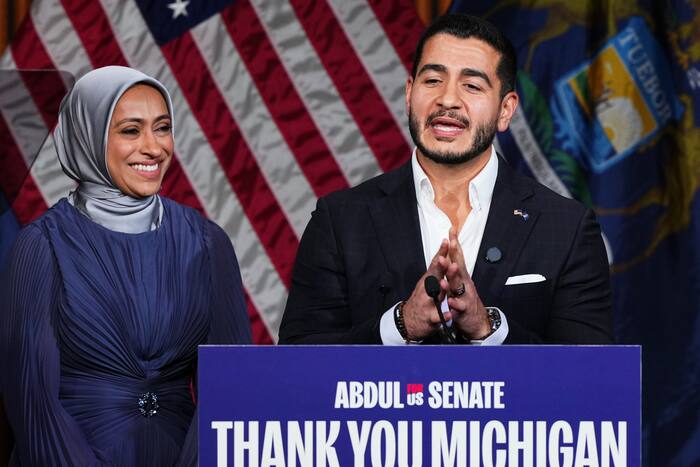
Political communication relies on lexical asymmetry, where a single term carries opposing semantic loads depending on the listener's cultural and linguistic baseline. When Michigan politician Abdul El-Sayed deployed the phrase "JD, habibi" in response to political criticism involving JD Vance, he executed a textbook maneuver in pragmatic linguistics: turning an Arabic term of endearment into an instrument of public condescension. The viral reception among Arab and Arab-American audiences was not a spontaneous cultural inside joke; it was the predictable output of a specific sociolinguistic mechanism where affection is inverted to establish dominance, signal in-group solidarity, and neutralize an opponent's attack without engaging on their rhetorical turf.
To understand why this specific two-word combination generated high engagement and asymmetric political value, one must strip away surface-level commentary about "cultural pride" and examine the underlying mechanics of code-switching, pragmatic inversion, and digital amplification. Don't forget to check out our recent coverage on this related article.
The Architecture of Pragmatic Inversion
In standard semantics, the Arabic word habibi (literally "my beloved" or "my darling") functions as a marker of intimacy, warmth, or familial closeness. However, in the pragmatics of Levantine, Egyptian, and Gulf dialects—as well as across the Arab diaspora—the term operates on a sliding scale of dominance and dismissal.
Linguists categorize this phenomenon as pragmatic inversion, where the literal meaning of a lexical item is subordinated to its contextual illocutionary force. When used between peers in a non-affectionate or confrontational setting, habibi strips the recipient of equal status. It mirrors the Southern American English "bless your heart" or the British "my dear fellow." The speaker assumes a posture of patient, slightly exasperated superiority, framing the opponent not as a formidable adversary, but as a misguided subordinate who requires gentle correction. To read more about the background here, The Guardian provides an informative summary.
The Three Axes of the "Habibi" Pivot
The deployment of habibi in an English-language political exchange operates across three distinct strategic axes:
- Status Realignment: Political attacks rely on framing the target as defensive or reactive. By addressing an opponent with a term of endearment, the speaker refuses the defensive posture. The rhetorical frame shifts from a peer-to-peer debate to an asymmetrical dynamic—akin to an adult addressing an overly excited child.
- In-Group Signaling (Dog-Whistling via Heritage): Unlike traditional political dog whistles, which rely on coded English phrases to obscure intent, heritage code-switching is overt to the in-group and opaque to the out-group. Arab-American voters immediately recognize the tonal shift—the exact inflection used by an Arab parent or elder when someone has said something remarkably foolish. To the uninitiated observer, it reads merely as a foreign word, potentially misinterpreted as genuine friendliness or exoticized confusion.
- De-escalation as Offense: Standard political counter-attacks escalate hostility, which often validates the original critic's framing. Introducing an affectionate term short-circuits the escalation loop. The opponent cannot easily attack the word itself without appearing hypersensitive to a term that literally translates to "my love," creating a rhetorical trap.
The Cost Function of Political Code-Switching
Code-switching in American politics historically carried a high penalty. Candidates from minority backgrounds faced an assimilationist baseline where deviating from Standard American English triggered alienating perceptions among broader electorate segments. When Barack Obama utilized African American Vernacular English (AAVE) cadences or Spanish-speaking candidates inserted unscripted Spanish into debates, political strategists meticulously calculated the trade-off between base mobilization and swing-voter alienation.
The calculus has shifted due to algorithmic media distribution. In a fragmented media environment, the primary objective of a political soundbite is no longer universal appeal; it is high-velocity transmission within specific identity networks that subsequently breach mainstream containment.
We can model the utility of strategic code-switching through a basic political cost-benefit equation:
- Mobilization Gain ($M_g$): The intensity of emotional resonance and shareability among the target demographic (here, Arab-American and broader Muslim-American voters, particularly concentrated in battleground states like Michigan).
- Alienation Cost ($A_c$): The negative reaction from swing or opposition voters who perceive the language as exclusionary or foreign.
- Algorithmic Multiplier ($A_m$): The engagement boost driven by novelty, humor, and cultural specificity on short-form video and text platforms.
When El-Sayed deployed "JD, habibi," the Alienation Cost ($A_c$) was artificially suppressed because the word habibi has already achieved partial lexical crossover into mainstream American pop culture (via music, social media memes, and diaspora slang). Simultaneously, the Mobilization Gain ($M_g$) spiked because the sarcastic usage remained culturally specific. The Algorithmic Multiplier ($A_m$) then carried the clip outside the initial demographic, fueled by Arab-American commentators translating the subtext for non-Arab audiences. That act of "cultural translation" in the comment sections and quote-tweets is itself an engagement engine, doubling the lifespan of the media cycle.
Diaspora Dynamics and the Michigan Electoral Context
The geographic and demographic context of this specific rhetorical event cannot be separated from its linguistic mechanics. Michigan holds one of the highest concentrations of Arab Americans in the United States, with cities like Dearborn and Hamtramck serving as critical electoral bellwethers.
In recent election cycles, Arab-American voters have demonstrated high elasticity and willingness to defect from traditional party alignments over foreign policy and domestic representation. For a political figure operating within Michigan's ecosystem, standard Democratic or progressive talking points often suffer from severe trust deficits.
Using culturally grounded mockery achieves what policy white papers cannot: it establishes authenticity through shared vernacular. When El-Sayed uses habibi in its sarcastic, confrontational register, he signals that his cultural identity is not a curated biographical bullet point for campaign mailers, but an active, lived cognitive framework. It proves he knows how Arabs actually argue.
The Mechanics of Cultural Validation
The celebration of the phrase among Arab audiences stems from a specific psychological relief: seeing a marginalized vernacular used offensively rather than defensively. Historically, Arabic words entering the American political lexicon have been securitized—terms like intifada, jihad, or sharia are routinely weaponized by political opponents to induce fear or demand disavowals from Arab and Muslim candidates.
By introducing a quotidian, domestic Arabic word and using it to mock a prominent national politician, the speaker inverts the linguistic power dynamic. Instead of defending against the weaponization of Arabic, the speaker weaponizes Arabic himself—not through aggression, but through ridicule. Ridicule is uniquely potent in politics because it denies the opponent the dignity of being feared.
Limitations and Failure Modes of Lexical Mockery
While the "JD, habibi" maneuver succeeded as a viral moment and base-mobilization tactic, relying on pragmatic inversion carries structural risks that limit its scalability in broader electoral campaigns.
First, contextual decay occurs rapidly. Once a culturally specific term is explained to the mainstream audience, it loses its in-group exclusivity. If a candidate repeats the tactic, it transitions from an authentic reflex to a calculated catchphrase, triggering cringe rather than solidarity. The efficacy of habibi as a political barb depends entirely on its spontaneity and precise tonal execution.
Second, misinterpretation by literalists remains a persistent vulnerability. In hyper-polarized media ecosystems, bad-faith actors routinely strip away pragmatic context to argue literal meanings. An opponent can easily pivot from being mocked to claiming the speaker is being duplicitous—saying "my love" while attacking—or, conversely, frame the use of non-English terms in political discourse as inherently divisive.
Third, viral engagement does not equal durable persuasion. High-velocity clips generate dopamine and social media impressions among already-aligned or adjacent voters, creating an illusion of momentum. However, rhetorical dominance in a 15-second clip does not resolve underlying policy friction or structural voter apathy. It lowers the barrier to attention, not the barrier to the ballot box.
Operationalizing Linguistic Asymmetry in Political Strategy
For political strategists and communications teams managing candidates from distinct cultural, regional, or linguistic backgrounds, the lesson of this exchange is not to force vernacular slang into speeches. Forced code-switching fails immediately because audiences detect the absence of native pragmatic competence.
Instead, communications architectures should be built around unfiltered cultural reflexes:
- Audit and Eliminate Defensive Assimilation: Stop training minority or regional candidates to neutralize their native speech patterns, idioms, or cadence during unscripted moments. The friction between a candidate's heritage vernacular and standard political English is precisely what creates memorable, high-contrast media moments.
- Deploy Subtextual Framing Over Direct Refutation: When confronted with bad-faith attacks from opponents, instruct principals to avoid line-by-line factual rebuttals in rapid-response formats. Instead, utilize culturally resonant framing—whether through regional idioms, heritage terms, or dry understatement—that positions the opponent as culturally illiterate or overly earnest.
- Design for the "Explainer" Secondary Cycle: Release clips containing in-group linguistic nuances without immediate translation or context. Allow the native audience to claim ownership of the moment first, incentivizing them to act as cultural interpreters for the broader public. This two-stage distribution model maximizes organic reach and insulates the campaign from accusations of pandering.
Political rhetoric is shifting away from broad-spectrum consensus language toward high-density, culturally specific signaling. Candidates who master the pragmatic inversion of their own heritage lexicons will consistently outperform opponents locked into traditional, monocultural debate frameworks—provided they deploy the tactic once, let the diaspora amplify the subtext, and move immediately back to substantive policy before the novelty curdles into caricature.