The engine of a wooden outrigger boat does not purr. It bangs. It is a relentless, metallic cough that vibrates through the soles of your feet, through the salt-crusted wood, and straight into your chest.
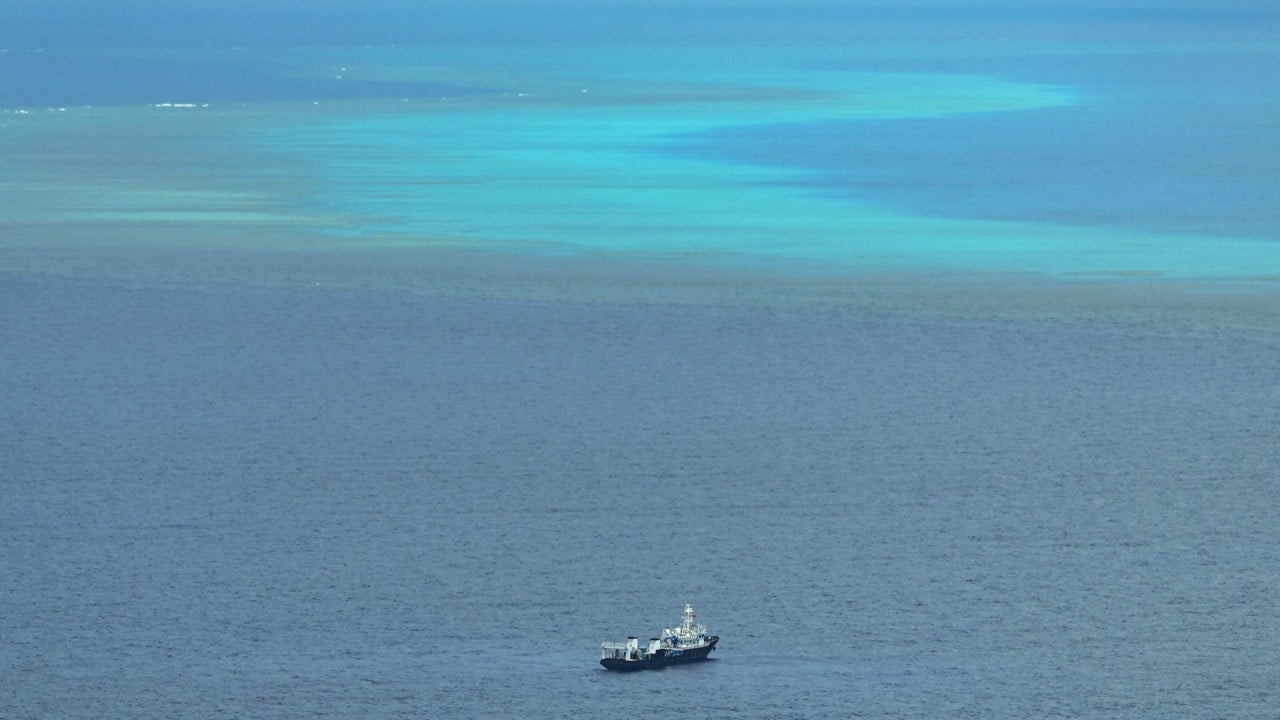
For generations of Filipino fishermen, that rough symphony was the sound of a living. You navigated by the stars, by the smell of the reef, and by the sudden, welcoming calm that greeted you when you slipped inside the embrace of Bajo de Masinloc. That is the local name for Scarborough Shoal. To the men who threw their nets here, it was never a geopolitical flashpoint. It was simply a triangular chain of reefs and rocks that formed a natural harbor in the middle of a vast, unforgiving sea. A sanctuary.
Now, it feels like a cage.
Imagine pulling up to your own front door and finding a stranger standing on the porch with a shotgun, telling you that your living room no longer belongs to you. That is the reality forty-four-year-old fishermen face every single day out here, some one hundred and twenty-four nautical miles off the coast of Luzon. When the gray hulls of the Chinese Coast Guard loom over the horizon, they do not just block a boat. They block a meal. They block a child’s school tuition. They block a way of life that has sustained these coastal towns for centuries.
The stakes in the South China Sea are usually measured in billions of dollars, trade routes, and naval tonnage. We look at maps covered in jagged, overlapping lines and read dry policy briefings about the "Nine-Dash Line" or the United Nations Convention on the Law of the Sea. But maps do not bleed.
The real story of Scarborough Shoal is written in the white-knuckle grip of a captain holding a wooden tiller, watching a steel vessel ten times his size bear down on him.
The Geography of Anxiety
To understand why a barren ring of coral matters so much, you have to look at what happens when sand becomes concrete.
For over a decade, a distinct pattern has played out across these waters. It begins with a presence. Chinese fishing trawlers—often acting as a maritime militia—anchor in areas claimed by neighboring nations. Then come the coast guard vessels to protect the trawlers. Finally, the dredgers arrive.
They vacuum up the living reef, crushing the coral into a slurry, and pump it onto the rocks until a permanent island rises from the waves. Then comes the runway. Then come the radar domes. Then come the missiles.
Subi Reef, Mischief Reef, Fiery Cross Reef. They were once just names on a nautical chart. Today, they are unsinkable aircraft carriers.
Philippine security officials are looking at Scarborough Shoal and seeing the final piece of a strategic noose. If Beijing succeeds in turning this specific shoal into another militarized outpost, they will have established a perfect golden triangle of surveillance and strike capability over the entire South China Sea. From Scarborough, Chinese fighter jets and missile batteries could reach Manila in minutes. They could monitor every ship leaving Subic Bay or Clark Freeport Zone.
It would turn the West Philippine Sea into a domestic Chinese lake.
The government in Manila has drawn a line. Admiral Alexander Lopez and various defense leaders have made it clear: any attempt to build artificial structures at Scarborough Shoal is a red line. The Philippines has vowed to block it.
But how does a nation with a navy comprised largely of legacy vessels and a handful of modern frigates stop a superpower that builds ships faster than anyone else on earth?
The Weaponization of the Everyday
The confrontation is rarely a matter of firing missiles. It is a war of attrition fought with water cannons, laser sights, and bureaucratic vocabulary.
Consider a typical encounter. A small Philippine resupply boat, built of wood and optimism, tries to bring food and fresh water to a tiny detachment of marines stationed on a grounded ship. Suddenly, two massive Chinese hull ships flank it. They do not fire guns. Instead, they unleash high-pressure water cannons.
The force is immense. It shatters windshields, rips away communication antennas, and leaves Filipino sailors crumpled on the deck with fractured ribs.
It is calculated brutality masquerading as law enforcement. By using "gray zone" tactics—actions that fall just short of provoking a traditional military response—Beijing forces Manila to make a agonizing choice every single day: back down and lose your territory, or fight back and risk starting World War III.
This is where the psychological weight settles. It is easy for analysts in Washington or Beijing to treat this as a grand game of chess. For the people on the water, the danger is physical. The water is freezing, the currents are treacherous, and help is days away.
The confusion is perhaps the most exhausting part. Under international law, specifically the 2016 ruling by the Permanent Court of Arbitration in The Hague, Beijing’s expansive claims have no legal basis. The tribunal explicitly ruled that Scarborough Shoal is a traditional fishing ground for multiple nations and lies squarely within the Philippines' Exclusive Economic Zone.
Yet, when you are staring up at a three-thousand-ton Chinese ship, a piece of paper from Europe offers very little shade.
The Ghost Towns on the Coast
The consequences of this geopolitical standoff wash ashore in places like Infanta and Masinloc, towns in the Zambales province of the Philippines.
Walk through these communities and you notice something strange. The docks are quiet. The large deep-sea fishing boats are tied up, rotting in the sun. The young men are gone, having migrated to Manila to drive taxis or work in construction.
When you ask the older fishermen why they no longer sail to the shoal, their eyes drift to the horizon.
They tell you about the intimidation. They tell you about having their catches confiscated at gunpoint. They tell you about the sheer cost of fuel; it takes days to sail out to Scarborough, and if you are chased away within an hour of arriving, you return home bankrupt, deeply in debt to the merchants who financed your ice and diesel.
The economic ecosystem of an entire region is collapsing. It is not just the fishermen who suffer. It is the women who clean the fish, the market vendors who sell it, the mechanics who fix the engines, and the families who rely on cheap protein to survive.
When a nation loses its fishing grounds, it loses its self-sufficiency. It begins importing what it used to catch. It becomes dependent.
A Strategy of Exposure
But Manila is no longer staying silent. A profound shift in strategy has occurred, born out of sheer necessity.
For years, the tactic was quiet diplomacy, trying not to poke the bear. That resulted in the loss of territory after territory. Now, the Philippines has turned to a weapon that Beijing cannot easily counter: transparency.
They are bringing journalists on the resupply missions. They are flying cameras over the shoals. When a Chinese ship cuts off a Philippine vessel, the footage is uploaded to the internet within hours. The world is watching the David and Goliath story play out in real time, in high definition.
This transparency strategy has forced the international community to take a side. The United States has repeatedly reaffirmed that its Mutual Defense Treaty with the Philippines applies to armed attacks on Philippine public vessels, aircraft, and armed forces anywhere in the South China Sea. Australia, Japan, and European nations are stepping up joint patrols and maritime aid.
Yet, reassurance is a fragile thing when you are the one floating in the dark.
The real problem lies in the unpredictability of a desperate situation. All it takes is one miscalculation. One captain who refuses to turn his wheel. One water cannon blast that knocks a sailor into the sea, where he drowns before his crewmates can reach him. One nervous finger on a trigger.
The sun sets over the Zambales coast in a bruise of purple and deep orange. On the beach, a fisherman repairs a net by the light of a small fire. He works with practiced, rhythmic movements, his calloused hands weaving the nylon thread back together.
He knows that tomorrow, the sea will still be there. He knows the fish will still be swimming through the coral alcoves of Scarborough Shoal. And he knows that the gray ships will be waiting for him, silent and massive, claiming ownership over the very water that runs through his fingers.
The conflict in the South China Sea is often described as a dispute over islands and rocks. But standing on this shore, watching the dark waves roll in, you realize it is actually about the space where a person's right to feed their family collides with an empire's desire to chart the globe.
The line has been drawn in the water, and the tide is rising.