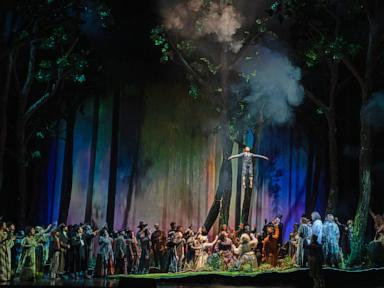
Grief makes time stretch until every second feels like a century, and Missy Mazzoli's opera Lincoln in the Bardo turns that exact sensation into sound.
George Saunders wrote his 2017 Man Booker Prize winner out of over a hundred fragmented voices hovering in a cemetery after Abraham Lincoln's young son Willie dies in 1862. That polyphonic structure sounds like a nightmare on paper for a composer. Yet when the Metropolitan Opera premiered Mazzoli and librettist Royce Vavrek's two-act adaptation in October 2026, it didn't feel like a polite literary footnote. It hit like a ghost story with teeth.
Why Lincoln in the Bardo Works on the Operatic Stage
Most novels collapse when you try to cram them onto an opera stage. Plot gets flattened, subplots vanish, and interior monologues turn clunky when sung out loud.
Lincoln in the Bardo is different because the novel already behaves like a choir. Saunders built the book out of overlapping testimonies, historical scraps, and spirits stuck in denial about being dead. Opera already asks audiences to accept heightened emotion, simultaneous voices, and theatrical artifice without blinking. When Mazzoli and Vavrek—their sixth operatic collaboration—shaped that material, they didn't have to invent artificial drama. The friction was already baked into the premise.
Every major character in the graveyard except President Lincoln is a ghost.
Realizing that freed Mazzoli to push vocal writing into strange, unvarnished territory. Living people breathe and anchor themselves in physical reality. Spirits linger in denial, looping through old habits and half-truths because they refuse to admit their time is up. Writing for seven principal singers, a chorus, and orchestra, Mazzoli treated the human voice less like a polished showroom instrument and more like a vessel haunted by memory.
The Long Road from a Manhattan Pub to the Met
This premiere didn't happen overnight, and honestly, the backstory is half the fun. Saunders first crossed paths with Mazzoli roughly a decade before the premiere in a Manhattan pub to talk about adapting the material. He had originally thought about the book in dramatic terms and imagined operatic possibilities even while writing it, then wisely stepped back and let the creative team do its job.
When Metropolitan Opera leadership sat down with Mazzoli to ask what stories she wanted to tell, she blurted out Lincoln in the Bardo without a rehearsed pitch because she didn't want to jinx the meeting. The Met commissioned the work in 2018 alongside Jeanine Tesori—making Mazzoli and Tesori the first two women to receive Met commissions—and the opera eventually became the first work by a female composer that the Met itself premiered. Even the route to New York had a twist: it was originally slated for Los Angeles Opera before that run was canceled, clearing the path for its fall 2026 Met debut conducted by Yannick Nézet-Séguin.
How the Staging and Cast Shape the Ghostly World
Watching a ghost story on a massive opera stage can easily go wrong. Too much literalism makes spirits look like people in bedsheets; too much abstraction leaves the audience cold.
Director Lileana Blain-Cruz leaned into theatrical texture rather than cheap scares. Costume designer Montana Levi Blanco took historical garments from the Met's own archives for the spirits and layered on wear, mold, and decay so the past literally clung to their backs. Puppet designer James Ortiz added uncanny physical weight—tendrils wrapping around Willie, pig heads, an iron furnace, and a grim vulture-like figure tied to Miss Elise Traynor. Those choices don't explain the supernatural away. They make it feel tactile and slightly unsettling.
On the vocal side, Peter Mattei brought quiet sorrow to Abraham Lincoln, carrying a grieving father's weight without resorting to melodrama. Christine Goerke stepped into the Reverend—a role Mazzoli wrote with her in mind from the start, and one Goerke said she had waited her whole life to sing—whose second-act confession cuts through the fog: he knows he's dead, faced judgment, was condemned, and hid in the bardo rather than accept his fate. Meanwhile, singers like Joshua Blue as Thomas Havens and Janai Brugger as Mrs. Francis Hodge brought the wrenching memory of slavery into the room, widening the grief beyond one family's loss into a national wound.
What Critics Praised and Where the Adaptation Strained
Even strong adaptations have seams, and pretending otherwise does the piece a disservice. Critics largely welcomed the Met run, praising Mazzoli's score and Blain-Cruz's staging, yet a fair look shows both triumphs and trade-offs.
The biggest win is tonal contrast. Saunders's novel mixes dark comedy, historical fragments, and heartbreak in a way that can feel dizzying at first. Mazzoli's score—running roughly two hours across two acts—gives that shifting emotional weather a pulse. You feel the weight of the Civil War in 1862, the ache of a father refusing to walk away from his child's crypt, and the stubbornness of souls who won't let go.
At the same time, compressing a sprawling, multi-voiced novel into a two-hour stage work forces hard cuts. Some reviewers noted that certain threads—including the late resolution around figures tied to the legacy of slavery like Thomas Havens and Mrs. Francis Hodge—can feel a bit hurried once the opera nears its close. That's an inherent risk whenever you adapt a dense ensemble novel for opera: you gain visceral immediacy and musical lift, even as you lose some of the book's room to wander.
Novel vs. Stage Adaptation in Practice
If you know the book and haven't seen the opera yet, expect a cousin rather than a carbon copy. In prose, Saunders lets you linger over dozens of micro-perspectives and archival snippets at your own pace. On stage, Vavrek's libretto and Mazzoli's music have to focus attention through distinct vocal lines, theatrical imagery, and dramatic pacing.
There's also a broader cultural shift worth noticing. For decades, major American opera houses talked a lot about bringing fresh contemporary voices to their main stages while programming the same warhorses season after season. Commissioning Mazzoli and Tesori in 2018 and bringing Lincoln in the Bardo to the Met in fall 2026 showed what happens when an institution backs a challenging, modern work with top-tier artistic leadership. And the story isn't stopping in New York—the production is co-produced with Indiana University's Jacobs School of Music for an April 2028 run, alongside a separate feature film adaptation in the works.
How to Experience and Dig Deeper Into the Work
If this piece caught your attention and you want to explore Lincoln in the Bardo beyond a quick summary, start with the source material or track down recordings and program notes from the Met run. The Met offered a free YouTube stream of the premiere run through mid-November 2026, and if you missed that window, look for Met Opera archival releases, program materials from composer Missy Mazzoli's official catalog, and Indiana University's upcoming April 2028 co-production.
Read George Saunders's novel again—or for the first time—while paying close attention to how each spirit talks to themselves versus how they talk to the living. Once you hear that tug-of-war in your head, you'll see why Mazzoli's opera found its voice right inside the fracture between grief and letting go.