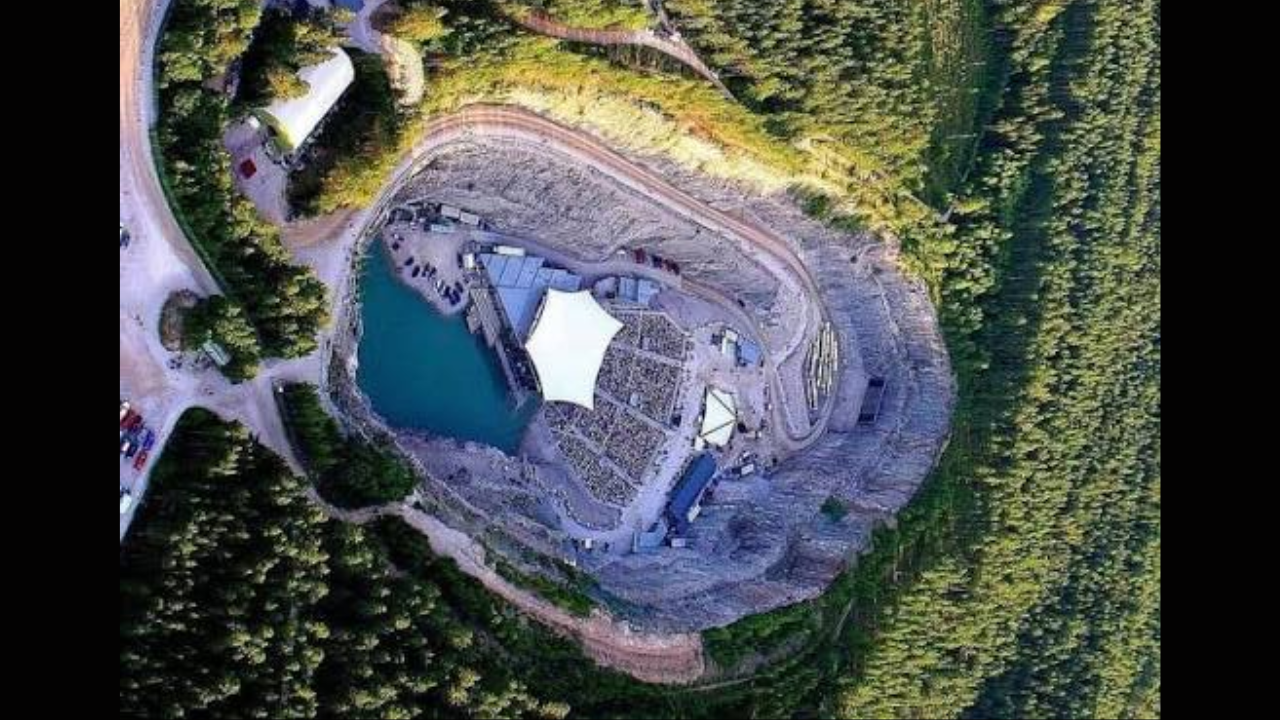
Industrial abandonment typically leaves behind negative capital assets. When extraction ceases at a commercial quarry, the operating entity faces immediate liabilities: reclamation bonds, environmental monitoring overhead, and the opportunity cost of sterilized land. In 1990, extraction operations ceased at a 55-metre-deep limestone quarry in Sweden, establishing a controlled environmental testbed for secondary land-use transition. Within a single year, natural hydrological recharge and ecological succession converted the pit into a flooded basin. Analyzing this transition requires moving beyond aesthetic observations to examine the underlying physical, chemical, and biological mechanisms that govern post-industrial ecological engineering.
The Hydrological Budget of Abandoned Deep Excavations
The transformation of a dry pit into a permanent water body is fundamentally a hydrogeological accounting problem. A quarry below the local water table acts as a massive artificial sumps. When dewatering pumps are switched off, the water level recovers according to a predictable mass-balance equation governed by groundwater inflow, direct precipitation, surface runoff, and evaporative loss.
In deep limestone formations, the surrounding rock mass typically exhibits dual porosity. Primary porosity within the rock matrix is negligible, but secondary porosity—comprising fractures, bedding planes, and karst dissolution channels—allows rapid fluid transmission. When pumping ceases, groundwater flows down the hydraulic gradient established by the excavation depth. The rate of fill is dictated by the transmissivity of the surrounding aquifer and the geometric volume of the pit.
For a 55-metre excavation, the initial rapid fill phase is driven by high hydrostatic head pressure from the surrounding aquifer. As the water level rises inside the quarry, the head differential decreases, causing the filling velocity to asymptotically approach zero until equilibrium is reached with the regional potentiometric surface. The chemical composition of the resulting water body is directly inherited from the surrounding lithology. Limestone dissolution introduces high concentrations of calcium and bicarbonate ions, creating an alkaline baseline with a high buffering capacity against acidification. This chemical stability serves as the primary constraint on subsequent biological colonization.
Ecological Succession Dynamics in Artificial Aquatic Basins
Natural aquatic ecosystems typically mature over millennia through organic sedimentation and trophic web complexification. An abandoned quarry bypasses these geological timelines through rapid artificial eutrophication and edge-effect colonization.
The biological recovery sequence follows a strict functional progression:
- Phase One involves airborne microbial and algal colonization. Nutrients released from exposed mineral surfaces and atmospheric deposition fuel rapid phytoplankton blooms, establishing primary productivity.
- Phase Two sees the arrival of mobile macro-invertebrates and aquatic macrophytes. Birds act as primary vectors for vegetative propagules and fish ova, introducing species capable of exploiting the newly formed littoral zones.
- Phase Three establishes trophic stratification. As organic matter accumulates at the 55-metre depth floor, aerobic respiration by decomposers depletes dissolved oxygen in the hypolimnion, creating distinct thermal and chemical layers that dictate fish distribution and nutrient recycling patterns.
This trajectory demonstrates that ecological recovery in artificial basins is not random. It is constrained by physical morphology. A steep-sided limestone pit lacks shallow littoral shelves, which limits the establishment of rooted macrophytes and restricts fish spawning habitats unless artificial structuring is introduced.
Economic Valuation and Secondary Asset Utilization
Treating an abandoned quarry purely as an environmental reclamation project ignores its potential utility as an infrastructure asset. The capital expenditure required to dig a 55-metre-deep basin with high structural wall stability is immense. When mining operations cease, the remaining void represents a pre-excavated volumetric asset.
Modern industrial strategy evaluates these voids through the lens of multi-use engineering.
Thermal Energy Storage
Deep water bodies maintain stable baseline temperatures at depth. Closed-loop heat exchange systems can leverage this thermal mass for district heating and cooling networks, utilizing the quarry as an industrial heat sink or source.
Pumped-Storage Hydroelectricity
A deep quarry situated near elevation differentials or existing water bodies can function as the lower or upper reservoir in a closed-loop pumped-storage scheme, balancing intermittent renewable energy grid loads through gravitational potential energy storage.
Aquaculture and Water Reservoirs
The alkaline chemistry of limestone quarries reduces heavy metal mobility and inhibits certain pathogens, rendering the stored water viable for municipal supply buffers or specialized aquaculture operations, provided heavy industrial runoff is mitigated.
Quantitative Risk Factors in Quarry Conversion
The transition from active industrial site to passive ecological asset introduces distinct risk vectors that require continuous engineering oversight. Slope stability represents the primary structural hazard. Limestone rock faces fractured by historical blasting operations are susceptible to wedge failures and planar sliding as pore water pressures increase during the filling process.
Furthermore, stratification dynamics can lead to sudden meromictic turnover. If bottom waters accumulate high concentrations of dissolved ions or anoxic byproducts without regular seasonal mixing, a wind event or thermal shock can trigger a complete water column inversion, resulting in downstream oxygen depletion and acute aquatic mortality. Mitigation requires hydraulic modeling to predict stratification stability and, where necessary, the installation of mechanical aeration systems to maintain baseline oxygen profiles across all depths.
Municipalities and private landowners must shift from viewing quarries as terminal liabilities to managing them as dynamic geomorphic assets. The Swedish case study illustrates that nature will rapidly colonize abandoned industrial infrastructure, but engineering intervention determines whether that ecosystem becomes a stable regional resource or a dormant environmental hazard.