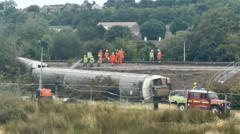
An old track defect on the approach to Lewes sat quietly in plain view for hours before a passenger service violently left the rails.
When investigators from the Rail Accident Investigation Branch released their initial findings, they didn't mince words. Rear-facing CCTV footage captured by earlier trains proved a clear track geometry irregularity existed on the immediate approach to the derailment site. Roughly 150 passengers were onboard the eight-carriage Southern service from London Victoria when disaster struck on August 13. Three carriages rolled onto their sides. Thirty people suffered injuries, requiring twenty hospital admissions.
The system missed the warning signs. Now, answers are required.
What the Initial RAIB Report Actually Found
The interim findings point directly to physical deformations on the line just outside Lewes railway station. Investigators flagged a visible track geometry irregularity alongside evidence of previous maintenance work in that exact zone.
Let's look at the hard data released so far:
- Train speed: Traveling at roughly 65mph, safely under the 70mph limit.
- Weather conditions: Ambient air temperature hovered around 27°C during a sustained hot spell.
- Embankment makeup: The local railway sits on a clay base notorious for shifting with moisture changes.
- Prior warnings: Commuters on earlier trains reported severe "rough riding" sensations across that stretch.
The investigation published photographic evidence suggesting the rail line buckled under thermal stress. Rail buckling happens when high temperatures expand continuous welded rails that have nowhere else to go. Combine extreme heat with a clay embankment prone to movement, and you get a ticking time bomb for heavy passenger traffic.
The Problem With Heat Management on UK Railways
Summer heatwaves routinely expose fragile infrastructure across the network. Steel rails absorb direct sunlight, pushing temperatures far higher than the ambient air reading. Network Rail employs hot weather safety protocols, including speed restrictions and track monitoring, but incidents keep happening.
Local politicians and regular commuters noted that the track had felt unusually bumpy long before the accident. When passengers notice rough riding, the track is already telling maintenance crews something is profoundly wrong. Ignoring those physical vibrations until a train rolls over is a systemic failure.
The stretch of line between Lewes and Haywards Heath remains closed while cranes lift heavy carriages and preserve wreckage evidence. Recovery teams face a grueling job clearing the corridor. Normal service won't resume until late August at the earliest.
Accountability and What Happens Next
Network Rail and Govia Thameslink Railway issued joint statements emphasizing safety as an absolute priority. Public relations statements won't fix broken rails or heal the injured passengers.
The Office of Rail and Road is running a parallel inquiry focusing on potential health and safety law breaches. Unlike the RAIB, which looks strictly at causation to prevent future crashes, the ORR carries the teeth required for criminal prosecution.
If CCTV footage from preceding services clearly captured an irregular track geometry hours before the crash, maintenance teams need to explain why alerts weren't triggered and acted upon immediately. Transport authorities must audit vulnerable clay embankments across the entire regional network before another heatwave triggers a catastrophe.


