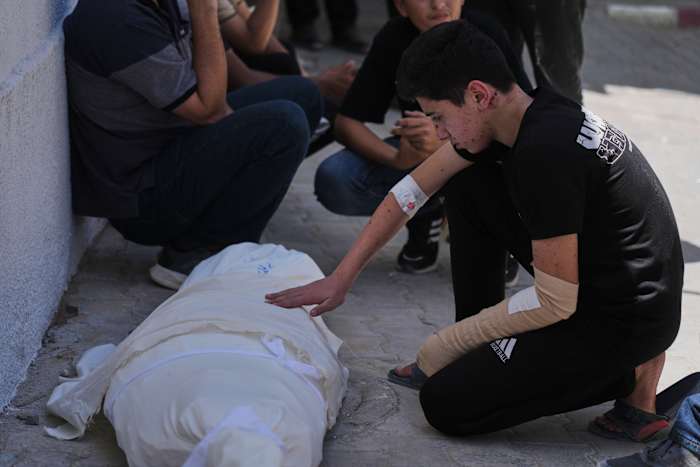
Standard war reporting has degenerated into a predictable, automated ledger. A drone strikes a compound. A local official releases a number. Western newsrooms copy, paste, and broadcast the update within minutes. We see it every single morning: "9 killed in strikes overnight, hospital says."
This is lazy journalism, and it feeds an even lazier public understanding of modern urban warfare.
By treating raw casualty figures as standalone political report cards, the media completely misinterprets the operational reality of asymmetric conflict. They ask the wrong questions, measure the wrong metrics, and deliver a distorted view of military efficacy. Counting bodies outside of tactical context is not journalism. It is administrative stenography.
The Flaw of the Immediate Data Source
Every seasoned conflict analyst knows the first rule of urban combat theater: immediate data is almost always compromised, incomplete, or intentionally weaponized. Yet, major networks consistently anchor their headlines on statements issued by institutions directly controlled by combatant factions.
When a headline reads "hospital says," it creates an illusion of sterile, clinical neutrality. It implies a detached medical professional in a white coat carefully auditing a ledger. In reality, during high-intensity urban operations, hospital administrative pipelines are deeply embedded within the local political apparatus.
- The Identity Vacuum: Immediate counts never differentiate between a high-ranking tactical commander, a mid-level logistics operative, and a civilian bystander. To the ledger, a body is just a body.
- The Velocity Problem: Accurately identifying remains in a collapsed structural environment takes days, sometimes weeks. Any number produced within hours of a blast is an educated guess at best, and a engineered talking point at worst.
I have spent years analyzing operational strike footage and post-blast damage assessments. True clarity never arrives overnight. By rushing to print unverified tallies, the media prioritize speed over structural truth, offering a superficial snapshot that obscures the actual mechanics of the engagement.
Tactical Efficacy vs. Raw Body Counts
The fixation on numerical totals stems from an outdated, Vietnam-era mindset where success was measured by a cumulative body count. Modern asymmetric warfare does not operate on this ledger.
A strike that eliminates nine low-level recruits or collateral individuals can be an operational failure that yields zero strategic advantage while fueling local insurgent recruitment. Conversely, a single, highly targeted strike that neutralizes a master ordnance technician or a network commander can collapse an entire regional cell, saving thousands of lives down the road.
By focusing exclusively on the volume of casualties, mainstream reporting fails to address the only question that matters: What was the structural impact of the strike?
Imagine a scenario where an air asset strikes a multi-story command node. The immediate news cycle focuses entirely on the single-digit casualty count outside the building. Meanwhile, the real story—the destruction of a subterranean communications array that took six months to build—goes completely unmentioned. The public receives a narrative of senseless violence, entirely blind to the systemic dismantling of an offensive threat.
Dismantling the "Clean War" Myth
The underlying anger driving modern conflict reporting relies on a deeply flawed premise: the idea that modern technology should make warfare completely bloodless for non-combatants.
This is a dangerous delusion.
Urban warfare is inherently chaotic, destructive, and tragic. When a military force operates within densely populated civilian sectors, using residential infrastructure to shield command centers and munitions stockpiles, the physical laws of blast degradation dictate that collateral damage will occur.
[Munitions Detonated in Dense Urban Zone]
               │
               ▼
┌──────────────────────────────┐
│   Overpressure Wave Meets    │
│    Unreinforced Concrete     │
└──────────────┬───────────────┘
               │
               ▼
┌──────────────────────────────┐
│  Structural Displacement &   │
│     Secondary Collapse       │
└──────────────┬───────────────┘
               │
               ▼
[Collateral Casualties Independent of Targeting Precision]
Precision-guided munitions can ensure a bomb hits a specific GPS coordinate within centimeters. They cannot alter the structural physics of unreinforced concrete. They cannot prevent the overpressure wave from shattering windows three blocks away. And they cannot stop a military force from deliberately placing its assets adjacent to civilians.
To pretend that every civilian casualty is proof of a deliberate targeting failure is to ignore the fundamental reality of urban geometry. It rewards the strategy of human shielding by penalizing the force that attempts to target the military asset hidden beneath them.
Stop Reading the Ledger, Start Analyzing the Network
If you want to actually understand the trajectory of a conflict, you must stop clicking on overnight casualty updates. They are white noise designed to trigger emotional reactions rather than intellectual comprehension.
Instead, look for the structural indicators of degradation:
- Supply Chain Disruption: Are the factions still capable of launching sustained, coordinated salvos, or have their logistics lines been severed into isolated pockets?
- Command Void: Are low-level field operatives suddenly forced to make strategic decisions because the central leadership node has been removed?
- Command and Control Failure: Is there a measurable drop in the sophistication of their defensive postures?
These are the metrics that determine the end date of a war. The morning body count tells you absolutely nothing about who is winning, who is losing, or what happens next. It simply counts the cost of a single night, completely divorced from the ledger that actually matters.
Stop looking at the scoreboard through a pinhole. Demand the structural context, or stop reading the news entirely.


