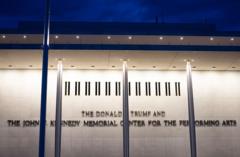
A federal court order has mandated the removal of Donald Trump’s name from the John F. Kennedy Center for the Performing Arts, ending a bitter administrative dispute over the physical and symbolic branding of one of Washington’s most prestigious cultural institutions. The ruling centers on the revocation of a specific naming rights agreement that had been codified during the final weeks of the previous administration. While the decision is framed in the narrow language of government contracts and federal property law, the ripple effects touch on the precarious nature of presidential legacies and the shifting standards of federal architectural honors.
The controversy did not emerge from a vacuum. It is the result of a multi-year friction between the Kennedy Center’s board of trustees and the federal government’s oversight bodies. At its heart, the case was never just about a plaque or a gilded sign. It was about whether a sitting president can use the "honorific" power of the executive branch to permanently etch their identity into federal buildings that were originally intended to remain non-partisan monuments.
The Contractual Fault Lines
To understand why a judge would take the drastic step of ordering the physical removal of a name, one must look at the mechanics of federal gift law. Most people assume that naming a wing or a theater after a donor or a political figure is a simple gesture of gratitude. In the federal system, it is a complex legal maneuver governed by the General Services Administration (GSA) and specific trust authorities.
The Trump naming agreement was fast-tracked. Investigative records indicate that the standard vetting processes, which usually take eighteen to twenty-four months for such a high-profile designation, were compressed into a matter of weeks. The court found that this "procedural shortcut" undermined the validity of the contract. When the government bypasses its own red tape, it creates a vacuum where legal challenges thrive.
The Kennedy Center operates as a unique public-private partnership. While it receives federal funding, it also relies heavily on private philanthropy. The board argued that the inclusion of the Trump name was a unilateral executive decision that did not align with the institution’s long-term donor agreements or its specific mission to honor the 35th president. The judge agreed, noting that the naming rights were "procedurally deficient" and lacked the necessary sign-off from the oversight committees that manage the National Mall and its surrounding federal structures.
Presidential Legacies and the Branding of Power
Washington D.C. is a city of stone and ego. Every president wants their name on a building, a library, or an airport. However, the Kennedy Center occupies a different tier of the cultural hierarchy. It is a living memorial to John F. Kennedy. Introducing a contemporary, polarizing political figure into that specific space was always going to trigger a rejection from the city's old-guard establishment.
There is a historical precedent for this kind of scrub. We saw it with the renaming of various federal sites following the shift in public perception of figures like J. Edgar Hoover. But those changes usually happen decades after the fact, once history has had time to settle. This move is different because it is happening in real-time, driven by litigation rather than a slow evolution of social values.
The defense argued that removing the name was an act of political retaliation. They claimed that the current administration was weaponizing the judiciary to erase the previous president from the map. The court, however, steered clear of the political theater. Instead, the ruling focused on the Master Plan for the Kennedy Center. This document serves as the constitutional framework for the building’s physical appearance. The judge ruled that the Trump signage violated the visual and historical integrity of the original Edward Durell Stone design, which is protected under the National Historic Preservation Act.
The Economics of the Erasure
Removing a name from a federal building is not as simple as taking a hammer to a wall. It involves a meticulous restoration process to ensure the underlying marble or limestone is not damaged. The costs of this "un-branding" are expected to reach into the hundreds of thousands of dollars.
Who pays for the cleanup? This question remained a sticking point during the trial. Usually, the federal government picks up the tab for building maintenance, but the board of the Kennedy Center has pushed for the funds to be recouped from the campaign or private entities that initially lobbied for the naming rights.
Breaking Down the Costs
- Physical De-installation: Specialized masonry work to remove bronze lettering and fill mounting holes.
- Signage Updates: Every map, directory, and digital kiosk in the massive complex must be reprogrammed.
- Legal Fees: Years of discovery and litigation have already cost the institution a significant portion of its discretionary budget.
This financial burden is a cautionary tale for other federal institutions. If you accept a political brand, you are also accepting the liability that comes with it when the political winds shift.
The "Why" Behind the Speed
The documents unearthed during discovery reveal a frantic effort to finalize the naming agreement before the 2021 inauguration. Emails from high-level GSA officials showed a clear directive to "get the signage up" before the change in power. This haste was the primary undoing of the legal defense.
In the world of government procurement, speed is almost always an indicator of a lack of due diligence. By skipping the public comment period and the environmental impact review—both of which are required for structural changes to historic federal buildings—the administration left the door wide open for a lawsuit. The Kennedy Center’s legal team didn’t have to prove that the name was offensive; they only had to prove that the paperwork was sloppy.
The "sloppy paperwork" defense is the silent killer of executive overreach. It lacks the drama of a constitutional crisis, but it is far more effective in a courtroom. Judges generally dislike it when the executive branch ignores its own administrative rules.
The Precedent for Future Administrations
This ruling sets a massive roadblock for any future president looking to leave a permanent mark on the federal landscape during their term. It reaffirms that federal buildings are not billboards for the incumbent. The John F. Kennedy Center for the Performing Arts has successfully asserted its independence as a trust, rather than a mere extension of the White House.
We are likely to see a ripple effect. Other sites, from regional federal courthouses to post offices that were renamed via executive order, are now being scrutinized by activists and local governments. If the Kennedy Center could win on the grounds of "procedural deficiency," then hundreds of other designations are theoretically at risk.
The irony is that the harder a president tries to cement their name into the infrastructure of the capital, the more likely they are to invite this kind of judicial scrutiny. Real legacy in Washington isn't bought with a sign; it is built through the very institutions that, in this case, fought to keep the name off the wall.
The removal will likely be completed under the cover of night or behind construction scaffolding to avoid further spectacle. But the absence of the name will be just as loud as its presence ever was. The marble will be patched, the letters will be melted down, and the Kennedy Center will return to its original, singular dedication. The law has a long memory, but it also has a very sharp chisel.
The immediate next step for the GSA is the appointment of a restoration architect to oversee the physical remediation of the Grand Foyer.