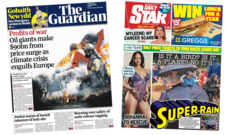
The Sound of Water on Tin
Arthur knows the sound of rising water before he ever looks at a gauge. It begins as a heavy, hollow drumming on the corrugated iron roof of his workshop, shifting quickly from a rhythm into a roar. By the time the threshold of his back door is damp, the arithmetic of his life has already changed.
He stands by the kitchen window, watching the drainage ditch at the edge of his property vanish beneath brown, churning froth. This is not the gentle drizzle of postcards or the poetic showers of autumn. This is super-rain. It is an atmospheric anomaly engineered by a warming sky, holding more moisture than the earth is built to swallow.
Ten miles away, in a brightly lit boardroom draped in glass and polished steel, a different kind of ledger is being tallied. Here, the weather is not a wet pair of boots or a ruined harvest. It is a column of numbers. Shares shift. Contracts are signed. The same meteorological violence that tears the tiles from Arthur's roof translates into soaring quarterly earnings for defense contractors and supply chain insurers.
We live in a split-screen reality. On one side, the physical weight of a changing world presses down on individual doorframes. On the other, distant financial engines extract value from the chaos.
The Arithmetic of Ambition
To understand how a morning paper links the profits of war with the fury of super-rain, we have to look past the headlines and examine the mechanics of modern crisis.
Consider what happens when stability fractures. A border is crossed. A treaty frays. The markets do not pause to grieve; they calculate. In financial districts from London to New York, specialized portfolios swell the moment geopolitical tension spikes. Factories that forge steel casing and electronic guidance systems do not merely manufacture goods. They act as vacuums, sucking up public capital that might otherwise reinforce a crumbling seawall or modernize a failing electrical grid.
Arthur does not read financial statements. He feels their downstream effects. When municipal budgets are diverted to meet distant strategic obligations, local flood defenses are quietly deferred. The concrete barrier meant to protect his valley goes unbuilt for another fiscal year.
Money is a choices machine. Every pound directed toward conflict insurance or armament manufacturing is a pound not spent anchoring the ground beneath our feet.
The connection between the two front-page crises—the geopolitical ledger and the meteorological one—is not a conspiracy. It is a competition for priority. When the world catches fire, everything else is left out in the rain.
The Weight on the Floorboards
Water does not care about geopolitics. It seeks the lowest point, moving with an indifferent, liquid patience.
When the floodwaters finally recede from Arthur’s workshop, they leave behind a thick, gray silt that smells of old oil and river mud. He spends hours scraping it from the floor with a flat shovel, his lower back aching with a dull, familiar fatigue.
The insurance adjuster arrives three days later, clipboard in hand, speaking a language of deductibles, policy exemptions, and climate risk stratifications. The premium has doubled again. The house, he is told, now sits in an uninsurable bracket.
"You understand," the adjuster says, offering a practiced, sympathetic smile, "the models have changed."
The models have indeed changed. The atmosphere now holds roughly seven percent more moisture for every single degree Celsius of warming. That invisible mathematical rule translates directly into blinding, torrential downpours that turn quiet country lanes into raging rapids. Yet, as the volume of risk increases, the capital required to mitigate it is pulled upward, funneled into the sprawling machinery of global security and conflict recovery.
We are spending our collective inheritance on defense against human enemies while failing to build defenses against the sky itself.
The Anatomy of the Breaking Point
History suggests that civilizations do not usually fall in a single, cinematic collapse. They fray at the margins through a series of expensive, compounding emergencies.
When infrastructure crumbles, it happens quietly at first. A bridge loses its rating. A drainage pipe clogs with silt and is left uncleaned. A hospital basement floods, ruining backup generators. Each individual failure is dismissed as an anomaly, an unfortunate act of nature or a temporary supply chain hiccup.
But anomalies are no longer anomalies. They are the new baseline.
Arthur sits on his porch steps once the cleanup is done, watching the clouds part to reveal a deceptive, bruised blue sky. His hands are stained with grease and dried mud. He is tired in a way that sleep cannot fix—the deep, existential fatigue of a person who realizes the rules of the game have been rewritten while he was busy playing the old one.
The papers on the newsstands will change tomorrow. New conflicts will erupt. New storms will brew over the Atlantic. The numbers will update on the glowing screens in the financial districts.
The rain will return. And Arthur will still be holding his shovel, waiting for a world that has learned how to count its losses to finally start measuring its survival.