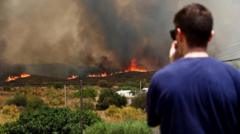
The sky over Almería turned a dusty, ominous yellow on Thursday afternoon. For many expats and tourists in the small Spanish village of Bédar, it looked like a standard calima—the familiar weather event where winds carry Sahara desert dust across the Mediterranean. But it wasn't dust. Within hours, a ferocious wildfire ripped through the region, killing at least 12 people and leaving dozens missing.
When a wildfire moves this fast, the biggest threat to your life isn't just the fire itself. It's the choices you make in the first twenty minutes.
The tragedy unfolding in southern Spain highlights a brutal reality about extreme weather events. When panic sets in, human instinct often drives people to flee. However, survival data and emergency protocols show that running blindly is exactly how people get killed.
The Reality of the Almería Trap
The fire broke out in a semi-arid zone near the Sierra de Los Filabres mountains, fueled by a dangerous mix of 40°C (104°F) heat, bone-dry brush, and sudden winds. Experts believe a fallen power line sparked the initial blaze in the parched scrubland. It spread instantly.
Antonio Sanz, Andalusia’s minister for emergencies, noted that the emergency services were immediately flooded with over 150 desperate calls. The fire didn't creep; it leaped across ravines and cut off roads before official evacuation orders could even reach some neighborhoods.
Look at how the fatalities occurred. Emergency officials confirmed that a group of nine people in the Los Gallardos district were explicitly told by local authorities to stay put inside their homes. They panicked and fled anyway. Seven of them died on foot, and the other two ended up in the hospital with severe burns.
Another four victims, believed to be British nationals, were found burned to death inside a right-hand drive vehicle. They had tried to escape down an alternative route through a deep ravine. It became a dead end. The ravine acted like a chimney, funneling smoke and intense heat straight toward them.
The Myth of Driving to Safety
When you see smoke, your brain tells you to get into a car and drive away as fast as possible. That instinct makes sense in a normal emergency, but wildfires break regular rules.
Cars offer a false sense of security. They are heavy metal boxes that quickly trap heat, and synthetic interior parts fill the cabin with toxic smoke long before the actual flames touch the chassis. Even worse, thick smoke completely destroys visibility on narrow, winding mountain roads. You can't see five feet ahead of your bumper, let alone navigate a cliffside.
Jeanne Henny, a 74-year-old British expat who survived the blaze, described the terrifying speed of the fire. It took her nearly thirty minutes to load her disabled friend and two dogs into her car. By the time she drove just one kilometer to the neighboring village of Serena, the main road to safety was already blocked by walls of fire surging up the cliffs.
Henny survived because she made a split-second, flawless three-point turn on a narrow road next to a drop-off, escaping down a rough mountain track. If she had hesitated or missed that turn, she would have shared the fate of her neighbors.
The lesson here is simple. If you don't leave early—meaning before the smoke even reaches your property—your chances of surviving on the road drop drastically.
Shelter in Place vs. Immediate Evacuation
So, when do you stay and when do you go? This is where people get confused, and that confusion is deadly.
If emergency services tell you to stay put, you stay put. Modern houses, especially the traditional concrete and stone structures found throughout southern Spain, offer significantly better thermal protection than a car or open ground. They shield you from radiant heat, which is the invisible energy that burns your lungs and ignites your clothes from hundreds of yards away.
Local mayors across the affected Almería municipalities reported that residents who ignored the urge to run and stayed locked inside their homes survived the night. The fire swept past them, scorched the exterior walls, and moved on.
If you are caught in a high-risk wildfire area, you need to change your mindset. Survival requires proactive preparation, not reactive panic.
- Map your routes early: Never rely on a single main road. Mountain villages love one-way loops and narrow tracks. Know every dirt road and alternative path out of your town.
- Set a hard trigger point: Don't wait for the police to knock on your door. If you see smoke plumes columns changing direction toward you, or if the sky turns black, leave immediately.
- Prep your property: Clear dry brush, esparto grass, and woodpiles at least 30 feet away from your home structure. Keep shutters closed to block radiant heat from shattering window glass.
- Pack a go-bag today: If it takes you thirty minutes to get your family or pets into a vehicle, you are already too late. Keep essential documents, medications, and emergency supplies by the front door.
Wildfires are becoming more frequent and intense across southern Europe. Relying on luck or assuming you can outrun the flames in a vehicle is a losing strategy. Pay attention to local emergency apps, understand the geography of your area, and remember that sometimes the safest move is simply locking your front door and waiting for the front to pass.