Actors fade from memory fast. Give it twenty years after they die, and most are just answers in a pub quiz. But Laurence Olivier isn't most actors. Decades after his passing, his name still carries an almost mythic weight in British theatre, and English Heritage just cemented that legacy exactly where it started.
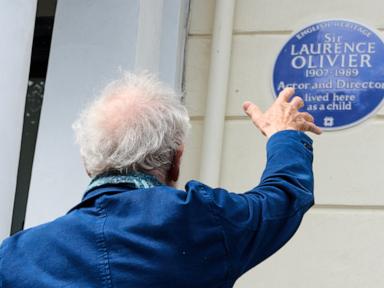
On Wednesday afternoon, June 10, 2026, a brand-new blue plaque was unveiled at 22 Lupus Street in Pimlico, Central London. This wasn't some grand estate where he lived at the peak of his Hollywood wealth. It's the modest childhood home where Olivier lived from the age of five to twelve. It's the exact spot where a kid from a strict religious household figured out he could command an audience.
The ceremony brought out the heavy hitters of the British stage. Ian McKellen did the honors of pulling down the curtain, giving the crowd a taste of classic theatrical bravado by roaring out the "once more unto the breach" speech from Henry V. It was a fitting tribute to the man who basically built the foundations of modern British drama.
The Formative Years at Lupus Street
Most people think of Olivier as the fully formed Shakespearean titan, dripping with theatrical royalty. They forget he started out as a curate's son messing around with makeshift props.
While living at 22 Lupus Street between 1912 and 1919, the young Olivier did what lonely, creative kids do. He rigged up a wooden box and some old blue curtains inside the house, creating a tiny, primitive stage. He spent hours singing, dancing, and acting out stories for anyone who would look.
But his real acting school was right across the road at St Saviour’s church. His father, Gerard Kerr Olivier, was a curate there. Young Laurence was a choirboy, but more importantly, he sat in the pews and studied the preachers. He watched how they manipulated the room. Years later, Olivier admitted that those church speakers taught him everything about performance. They knew exactly when to drop their voices to a whisper, when to bellow about hellfire, when to slip in a joke, and when to break your heart. He didn't learn to act at a posh drama school; he learned it by watching men of God work a Sunday crowd.
Ian McKellen on the Spectre of Lost Opportunities
Having Ian McKellen unveil the plaque wasn't just a random celebrity booking. McKellen is one of the few working actors with a direct, personal link to Olivier’s golden era.
McKellen shared a story from his early days when he was briefly part of Olivier’s National Theatre company at the Old Vic. When McKellen decided to leave the company, Olivier sent a message to his agent saying he was "haunted by the spectre of lost opportunities." It shows the intense, competitive, and deeply passionate drive that Olivier possessed. He couldn't stand seeing talent walk away from the institution he was sweating blood to build.
Later, when McKellen played Macbeth at Stratford in 1976 under Trevor Nunn, Olivier left him another note. He called it the most achieved version of the play he had ever seen. That was high praise, considering Olivier’s own 1955 Macbeth at Stratford is still spoken of in hushed, reverent tones by theatre historians.
The Legacy Beyond the Acting
It's easy to look at Olivier's Oscar for Hamlet in 1949 or his roles in classics like Rebecca, Wuthering Heights, and Marathon Man and assume his legacy is purely on celluloid. That's a mistake. Olivier’s biggest gift to London wasn't a film performance; it was an institution.
He campaigned like a politician to establish the National Theatre. He didn't just want a building; he wanted a state-funded powerhouse that would protect and elevate British acting. When the brutalist concrete landmark on the South Bank finally opened in 1976, Olivier was its driving force and its first artistic director. Indhu Rubasingham, the National Theatre's current artistic director, noted at the ceremony that Olivier built a world-class company completely from scratch through sheer courage and vision. Today, the largest auditorium in that building bears his name.
Tracking Down London Blue Plaques
If you want to understand how London honors its icons, the blue plaque scheme is the ultimate map. Run by English Heritage, it’s been going for over 150 years. The very first one went up in 1867 to honor the poet Lord Byron, though that house was eventually knocked down. The oldest one you can actually see today belongs to France’s final emperor, Napoleon III.
To get a plaque, the rules are incredibly strict:
- The person must be dead for at least 20 years.
- The building must survive with a substantially unaltered exterior.
- The subject must have made an exceptional impact in their field.
Olivier already has a plaque in his birthplace of Dorking and a bronze statue outside the National Theatre, but this Pimlico circle ties his legacy directly back to the streets of London where the spark first caught fire.
If you want to see it yourself, take the Victoria line to Pimlico station. Walk down to 22 Lupus Street, look up at the blue circle, and then turn around to look at St Saviour’s church across the road. You can see the exact physical orbit where a young kid transformed himself from a quiet choirboy into the greatest actor of the twentieth century. Don't just read about the history; walk the path and see where the stage was set.