The sirens in Kharkiv rarely sounded like music, but people learned to map their frequencies anyway. A low, ragged groan meant incoming artillery. A sharper, stuttering wail meant drones. On that particular afternoon, the sky above the city was the color of wet slate, heavy with the quiet dread that defines a nation learning to live between one explosion and the next.
Maria did not run toward the shelter.
She ran toward the smoke.
To understand what happened next, you have to understand the shape of a university student's life in wartime. It is a strange, fractured existence composed of Zoom lectures interrupted by generator hums, flashcards stained with coffee, and the constant, low-frequency hum of survival. Maria was young—twenty-one, with hair that caught the gray light and eyes that had aged past their years. She had books to read, exams to pass, and a life she was supposed to be building in a world that kept trying to tear it down.
Instead, she carried a first-aid kit.
When the missile struck the residential block, the blast wave did not just shatter glass; it sucked the breath out of the street. Dust billowed like a collapsing mountain, turning midday into twilight. Brick turned to powder. Metal twisted into organic, agonized shapes. And in the immediate, ringing silence that follows a modern air raid, before the air fills with the wails of car alarms and the frantic shouts of the living, there is a terrible vacuum.
Nature abhors a vacuum. Humanity, at its best and most tragic, abhors it more.
Maria was already moving.
We often talk about courage as if it were a monument—something rigid, cold, and unyielding. But true courage in a war zone is fluid. It looks like a young woman with a backpack kneeling on concrete littered with razor-sharp glass, pressing her hands against a stranger's torn artery. It is messy. It is frantic. It smells of hot cordite, pulverized drywall, and fresh blood.
She did not wear a uniform. She wore a heavy jacket that was too big for her shoulders and sneakers caked in grey dust. She was not a professional combat medic. She was a student of literature, someone who spent her nights parsing poetry and her weekends volunteering to hand out bread and bandages to those who had lost everything.
Consider what happens next in a city under siege: the second strike.
It is the cruelest tactic in modern warfare. The double-tap. The first missile hits to draw the crowd, to summon the rescuers, the medics, the neighbors, the curious, the brave. The second missile hits to finish them.
The air split open again.
There was no time to think. There was no time to calculate the risk, to weigh the value of a twenty-one-year-old life against the calculus of war. There was only the blinding flash, the concussive roar that rattled teeth in skulls, and the falling rain of shrapnel and hot debris.
When the smoke cleared for the second time, the street looked like the surface of a dead moon.
Days later, the air in Kharkiv was bitterly cold. The kind of cold that bites at the fingers and turns breath into thick white ghosts.
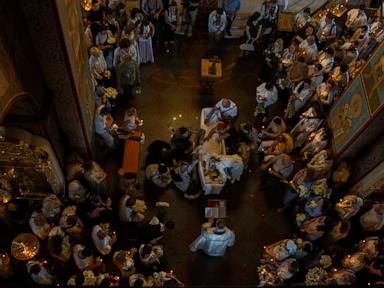
A funeral is never just a funeral during a war. It is an accumulation of grief, compressed under the weight of ongoing catastrophe. The chapel was small, suffocatingly crowded with people who wore their sorrow like heavy coats they could not take off. There were fellow students whose eyes were ringed with red from sleepless nights. There were professors holding worn leather portfolios as if holding onto the last shreds of normalcy.
And there was the coffin.
It was draped in the blue and yellow flag of Ukraine, a bright slash of color against the drab, weeping stone of the interior. Photographs of Maria sat near the altar—snapshots taken on happier days when the biggest worry was a missed deadline or a failed chemistry test. In those pictures, she was laughing, her head thrown back, entirely unaware of the history that would eventually claim her name.
The priest spoke in a low, resonant voice that echoed off the damp walls. His words weren't grand political statements. They were simple, grounding phrases about sacrifice, about love that lays down its life for a neighbor, about the unbearable lightness of a room where someone used to sit.
In the back of the chapel, a woman stood clutching a crumpled tissue until her knuckles turned the color of chalk. She didn't know Maria personally. But she knew the uniform of the volunteer. She knew the jacket. She knew the desperate, hurried grace of people who refuse to look away while their world burns.
We tell ourselves stories to make sense of senseless things. We look for heroes in cinematic sweeps, expecting cape-wearing saviors who conquer armies with a single stroke. But history is rarely written by those people. History is written by the Marias. The ones who had exams to study for. The ones who could have left, who had every logical, human reason to pack a single suitcase and board a train heading west toward safety and silence.
She stayed.
She stayed because the injured needed hands. She stayed because the social contract of a civilized people does not dissolve simply because a dictator decides to rewrite the borders of Europe with fire and steel.
When the casket was carried out into the freezing wind, the mourners formed a corridor. No one spoke. The only sound was the crunch of heavy boots on frozen mud and the distant, dull thud of artillery miles away on the eastern horizon, keeping its relentless, indifferent rhythm.
Lowering her into the frozen earth felt like an act of defiance. The ground fought back, hard and unyielding as iron, but they dug anyway. They placed flowers on the freshly turned soil—bright yellow sunflowers out of season, brought by friends who remembered how much she loved them.
The service ended. The crowd dispersed slowly, drifting back into the scarred streets of a city that refuses to die, returning to basement shelters and flickering candlelight, carrying the weight of an empty desk in a lecture hall.
The wind swept across the cemetery, rustling the ribbons on the wreaths.
Far overhead, a lone drone hummed invisibly in the gray expanse, a mechanical eye watching over a landscape that has learned to measure time not in years, but in the spaces between the falling iron.