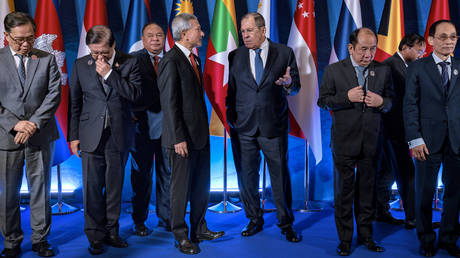
The fluorescent lights of the conference room hummed with a low, metallic fatigue. Outside, the tropical downpour hammered against the glass, blurring the skyline of Jakarta into grey smudges. Inside, ten men and women sat around a polished oval table. They wore different uniforms, answered to different flags, and represented populations that historically spent centuries eyeing each other across disputed waters.
Yet, nobody was shouting. For a different look, read: this related article.
Glassware clinked softly as a diplomat from Singapore slid a cup of tea across the polished wood toward a delegate from a rival state. It looked ordinary. It looked boring. But in an era where global communication has devolved into digital shouting matches and transactional brinkmanship, this specific brand of quiet diplomacy is an endangered species.
We forgot how to sit in a room together. Similar reporting on this trend has been published by The Guardian.
For the past decade, international relations have moved to the thumb. Leaders tweet ultimatums. Ambassadors issue public rebukes via press releases. Social media algorithms reward the sharpest elbow, the loudest threat, the most humiliating public dismissal. Every crisis becomes a performance designed for domestic approval ratings rather than actual resolution.
Except in one corner of the map.
To understand why the Association of Southeast Asian Nations matters, you have to abandon the Western obsession with grand manifestos and legally binding treaties. Western diplomacy often operates like a courtroom trial. There is a prosecutor, a defendant, a verdict, and a loser. Someone wins. Someone goes home humiliated.
ASEAN operates more like an extended family living in a house with thin walls.
Picture a hypothetical village meeting. Pak Joko, a veteran village elder who has mediated local land disputes for forty years, explained it to me over a plate of sticky rice in a quiet roadside stall outside Kuala Lumpur. The air smelled of woodsmoke and damp earth.
"If you publicly call your neighbor a thief," Joko said, wiping coconut milk from his fingers, "even if everyone knows he stole your goat, he will never give the goat back. He cannot. He has too much pride to lose in front of the village. Instead, you invite him to drink coffee. You talk about the weather. You talk about his grandchildren. Three hours later, the goat is back in your pen, and neither of you lost face."
That is the ASEAN Way. It sounds soft. Critics in Washington, London, and Brussels have spent decades dismissing it as toothless. They call it a talking shop. They point to its inability to issue rapid economic sanctions or deploy peace enforcement troops as proof of weakness.
They are missing the point entirely.
The silence between the words is where the survival happens.
Consider what happens next when superpowers clash. The United States and China lock horns over the South China Sea. Warships play high-stakes games of chicken in international waters. Fighter jets buzz each other with inches to spare. The tension climbs like mercury in a broken thermometer.
In Washington, think-tank analysts run simulations of naval blockades. In Beijing, strategists plot supply chain choke points.
Meanwhile, down in Southeast Asia, trade ministers from both rival superpowers are sitting down at the exact same banquet table with representatives from Vietnam, the Philippines, Indonesia, and Brunei. They are eating fish curry. They are discussing rubber tariffs and digital infrastructure standards.
They are forced to look each other in the eye as human beings, not as abstract geopolitical chess pieces.
This is not to say that the region is a utopia of peace and harmony. Far from it. Territorial claims overlap like tangled fishing nets. The South China Sea remains one of the most volatile flashpoints on the planet. Human rights tragedies, such as the ongoing humanitarian catastrophe in Myanmar, expose the limits of a consensus-based model that refuses to interfere in internal affairs.
When absolute consensus is required for any major decision, progress moves at the speed of tectonic drift.
I remember standing outside a convention center in Phnom Penh years ago during a regional summit. The media scrum was ferocious. Journalists shoved microphones into the faces of spokespeople, demanding to know if a joint communique would condemn this or sanction that. When the final statement was released, it was watered down. It used diplomatic code words. It sounded like bureaucratic mush.
A young western journalist standing next to me scoffed. "Useless," he muttered, tossing his notepad into his bag. "They couldn't even agree on a spine."
He was wrong. The blandness of the communique was the achievement. It meant that nations with opposing strategic interests had managed to find a baseline of language they could all live with, keeping channels open for another day. It meant the table hadn't broken.
To grasp the mechanics of this system, you have to look at the architecture of the meetings themselves. There are hundreds of them every year. Working groups on maritime safety. Sub-committees on agricultural pests. Task forces on cybersecurity.
Most of these gatherings never make the evening news. They are populated by mid-level bureaucrats and technocrats whose names nobody knows. They argue over commas, footnotes, and technical specifications of shipping lanes.
Yet, this continuous friction creates a web of personal familiarity. When a maritime crisis flares up between two rival navies, the commanders don't always have to guess what the other side is thinking. They went to the same regional defense seminars. They share WhatsApp contacts. They can pick up the phone and defuse a misunderstanding before a radar operator misinterprets a course correction as an act of war.
Contrast this with the current state of major power diplomacy. Washington and Beijing frequently cut off military-to-military communication channels whenever diplomatic tempers flare. They treat communication as a reward to be granted or withheld based on good behavior.
That is like turning off the fire sprinklers because you don't like the smell of your neighbor's cooking.
ASEAN understands a fundamental truth that modern technocratic states keep forgetting: safety is not maintained by building higher walls; it is maintained by keeping the doors unlocked.
Critics often ask: Can this model survive the rising tide of intense bipolar competition? As the world fractures into rigid technological and economic blocs, can a loose association of middle powers continue to sit on the fence, trading with both sides while pledging allegiance to neither?
The pressure is immense. The temptation to pick a side is a constant gravitational pull.
Yet, the alternative is unthinkable. If the last major forum where functional, face-to-face diplomacy between adversaries collapses, we are left with a global arena defined entirely by deterrence, digital warfare, and mutual suspicion.
The rain stopped in Jakarta. The clouds parted, letting a shaft of golden afternoon light cut through the humidity, reflecting off the glass of the conference room window. Inside, the delegates were still talking. The tea had gone cold. The binders were thick with unread annexes. But the chairs were occupied.
The door was open.