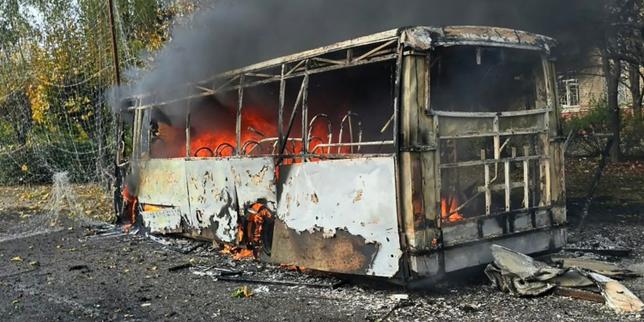
The morning frost had not yet burned off the asphalt when the buses pulled away from the depot.
Outside the window, Kramatorsk looked like it always did in the gray crucible of late autumn: industrial, stubborn, exhaling plumes of coal smoke into a sky that threatened snow. Passengers climbed the metal steps with the heavy, practiced exhaustion of people who had long forgotten what an ordinary Tuesday felt like. There were shopping bags. There were woolen scarves wound tight against the damp chill. There were quiet nods between strangers who shared the same silent arithmetic of survival, calculating how many days they had left in a city that sat squarely in the crosshairs of an artillery range. You might also find this related story interesting: The Polarisation of European Politics Over Israel: Structural Fault Lines Beyond Left and Right.
Halfway down the avenue, the air split.
Not with the distant, rolling thunder that residents had learned to tune out like background static, but with a sharp, blinding crack that erased the morning in a millisecond. As extensively documented in latest articles by The Guardian, the implications are widespread.
By the time the smoke cleared, two passenger buses—vehicles meant for grocery runs, hospital visits, and the desperate normality of moving from one neighborhood to another—were reduced to jagged skeletons of twisted steel and charred rubber. Thirty-three human lives vanished into the freezing air before they could reach their stops. Thirty-three ordinary routines snapped instantly into history.
We talk about war in grand, sweeping terms. We discuss counteroffensives, ballistic trajectories, defense pacts, and the geopolitical chess matches played out in capitals thousands of kilometers away. We look at satellite maps with neat little arrows pointing north and south, as if armies were symbols moving across a felt board.
Numbers make it easy. Thirty-three dead. Two buses. A strike in Kramatorsk.
The statistics are clean. They fit neatly into a morning news bulletin. They can be read in thirty seconds by a news anchor wearing a sharp suit under studio lights.
But war is never clean on the receiving end.
Imagine, for a moment, standing at a bus stop on a bitter morning, waiting for transport that will take you away from the rumble of the front lines, only to discover that the front line has come looking for you. Imagine the precise weight of a leather handbag left lying open on the pavement, snow dusting its contents. Imagine the silence that follows an impact—a silence so absolute it feels heavier than the blast itself.
This is the invisible tax paid by those who stay behind. While diplomats debate peace formulas and defense budgets swing billions of dollars across oceans, daily life in eastern Ukraine is a grueling exercise in Russian roulette. Going to work, buying bread, or visiting a relative requires crossing an unmapped threshold where survival is less about strategy and more about sheer, unadulterated luck.
The strike in Kramatorsk is not an anomaly. It is the grim baseline of a conflict that has normalized the unthinkable. Every shattered window, every crater in a public square, every empty seat at a kitchen table represents a tear in the fragile fabric of human endurance.
We must ask ourselves what happens to a society when the ordinary act of boarding a bus becomes an act of profound courage.
History teaches us that endurance has a breaking point, yet the people of this region continue to defy that rule, rebuilding shattered walls by afternoon and burying their dead by dawn. They do not have the luxury of looking away. They live inside the statistics we consume over morning coffee.
When the last headline fades and the news cycle shifts its restless gaze toward the next crisis, the scars on that stretch of asphalt in Kramatorsk will remain. The buses will be towed away. The glass will be swept from the street. But thirty-three lives will remain suspended in the cold morning air, a haunting reminder of the cost of a war measured not in territory gained, but in futures stolen.
There is no neat resolution to a tragedy like this. There is only the memory of ordinary people who stepped out into the cold to catch a ride, and never came home.


