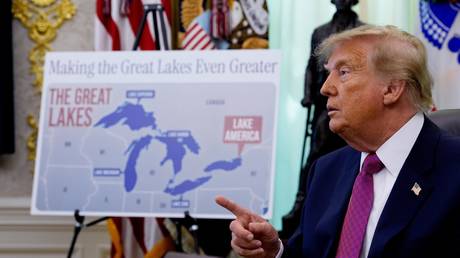
President Donald Trump signed an executive order directing the federal government to officially rename Lake Ontario as Lake America, deploying a symbolic cartographic weapon in the middle of an escalating, multi-billion-dollar trade conflict with Canada.
The move requires federal agencies, domestic maps, and internal databases to adopt the new nomenclature within thirty days. Washington possesses zero legal authority to compel Ottawa, international governing bodies, or foreign mapmakers to follow suit. Prime Minister Mark Carney swiftly rejected the decree, noting that the moniker originates from the Indigenous Wendat word ontari'io—meaning the lake of shining waters—predating both the American Declaration of Independence and the Canadian Confederation.
Cartographic posturing rarely happens in a vacuum. This dispute masks a deeper economic collision rooted in collapsed negotiations, retaliatory tariffs, and structural trade deficits that threaten the stability of the world's longest undefended border.
The Tariff Wall and the Collapse of Talks
Trade relations between Washington and Ottawa fractured completely after bilateral negotiations hit a brick wall over structural enforcement mechanisms. The White House slammed a 50 percent tariff on roughly 20 billion dollars worth of Canadian imports, targeting everything from regional steel and aluminum to agricultural goods, whiskey, and manufactured components.
Ottawa returned fire immediately. Prime Minister Carney's administration enacted retaliatory duties ranging from 25 to 50 percent on hundreds of American export categories, deliberately matching the U.S. tariff rates dollar-for-dollar. Trade officials in Ontario went further, utilizing regional energy leverage by slapping surcharges on electricity exports moving south across the border.
The White House defends these measures by pointing to a persistent trade deficit with its northern neighbor, citing a figure hovering near 60 billion dollars. Yet economists point out a glaring structural reality behind that number. The deficit is driven almost entirely by American petroleum imports. Strip out energy transactions, and the United States actually maintains a comfortable trade surplus with Canada.
Trade disputes often rely on selective math to justify political posture. When the administration claims American farmers face a 400 percent tariff, they are pointing toward hyper-specific, over-quota dairy and poultry protections. Roughly 97 percent of standard U.S. agricultural exports cross the northern border completely duty-free under the architecture of the United States-Mexico-Canada Agreement.
Cartography as a Political Tool
Renaming Lake Ontario is not an isolated bureaucratic whim. It mirrors the administration's playbook from the previous year, when an executive order attempted to rebrand the Gulf of Mexico as the Gulf of America.
In practical terms, domestic agencies will update their internal documents, and digital mapping corporations will wrestle with regional display configurations, showing one name to domestic U.S. users and another to international audiences. But the psychological objective supersedes geographic accuracy. By asserting that the United States holds most of the lake's volume and deepest underwater trenches within its sovereign boundaries, the administration turns a shared natural resource into a nationalist talking point.
Canadian provincial leaders have met the decree with a mix of exhaustion and open mockery. Doug Ford, premier of Ontario, dismissed the action flatly on social media, while Nova Scotia Premier Tim Houston called the maneuver pure foolishness. Even domestic figures like New York Governor Kathy Hochul noted that state agencies and local cross-border economies reliant on uninterrupted commerce will refuse to adopt the terminology.
Economic Fallout for Working Communities
Beneath the political theater lies real economic friction. Factories in the industrial Midwest and manufacturing hubs across Ontario rely on a deeply integrated supply chain where automotive parts cross the border multiple times before a vehicle rolls off the assembly line.
Imposing a 50 percent tariff on steel, aluminum, and vehicle components acts as a direct tax on domestic manufacturing. Producers cannot simply pivot to alternative domestic suppliers overnight. The specialized inputs required for heavy industry take years to scale locally. Passing those sudden costs down the line forces consumers to pay higher prices for vehicles, appliances, and housing materials just as midterm political cycles reach their peak.
Furthermore, the rhetoric surrounding defense spending has added unnecessary strain to a mutual security pact. Trump frequently asserts that the United States defends Canada for nothing. Military analysts point out that both nations are bound by North Atlantic Treaty Organization commitments and the historic Ogdensburg Agreement, sharing joint aerospace defense architectures like the North American Aerospace Defense Command designed to protect the entire continent from shared threats.
As the new tariff schedules take full effect and government agencies begin the bureaucratic process of scrubbing old maps for new terminology, the underlying trade dispute remains unresolved. A name change on a federal database does nothing to alter the water flowing through the St. Lawrence Seaway, nor does it fix the structural imbalances straining the North American economy. The real test will not be what bureaucrats call a lake on a digital server, but how long businesses and consumers can absorb the cost of a trade war fought with tariffs and cartography.