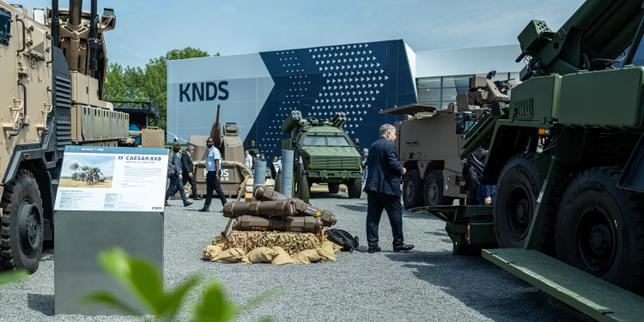
The financial press is currently swooning over the proposed stock market listing of KNDS, the defense conglomerate fusing France’s Nexter and Germany’s Krauss-Maffei Wegmann (KMW). The consensus view is comforting. Pundits claim this initial public offering (IPO) is a masterclass in geopolitical equilibrium, carefully structured to preserve a 50-50 balance of power between Paris and Berlin while unlocking capital to build Europe’s ultimate military champion.
It is a beautiful narrative. It is also completely detached from corporate and military reality.
The belief that you can float a major defense contractor on a public exchange while maintaining a rigid, politically mandated diplomatic equilibrium is a fantasy. In the real world, stock markets demand agility, clear governance, and capital efficiency. Diplomatic compromises demand the exact opposite: redundant supply chains, dual headquarters, and vetoes that paralyze decision-making.
By treating the KNDS IPO as a diplomatic balancing act rather than a corporate restructuring, France and Germany are not building a European defense powerhouse. They are corporate-engineering a slow-motion car crash.
The Myth of the Fifty Fifty Equilibrium
Let’s dismantle the foundational premise of the current discourse. The idea that a 50-50 ownership split represents "stability" is the first lie taught in corporate finance. In business, a 50-50 structure is not a balance; it is a recipe for permanent gridlock.
When Nexter and KMW merged in 2015 to form KNDS, it was hailed as a marriage of equals. In practice, it created a hydra. For over a decade, crucial programs like the Main Ground Combat System (MGCS)—the planned successor to the French Leclerc and German Leopard 2 tanks—have been plagued by bitter infighting. France wants a lighter, more agile tank compatible with its overseas intervention strategy. Germany wants a heavily armored beast designed for the plains of Eastern Europe.
Injecting public shareholders into this mix does not solve the governance problem; it compounds it.
Imagine a scenario where the newly public KNDS needs to consolidate its tank track manufacturing to cut costs and boost margins for public investors. Closing a facility in Roanne, France, or Kassel, Germany, would make perfect financial sense. But politically, it is impossible. The resulting boardroom warfare will pit fiduciary duty to shareholders directly against nationalist political mandates.
Public markets punish companies that prioritize national pride over profit margins. By forcing KNDS to maintain an artificial national equilibrium post-IPO, the two governments are guaranteeing that the company will trade at a permanent "diplomatic discount" compared to agile, single-nation competitors like BAE Systems or Rheinmetall.
Rheinmetall Is Already Eating KNDS’s Lunch
While Paris and Berlin spend years debating the precise percentage of shares to float without upsetting national egos, their chief competitor is operating with ruthless capitalistic efficiency.
Rheinmetall, Germany’s independent defense giant, does not wait for bilateral ministerial approval to make a move. When the war in Ukraine triggered a massive surge in European defense spending, Rheinmetall immediately scaled up ammunition production, acquired Spanish explosive maker Expal, and established joint ventures inside Ukraine.
What did KNDS do? It waited for political consensus.
The Agility Gap: KNDS vs. Rheinmetall
| Operational Metric | KNDS (Politically Balanced) | Rheinmetall (Market Driven) |
|---|---|---|
| Decision-Making Speed | Months to years (Requires bilateral political sign-off) | Weeks (Board-level execution) |
| Supply Chain | Duplicated across France and Germany to appease politicians | Optimized globally for cost and speed |
| M&A Strategy | Restricted by national sovereignty concerns | Aggressive, opportunistic acquisitions |
| Investor Appeal | High regulatory and political risk | Clear growth trajectory tied to global demand |
I have seen engineering firms blow hundreds of millions of euros trying to appease two masters with conflicting requirements. You end up with a product that is twice as expensive and delivered five years too late. Look at the NH90 helicopter program or the Eurofighter Typhoon. These projects became infamous procurement nightmares because they were designed by international committees, not unified corporate leadership. KNDS is on track to repeat this exact mistake on a corporate scale.
The Export Control Paradox Public Markets Won't Tolerate
The most glaring vulnerability of the KNDS listing is the unresolved clash over export controls. It is the elephant in the boardroom that no investment bank wants to talk about during the pre-IPO roadshow.
France views defense exports as an instrument of foreign policy and economic survival. Paris will happily sell hardware to almost any sovereign state that can pay. Germany, driven by domestic political coalitions, applies a much stricter, highly moralistic framework to weapons exports. Berlin has repeatedly blocked sales of jointly developed equipment to nations in the Middle East and Asia, infuriating French industrial partners.
How do you pitch an IPO to institutional investors when the company’s addressable market can be slashed overnight by a change in the German governing coalition?
A public company cannot function when its primary revenue growth engine is subject to a geopolitical veto held by a third-party government. If KNDS goes public without a binding, ironclad treaty that strips both Paris and Berlin of their unilateral vetoes over exports, the stock will be toxic for international asset managers.
Fix the Governance Before You Ring the Bell
The premise of the current strategy is entirely flawed. Governments are asking: How do we structure an IPO to protect French and German sovereignty? They should be asking: How do we restructure KNDS so it can actually win contracts?
If Europe genuinely wants a champion capable of competing with American titans like Lockheed Martin or General Dynamics, it must abandon the sacred cow of 50-50 national parity. An IPO should be used as a catalyst to break the political deadlock, not institutionalize it.
First, one nation must take the lead operational role, or the company must be structured with a fiercely independent CEO who possesses the sole authority to shutter inefficient factories, regardless of which side of the Rhine they sit on. Second, the golden shares retained by the governments must be strictly limited to national security vetoes over hostile foreign takeovers, with zero say in commercial strategy or product design.
If France and Germany refuse to relinquish day-to-day control, they should skip the IPO entirely. Keep the company private, accept the inefficiencies, and fund it purely through state subsidies. Taking a dysfunctional diplomatic compromise public is an insult to investors and a danger to European security.
Stop treating defense industrial strategy as a therapeutic exercise in European unity. The stock market does not care about the Elysée Treaty. It cares about execution. Until KNDS is allowed to operate like a business rather than an international embassy, its stock market debut will be nothing more than an expensive exercise in rearranging the deckchairs on a divided ship.
Ditch the diplomatic balancing act. Appoint a single, ruthless leadership team. Let the market decide where the tanks get built.