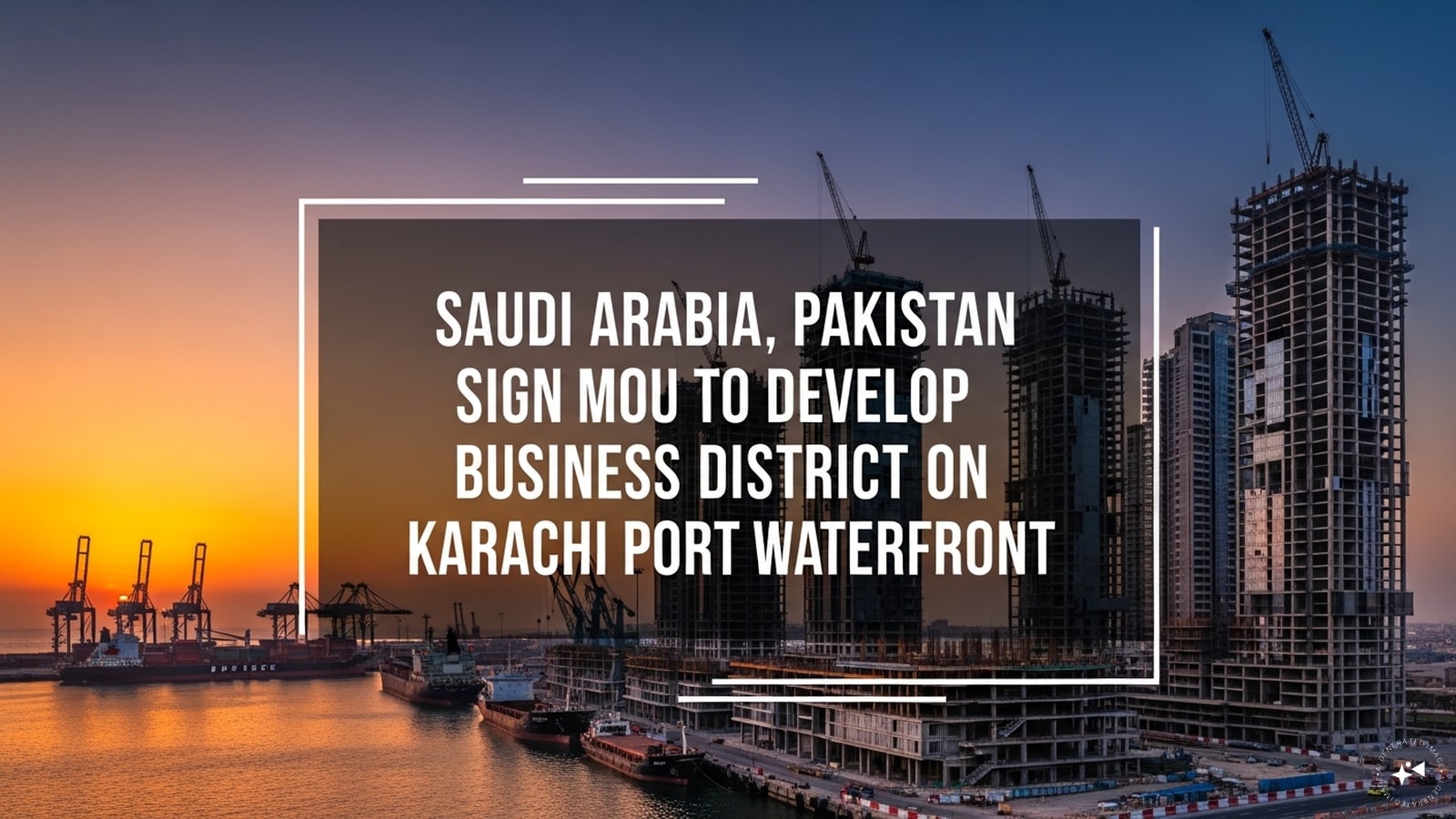
The ink is barely dry on the memorandum of understanding between Saudi Arabia and Pakistan to build a gleaming new business district on the Karachi port waterfront, and the cheerleaders are already out in full force. Press releases are singing praises of real estate transformation, foreign capital inflows, and Dubai-style skylines.
It is the same tired script we see every time a developing economy signs a non-binding piece of paper with a Gulf sovereign wealth fund. Meanwhile, you can explore related events here: Why the New White House Tariffs Threaten Canadian Exporters.
Here is the uncomfortable reality that mainstream financial commentators are ignoring: building luxury real estate on a dysfunctional port does not fix a broken macroeconomic foundation. In fact, poured concrete on a waterfront is often where capital goes to die when the underlying institutional plumbing is cracked.
If you think this MoU is the catalyst for a sudden economic turnaround in Karachi, you are looking at the wrong metrics. Let’s dismantle the lazy consensus and look at how maritime logistics, sovereign debt, and real estate speculation actually collide. To understand the complete picture, we recommend the recent analysis by Bloomberg.
The Flawed Premise of the Waterfront Savior Complex
The prevailing narrative treats real estate as an economic engine. It is not. Real estate is a sponge that absorbs excess wealth generated by actual productive industries—like manufacturing, technology, and high-yield services.
When Dubai built its glittering waterfront, it did so on the back of decades of aggressive deregulation, world-class port management via DP World, and a tax-free environment that actively lured global talent. The buildings followed the business; the business did not follow the buildings.
Karachi faces a entirely different structural bottleneck. The Karachi Port Trust (KPT) and the nearby Port Qasim handle more than 90% of Pakistan's international trade. Yet, these ports are plagued by chronic inefficiencies, high freight handling costs, and bottlenecked hinterland connectivity.
Turning prime maritime logistics land into luxury commercial offices and high-end residential towers is a fundamental misallocation of a scarce resource. You do not fix a supply-chain bottleneck by building a shopping mall next to the container terminal.
The MoU Illusion: Paper vs. Pipelines
I have spent years analyzing cross-border capital flows in emerging markets, and if there is one universal truth, it is this: MoUs are the financial equivalent of a swipe right on a dating app. It signals a vague interest, not a marriage proposal, and certainly not a dowry.
- Non-Binding Reality: An MoU carries zero legal obligation to deploy capital. It allows politicians to score quick public relations victories and sovereign funds to keep their options open.
- The Risk Premium Paradox: Saudi Arabia’s Public Investment Fund (PIF) or its allied corporate entities are sophisticated, ruthless allocators of capital. They look at risk-adjusted returns. When Pakistan’s inflation rates fluctuate wildly and the rupee faces structural devaluation pressures, the risk premium skyrockets.
- The Sovereign Guarantee Trap: Foreign investors in high-risk jurisdictions routinely demand sovereign guarantees on returns or dollar-convertibility assurances. For a state already navigating tight IMF programs, providing these guarantees is a fiscal landmine.
If a state cannot guarantee that a foreign investor can easily repatriate profits due to recurring balance-of-payments crises, the mega-towers remain nothing more than 3D architectural renderings on a website.
Land Reclamation is a Logistics Killer
Let's talk about the physical reality of port operations, a detail completely missed by journalists writing about "vibrant waterfront districts."
Modern maritime commerce requires vast swathes of land for container staging, intermodal rail connections, customs facilities, and deep-water berths. The world’s most successful ports, from Singapore to Rotterdam, are aggressively expanding their industrial footprints, not shrinking them to accommodate luxury penthouses.
Imagine a scenario where thousands of daily upscale commuters, retail shoppers, and corporate executives clog the exact same arterial roads used by heavy freight trucks moving 40-foot containers from the docks. It is a logistical nightmare.
By gentrifying the waterfront, you effectively choke the port's capacity to expand its industrial footprint. You are trading long-term structural trade capacity for a short-term real estate pop that benefits a handful of well-connected developers.
Dismantling the Consensus Questions
When news of this deal broke, the standard questions flooded the market. Most of them miss the mark entirely because they accept a flawed premise.
"Will this project solve Karachi’s economic woes?"
This is the wrong question. A business district does not cure structural fiscal deficits, an undocumented economy, or an energy sector crippled by circular debt. If the domestic market lacks the purchasing power to fill luxury office spaces, these projects become ghost towns or vehicles for local elites to park untaxed capital in concrete.
"How much foreign direct investment will this bring?"
The honest answer? Significantly less than the headline figures suggest. True Foreign Direct Investment (FDI) goes into productive assets that generate export revenues. Real estate investment is largely non-tradable. It generates local currency revenue but requires foreign foreign exchange to repatriate profits, ultimately worsening the dollar-drain problem over the long term.
The Hard Truth About Sovereign Wealth Alliances
Gulf capital is no longer charitable. The era of the "brotherly country" bailouts, where billions were deposited into central banks with no strings attached, is dead. Riyadh and Abu Dhabi have made it explicitly clear that future capital deployment will be strictly commercial.
When Saudi entities look at the Karachi waterfront, they are looking for distressed assets at deep discounts, or strategic positioning that aligns with their own domestic transformation agendas. They want high-yielding logistics infrastructure or monopolistic real estate plays.
If the host country cannot provide a stable regulatory environment, clean land titles, and guaranteed security, the project stalls. Look at the long list of announced mega-projects across South Asia and North Africa over the last two decades that are now nothing more than half-built concrete skeletons.
The Actionable Pivot for Port Development
Stop trying to build Dubai in a city that lacks Dubai’s institutional framework. If policymakers actually want to leverage Saudi capital to transform Karachi, they need to abandon the luxury real estate fantasy and pivot to cold, hard industrial utility.
- Prioritize Special Economic Zones (SEZs) Over Commercial Districts: Shift the focus from office towers to export-oriented manufacturing zones directly attached to the port. Give Saudi investors tax-free manufacturing hubs where they can set up downstream industries.
- Invest in Deep-Water Berthing and Automation: Use foreign capital to modernize the port infrastructure itself. Increase crane productivity, automate customs clearance, and deepen channels to accommodate neo-Panamax vessels. That is how you generate sustainable economic compounding.
- Fix the Inner-City Logistics Network: Build dedicated, grade-separated freight corridors connecting the port directly to the national highway network, completely bypassing the urban core.
If you don't fix the underlying infrastructure, no amount of glass facades will matter. Investors do not move to a city because it has a nice view of the harbor; they move because they can operate efficiently, safely, and profitably.
The Karachi waterfront MoU is a classic symptom of a real estate-obsessed economic mindset that prioritizes optical prestige over structural productivity. Until the fundamental mechanics of the port's logistics, governance, and macroeconomic stability are fixed, any business district built on the waterfront will be nothing more than a glittering monument to misallocated capital.