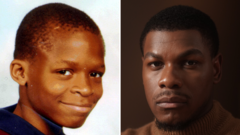
John Boyega didn't just take another role when he signed on for the BBC drama Damilola, Our Loved Boy. He stepped into a piece of London history that still feels like an open wound for many. If you grew up in the UK in the early 2000s, you remember the silver puffer jacket. You remember the Peckham stairwell. Most of all, you remember the face of a ten-year-old boy who just wanted to be a doctor.
The film focuses on the Taylor family’s journey rather than just the crime. Boyega plays a key part in this narrative, but his involvement goes deeper than a standard acting gig. He knew Damilola. They were friends. That personal connection changes the entire energy of the production. It isn't just a career move for a Star Wars lead. It’s a debt of memory.
Why this story still breaks hearts decades later
Damilola Taylor moved from Nigeria to South London in August 2000. Four months later, he was dead. He was found bleeding out in a concrete stairwell on the North Peckham Estate, having been stabbed in the leg with a broken bottle. The initial police investigation was a mess. It took years, multiple trials, and a massive amount of public pressure to get even a semblance of justice.
The BBC film seeks to look past the headlines. It focuses on Richard and Gloria Taylor, Damilola's parents, and their agonizing struggle to keep their family together while the world watched their private grief. Boyega’s presence brings a specific kind of gravity to the project. He was one of the last people to see Damilola alive. They were at the same youth club. They played together. When you see Boyega talk about this role, you aren't seeing an actor promote a project. You're seeing a man processing a childhood trauma through his craft.
The struggle for justice and the Taylor family legacy
Richard Taylor, played by Babou Ceesay in the film, became a tireless campaigner against knife crime. He didn't want his son to be remembered only as a victim. He wanted his son’s name to mean something for the kids still living on estates like North Peckham.
The legal battle was a nightmare. The first trial in 2002 saw four youths acquitted. It felt like a slap in the face to a grieving community. It wasn't until 2006 that Danny and Ricky Preddie were finally convicted of manslaughter. Even then, the "justice" felt hollow. The film doesn't shy away from the frustration. It captures the exhaustion of a father who has to become a politician just to get the police to do their jobs properly.
Boyega's involvement highlights a bridge between the Peckham of 2000 and the global stage he now occupies. He's spoken openly about how the area has changed, but also how the underlying issues—poverty, lack of opportunity, and systemic neglect—haven't really gone away.
Breaking the cycle of violence through storytelling
Some people ask why we need to keep revisiting these tragedies. Isn't it just trauma porn? Honestly, no. Not when it’s handled with this much care. This isn't a "gritty" crime thriller. It’s a character study about resilience.
The BBC worked closely with the Taylor family to ensure the tone was right. They didn't want a sensationalist piece. They wanted a memorial. By casting someone like Boyega, who has genuine roots in that specific community, the production gains an authenticity that money can’t buy. He knows the streets. He knows the accent. He knows the specific weight of expectation placed on young Black boys in London.
The impact of the Damilola Taylor Trust
The film also serves as a massive platform for the Damilola Taylor Trust. Since its inception, the trust has worked to provide career opportunities for underprivileged youth. It’s about showing kids that their lives aren't destined to end in a stairwell.
- Youth Engagement: Providing workshops and mentorship.
- Knife Crime Awareness: Pushing for policy changes at the highest levels of government.
- Healthcare Support: Honoring Damilola’s dream of becoming a doctor by supporting medical students.
Richard Taylor’s work earned him an OBE, but his real reward is seeing kids from Peckham go on to do great things. Boyega is the ultimate example of that. He’s the local boy who made it out, coming back to tell the story of the friend who didn't.
Production details and what to expect
The script was penned by Levi David Addai, who has a knack for writing dialogue that feels lived-in rather than scripted. He avoids the "theatrical" tropes of many British dramas. Instead, the scenes are quiet. They're filled with the mundane details of a family trying to eat dinner while their lives are falling apart.
While Boyega’s role is significant, the heavy lifting is done by Babou Ceesay and Wunmi Mosaku. They play the parents with a devastating level of restraint. You feel the tension in their marriage. You feel the cultural clash of moving from Nigeria to a London estate that felt more like a war zone than a land of opportunity.
Why you should watch this now
In a world of fast-paced news cycles, we forget names too easily. We remember the "event" but forget the person. This film forces you to remember Damilola as a child, not a statistic. It challenges the viewer to think about what has actually changed in the twenty-plus years since that November afternoon.
If you want to understand the modern London landscape, you have to understand the Damilola Taylor case. It changed how the Met Police handle youth crime. It changed how the media reports on Black victims. It changed the lives of everyone in Peckham.
Watch the film on BBC iPlayer. Look into the work of the Damilola Taylor Trust. Support local youth centers that give kids a place to go after school. The best way to honor a memory is to prevent the next tragedy from happening. Don't just consume the drama—engage with the cause it represents.