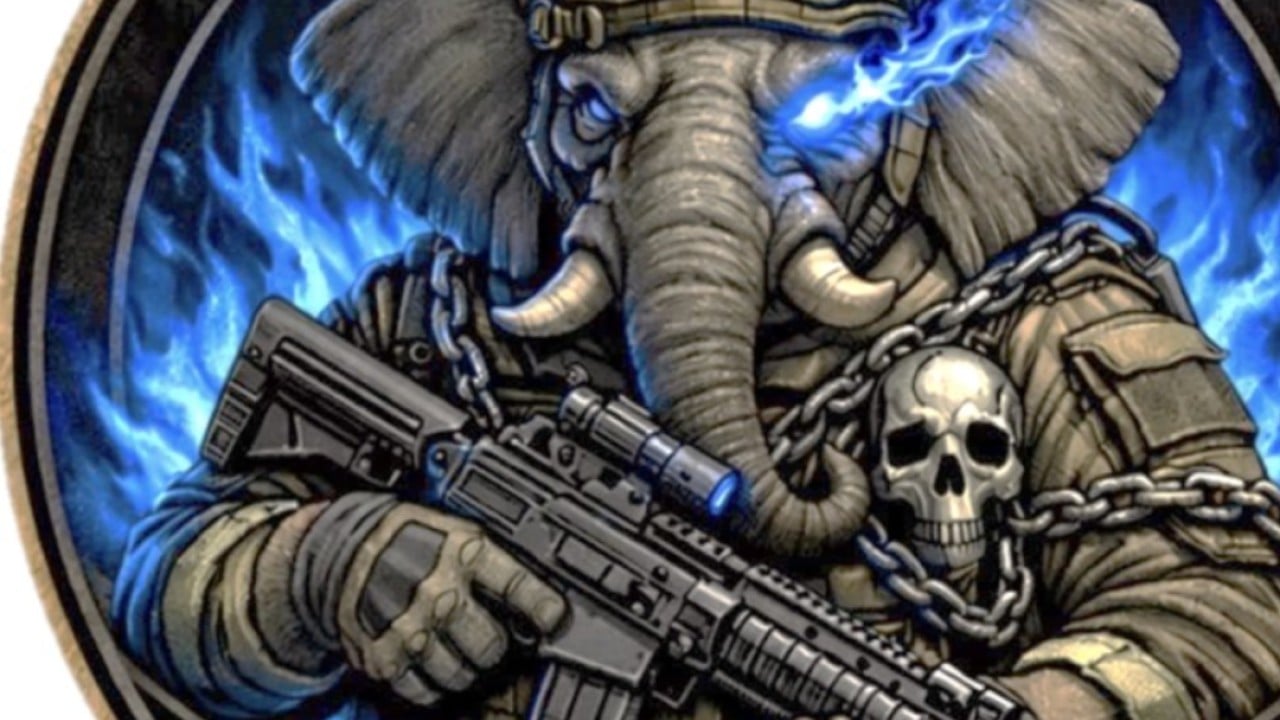
Japan’s military just learned a hard lesson about cutting corners with technology. The Ground Self-Defense Force (GSDF) recently tried to modernize its image by introducing a new logo for a supply unit. Instead of a professional design that reflects the discipline of a national defense force, they released an AI-generated mess. It features an elephant holding a machine gun. It’s weird. It’s anatomically nonsensical. And honestly, it’s a bit embarrassing for a multi-billion dollar military organization.
The logo belonged to the GSDF’s 102nd Quartermaster Unit based at Camp Nerima in Tokyo. They wanted something that symbolized strength and reliability. They got an elephant with extra toes and a gun that seems to be melting into its trunk. This isn't just about bad art. It’s about what happens when public institutions prioritize "looking tech-savvy" over actual quality and logic.
Why the GSDF elephant logo looks so wrong
If you've spent more than five minutes playing with tools like Midjourney or DALL-E, you know the "AI look." It’s that eerie, overly polished texture combined with a complete lack of structural understanding. The GSDF logo has every hallmark of a rushed prompt.
Look closely at the trunk. The way it grips the weapon defies physics. The elephant’s eyes have that vacant, soulless stare common in early generative models. Then there are the feet. AI famously struggles with digits, and this elephant appears to have an indeterminate number of toes.
The public reaction in Japan was swift. Critics on social media didn't just mock the aesthetics. They questioned the message. Why is a logistics and supply unit—the people responsible for food, water, and fuel—represented by a heavily armed pachyderm? It feels aggressive in a way that doesn't align with the GSDF’s typical branding. It’s a clunky attempt at "cool" that fell flat because nobody bothered to have a human designer fix the glitches.
The problem with government agencies using cheap AI
This isn't just a Japan problem. We're seeing a global trend where organizations think AI is a "press button, get result" solution for branding. It’s cheap. It’s fast. But for a military unit, "cheap and fast" shouldn't be the vibe.
Design matters. A logo is a symbol of authority. When the 102nd Quartermaster Unit put this out, they told the world they don't value attention to detail. If you can't bother to check if your mascot has the right number of legs or if its gun is floating in mid-air, why should the public trust your logistics?
The fallout of the elephant gaffe
The GSDF eventually pulled the logo from its official channels after the mockery became too loud to ignore. But the damage was done. The incident highlights a massive gap in digital literacy within high-level institutions. There’s a clear lack of a "human in the loop" process. Someone at Camp Nerima looked at that image, saw a gun and an elephant, and said, "Looks good, post it." That lack of critical oversight is the real story here.
It’s also a slap in the face to Japan’s vibrant community of professional illustrators and designers. Japan has one of the richest visual cultures on earth. They have thousands of talented artists who could have created a meaningful, hand-drawn symbol for the unit. Instead, the GSDF chose a free or low-cost shortcut that ended up costing them their dignity.
Lessons from the AI elephant blunder
You can't automate identity. Branding requires intent. It requires a human to say, "This symbol represents our history and our future." An algorithm doesn't know what the 102nd Quartermaster Unit stands for. It only knows how to mash together pixels based on a probability map of what an "elephant with a gun" might look like.
If you’re running an organization—whether it’s a local business or a wing of the national defense—don't let this happen to you. Use AI for brainstorming. Use it to generate mood boards. But never, under any circumstances, let an unedited AI image be the face of your brand.
- Hire a professional. A human designer would have caught the anatomical errors in seconds.
- Check the optics. Does an aggressive, gun-toting animal fit your specific mission? For a supply unit, probably not.
- Proofread everything. This applies to images too. Look at the edges. Look at the shadows. If it looks "off," it is off.
The GSDF elephant is now a meme, a cautionary tale of what happens when "good enough" meets the internet. Don't let your next project become a punchline. Take the time to build something real. The internet never forgets a fifth leg or a floating gun.