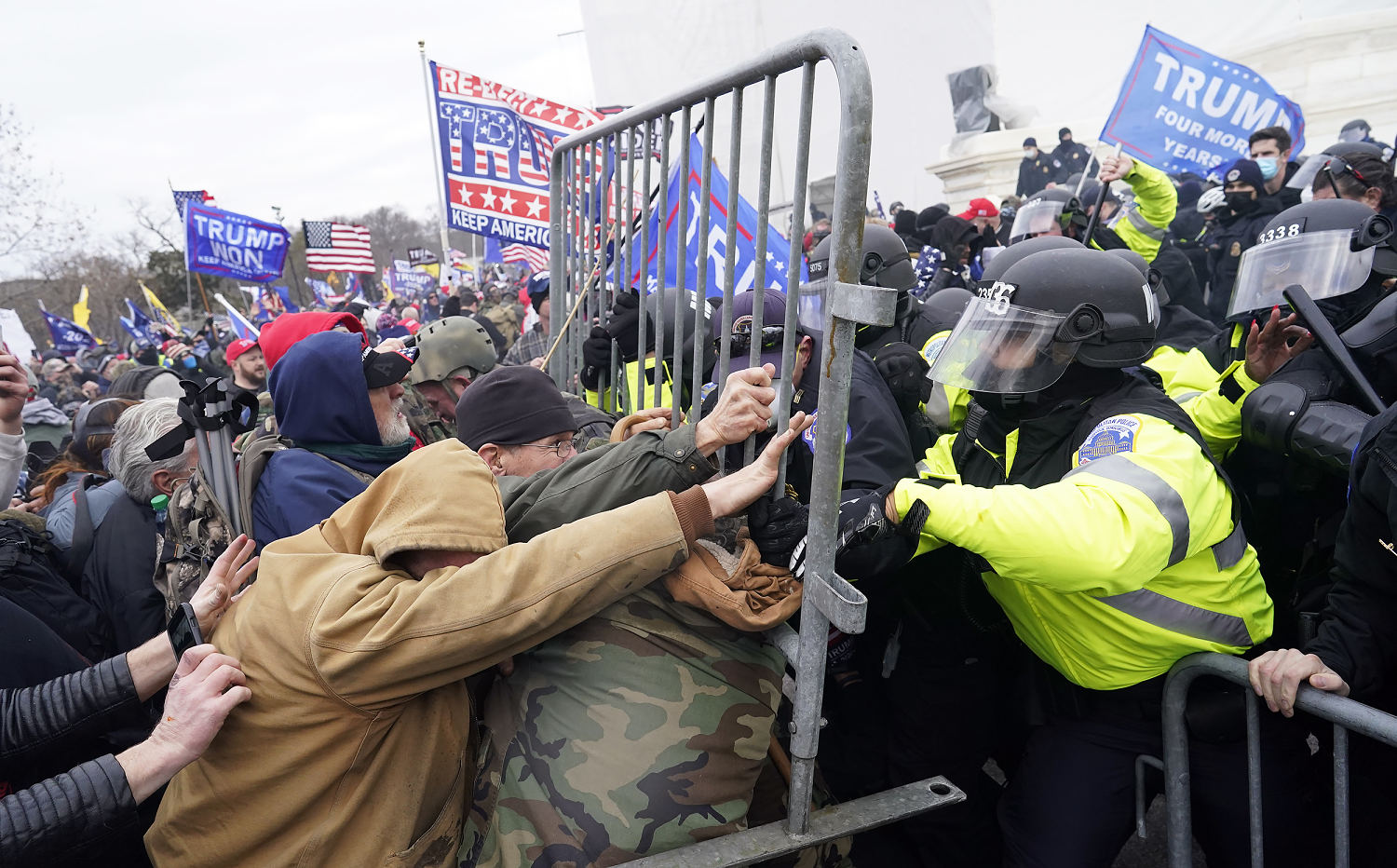
The lawsuit filed by January 6 defendants claiming "excessive force" by Capitol Police isn't just a long shot. It is a fundamental misunderstanding of how the American legal system protects the state’s monopoly on violence.
Most media outlets are framing this as a simple partisan battle—a "he said, she said" between rioters and officers. That is the lazy consensus. The reality is far more clinical and far more brutal for the plaintiffs. By filing a class-action lawsuit, these individuals are stepping into a trap designed by decades of conservative and liberal judicial consensus specifically to shield police officers from the consequences of their actions in high-pressure environments.
The protestors think they are fighting for civil liberties. In reality, they are about to prove exactly why those liberties are a myth when you're standing on the wrong side of a police line.
The Qualified Immunity Meat Grinder
The central obstacle in this case isn't "the truth" of what happened on the ground. It is the doctrine of Qualified Immunity.
To win an excessive force claim, a plaintiff must prove that the officer violated a "clearly established" statutory or constitutional right. In practice, this means you have to find a previous court case with facts so nearly identical to yours that the officer should have known their behavior was illegal.
Imagine a scenario where an officer uses a specific type of chemical irritant at a specific angle during a riot. If there isn't a prior court ruling in the D.C. Circuit saying that exact move is illegal, the officer walks.
For the Jan. 6 plaintiffs, the mountain is even steeper. They weren't at a peaceful sit-in. They were part of a crowd that breached a perimeter. Courts historically grant police massive leeway—a "zone of discretion"—when they perceive a threat to life or the seat of government. You don't get to ignore a police command and then complain that the enforcement of that command was uncomfortable.
The Myth of the Passive Observer
The lawsuit argues that "non-violent" participants were swept up in the police response. This is a tactical error in legal strategy.
Under the Fourth Amendment's "reasonableness" standard, established in Graham v. Connor, the court doesn't look at the situation through the lens of 20/20 hindsight. It looks through the lens of a "reasonable officer on the scene."
If you are in a crowd of five thousand people screaming and pushing against a line, the law does not require the officer to stop and interview you about your personal intentions before deploying tear gas. In the eyes of the law, the crowd is a singular organism. If the organism is hostile, the response is justified.
The Trap of the Class Action
Filing this as a class action is the height of legal arrogance.
Class actions require "commonality"—the idea that the injuries and facts are similar enough to be handled as one group. But Jan. 6 was a series of thousands of individual micro-confrontations. One person might have been hit by a baton while standing still; another might have been pepper-sprayed while trying to grab a riot shield.
By lumping these together, the plaintiffs make it easy for the defense to dismantle the entire suit. All the government has to do is show that a handful of the "class members" were being violent, and the "commonality" of the group dissolves. The suit isn't a weapon; it's a target.
What the Plaintiffs (and the Media) Get Wrong About Force
There is a common misconception that police force must be "fair." It doesn't. It only has to be "objectively reasonable" to gain control of a situation.
- Proportionality is a lie: Police are trained to use one level of force higher than what they are facing. If you push, they strike. If you strike, they use chemicals. If you threaten life, they use lead.
- The "Bystander" Defense: If you remain in a restricted area after an order to disperse, you have legally assumed the risk of the enforcement measures that follow. "I didn't hear the order" is not a legal defense; it's an admission of negligence.
The Financial Reality of Symbolic Lawsuits
I have watched groups blow millions of dollars on "principled" litigation that was dead on arrival. These lawsuits serve the lawyers’ billable hours and the political narratives of both sides. They do not serve the individual defendants.
For the "excessive force" claim to succeed, the plaintiffs would need a smoking gun: an order by a commander specifically telling officers to use force not to clear the building, but to punish or intimidate a specific group. In the chaos of Jan. 6, where the Capitol Police were demonstrably overwhelmed, "punitive" intent is nearly impossible to prove.
The defense is simpler: "We were afraid for our lives, and the building was being breached."
That is an ironclad legal defense in America.
The Unspoken Truth
The Jan. 6 plaintiffs are about to discover what marginalized communities have known for fifty years: The court is not your sanctuary. It is a fortress.
If you walk into a restricted zone, ignore a lawful order to disperse, and become part of a mass movement that breaks a police line, the law does not care if you were "just there to watch." You have provided the state with the exact legal justification it needs to use force against you.
The lawsuit isn't a challenge to the system. It is a demonstration of how perfectly the system works to protect its own.
The lawyers win. The politicians win. The defendants lose twice.