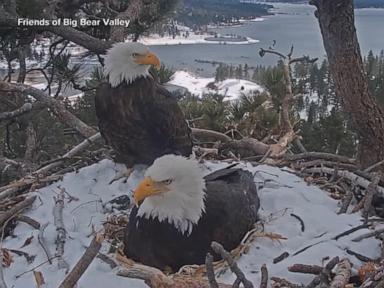
We love to pat ourselves on the back. Millions of screens glow in the dark, fixed on a nest in Big Bear Valley, Southern California, watching a pair of raptors manage domestic chaos. The mainstream media calls it a triumph of unity. They write glowing profiles about how Jackie the bald eagle bridges political divides, heals national cynicism, and brings strangers together in a shared digital campfire.
It is a comforting lie.
Strip away the warm-and-fuzzy sentimentality, and the 24/7 eagle cam is not a symbol of human connection. It is an industrial-scale distraction engine. We are not bonding over nature; we are outsourcing our emotional regulation to a couple of oversized birds because dealing with actual human neighbors has become too uncomfortable.
Let us look at the mechanics of this phenomenon without the Hallmark filter.
The Anatomy of Manufactured Awe
The lazy consensus around viral animal live streams is that they restore our faith in humanity. People from opposite sides of the ideological spectrum sit in the chat room of the Friends of Big Bear Valley stream, typing heart emojis, agreeing on one thing: the health of an eaglet matters.
That sounds noble until you look at the economics of attention.
I have spent years analyzing how digital platforms capture cognitive bandwidth. Attention is finite. Every minute a citizen spends weeping over a hatched egg or stressing over a delayed incubation shift is a minute they are not looking at municipal zoning boards, local school funding, or the actual ecological degradation happening outside their windows.
Imagine a scenario where the collective hours spent watching Jackie translate into precinct-level political engagement or volunteer hours at a local watershed cleanup. The numbers would be staggering. Instead, that energy goes into a proprietary chat box governed by moderators who delete dissent faster than a nesting hawk drops a stick.
We are trading civic participation for vicarious biology.
The Anthropomorphism Trap
Here is where the expertise of behavioral biology gets trampled by the stampede of sentimental marketing. Bald eagles are apex predators. They are ruthless, efficient survival machines governed by instinct, environmental pressure, and evolutionary ruthlessness.
Yet, the comment sections are flooded with projections of human soap opera drama. Every shift change is analyzed through the lens of human marital strife. Every delayed return to the nest is spun into a narrative of domestic neglect or heroism.
This is not appreciation of wildlife. This is projection therapy.
When you project human morality onto Haliaeetus leucocephalus, you miss the actual brilliance of the animal. You miss the physics of their flight, the biomechanics of their talons, and the harsh reality of avian resource management. Nature does not care about your emotional arc. When an eaglet fails to thrive or weather destroys a clutch, the chat room goes through stages of grief that mirror a suburban family tragedy.
That is not education. That is emotional manipulation disguised as conservation outreach.
The Corporate Co-Option of Wilderness
Let us talk about who actually benefits from this digital amphitheater.
The stream is hosted by a non-profit organization operating in a high-rent, high-demand tourist region of Southern California. Viewer numbers translate into donations, merchandise sales, and elevated local profile. That is not a crime—non-profits need funding to operate. But let us stop pretending this is pure altruism or a spontaneous grassroots movement.
It is content creation.
The camera angle is curated. The infrastructure is engineered. The narrative is sustained by the dopaminergic loop of the refresh button. You check the stream during a boring Zoom meeting. You check it before bed. You wake up and check if the fish delivery arrived.
You have been gamified by an apex predator.
If conservation organizations want to save local ecosystems, they should be broadcasting the mundane, ugly, unsexy realities of habitat loss, water rights battles, and microplastic accumulation in local food webs. But nobody donates fifty bucks to watch a graphic designer map out suburban sprawl. They donate to watch a fluffy white head break through a shell because it triggers a primitive parental instinct without any of the messy overhead of raising actual human offspring.
The Cost of Cheap Empathy
What happens when your primary source of empathy is a livestreamed bird? Your capacity for real-world friction atrophies.
True community requires argument. It requires compromise with people who smell bad, vote differently, and disagree with your vision of the neighborhood. It requires showing up to a Tuesday night city council meeting where the HVAC system hums too loudly and the coffee is burnt.
Watching Jackie requires none of that. You click a link, type a glowing comment, and instantly feel like part of a global tribe. You get all the biochemical rewards of community building with zero skin in the game.
This is why the cultural appetite for these streams is inversely proportional to our social health. The more atomized, lonely, and politically exhausted a society becomes, the more it leans on digital surrogates to simulate belonging.
Stop Watching the Nest
I am not asking you to hate birds. I am asking you to stop treating a high-definition webcam feed as a substitute for a functioning society.
If you truly care about the eagles, look up from your screen and fight the local development projects choking out the remaining riparian corridors in your own zip code. Support organizations that buy actual land rights, not just streaming licenses.
Or, if you are going to stare at the screen, at least be honest about what you are doing. You are not building a bridge across the political aisle. You are zoning out on a digital pacifier because the real world got too loud.
Close the tab. Go outside. Talk to a neighbor you despise. That is where the real work is.