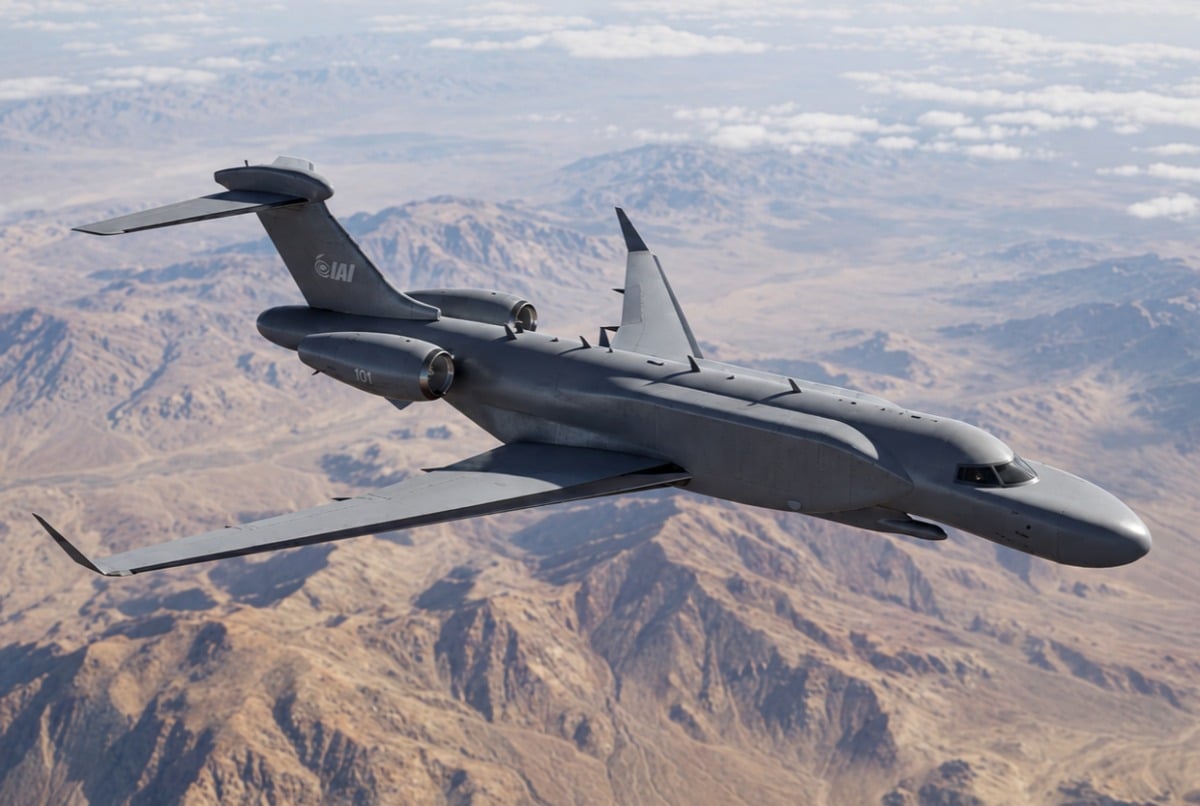
Israel Aerospace Industries has mastered a high-stakes trick in modern defense manufacturing: taking civilian Gulfstream business jets and turning them into multi-mission spy planes capable of reshaping regional battlefields. By stripping out luxury leather seating and installing high-powered phased-array radars, signal intelligence suites, and real-time data links, IAI converts business aircraft like the Gulfstream G550 into specialized Special Electronic Mission Aircraft. These platforms deliver strategic intelligence, surveillance, and reconnaissance capabilities that used to require massive, expensive military transports like the Boeing E-3 Sentry, but at a fraction of the operating cost.
This transition from commercial luxury to military dominance is not just a clever engineering feat. It represents a fundamental shift in how air forces approach battle management, electronic warfare, and signals collection. You might also find this related coverage insightful: Why Smart Rifle Triggers Will Not Save Infantry From Drones.
The Engineering Behind the Transformation
Converting a commercial business jet into a military intelligence platform is an exercise in structural violence. Civilian jets are designed for high-altitude cruise efficiency, long range, and passenger comfort. They are not built to carry massive, drag-inducing radar canoes underneath their belly or giant side-looking airborne radar cheek fairings along the fuselage.
When IAI modifies an airframe for its Conformal Airborne Early Warning or signals intelligence roles, engineers must re-engineer the aerodynamics from the ground up. As extensively documented in latest articles by Wired, the effects are significant.
First comes the power extraction problem. High-performance active electronically scanned array radars demand immense electrical power. Standard business jet generators, built to run cabin lights and galley microwaves, fall completely short. Engineers must install modified auxiliary power units and high-output engine-driven generators capable of cranking out hundreds of kilowatts of extra power. Managing the extreme heat generated by these electronics requires supplemental cooling loops, often forcing the installation of additional environmental control system scoops along the airframe.
Then there is the physical alteration. Cutting into a pressurized airframe to route thick bundles of fiber-optic cabling and structural supports for radar antennas destabilizes the factory weight-and-balance envelope. The airframe must be reinforced with composite and titanium structural members. Antenna radomes—often made of advanced fiberglass or quartz composites that allow radar signals to pass through without distortion—are integrated directly into the fuselage contours to minimize aerodynamic drag.
The result is a hybrid machine. On the radar screen of civilian air traffic control, it maintains the speed, ceiling, and flight profile of a high-end corporate jet. Underneath, it carries the sensing horsepower of a strategic command post.
Why Small Airframes Are Displacing Military Giants
For decades, military intelligence gathering belonged to big airframes. Western air forces relied heavily on platforms built on commercial airliners like the Boeing 707. These aircraft had the physical space required to house dozens of human operators sitting in front of bulky CRT monitors, along with the vacuum-tube electronics needed to process radar signals.
That operational model is dead.
Modern microelectronics, software-defined radios, and advanced automation have squeezed the processing power of a room-sized mainframe into rack-mounted blade servers. You no longer need twelve operators onboard an aircraft to monitor radar tracks. Algorithmic track fusion and automated threat identification handle the heavy lifting, allowing two or three mission system operators onboard—or even operators sitting in a ground station miles away via satellite link—to execute the same mission.
Operational economics drove this shift.
Flying a heavy, four-engine legacy military aircraft costs tens of thousands of dollars per flight hour in fuel, maintenance, and aircrew overhead alone. A twin-engine business jet operates at a sliver of that cost. It flies higher—often above 40,000 feet—putting its sensors above weather interference and extending the line-of-sight horizon for ground-looking radars and radio interception systems. Higher altitude translates directly to greater stand-off range, keeping the aircraft and its crew safely outside the engagement envelope of enemy long-range surface-to-air missile systems.
Turnaround time is another critical factor. A business jet airframe can land, refuel, undergo routine maintenance using widely available commercial supply chains, and return to the air far faster than a specialized, low-density military transport.
The Sensor Suite Matrix
IAI does not just bolt a single radar onto an airplane and call it a day. The true capability of these modified platforms lies in sensor fusion—the ability to combine disparate data streams into a single, cohesive battlefield picture in real time.
Active Electronically Scanned Array Radars
Unlike legacy radars that rely on a mechanically rotating dish inside a giant radome, modern airborne early warning jets use solid-state radar modules mounted on the sides and nose of the aircraft. These modules steer radar beams electronically at the speed of light. The system can scan 360 degrees instantaneously, tracking hundreds of low-radar-cross-section targets simultaneously, from low-flying cruise missiles to fast-attack craft at sea.
Signals and Electronic Intelligence
Surveillance is about more than just seeing metal in the air or on the water; it is about listening to the electromagnetic spectrum. Antenna arrays embedded in the wingtips and tail cone passively detect, identify, and geolocate enemy radar emitters and radio communications. The system maps the enemy order of battle without firing an active radar pulse that would give away its own location.
Electro-Optical and Infrared Sensors
For positive visual identification, retractable sensor turrets are mounted under the chin or belly. These optical sensors operate in daylight and thermal bands, giving operators high-definition visual confirmation of ground targets, ship hulls, or coastal activity from dozens of miles away.
High-Capacity Satellite Data Links
The aircraft operates as a central node in a network-centric warfare grid. Through line-of-sight and Beyond-Line-of-Sight satellite communications, data collected by the plane is instantly piped down to ground commanders, naval vessels, and strike fighters, allowing target engagements to happen within seconds of detection.
The Geopolitical Drivers Behind the Demand
The global market for business-jet-based spy planes is exploding, driven by changing threat profiles and tightening defense budgets across Europe, Asia, and the Middle East.
In NATO's eastern flank, the requirement for persistent, long-range surveillance has never been more urgent. Modern integrated air defense systems make creeping close to hostile borders extremely dangerous for large, unstealthy aircraft. High-altitude, long-endurance business jets equipped with side-looking airborne radar can peer deep into sovereign territory while staying safely inside friendly airspace.
In the Indo-Pacific, the challenge is maritime domain awareness. Nations with vast ocean areas to monitor cannot afford fleets of specialized maritime patrol aircraft for every sector. A multi-mission business jet configured for sea surveillance can sweep thousands of square miles of ocean, track dark fleets operating without automated identification transponders, and vector naval assets to intercept suspicious vessels.
Israel Aerospace Industries captured an early lead in this niche by treating the aircraft as a software container rather than a static piece of hardware. When a customer needs a new electronic warfare capability, IAI updates the internal processing software or swaps out modular hardware racks without needing to re-certify the entire structural airframe.
The Vulnerabilities and Operational Limitations
Despite their advantages, modified business jets are not magic bullets. They come with distinct operational compromises that air planners must accept.
They lack stealth. A business jet covered in radar fairings, cooling scoops, and antenna bumps presents a massive radar cross-section to hostile tracking systems. It relies entirely on stand-off range, onboard self-protection suites—such as directional infrared countermeasures and radar warning receivers—and friendly fighter escorts to survive in contested airspace. If an enemy long-range interceptor or advanced surface-to-air missile system breaches that stand-off buffer, the spy plane is exceptionally vulnerable.
Space inside the cabin remains tight. While automation reduces the need for large onboard crews, it leaves zero margin for expansion. Adding new sensor systems or specialized operators often requires removing existing equipment. Power and cooling limits, while greatly expanded over the stock aircraft, still hit hard ceilings dictated by the physical size of the airframe and engines.
There is also the problem of airframe fatigue. Business jets were designed to lift executives up to cruising altitude, level off for a few hours, and land smoothly at paved airports. Operating them as military surveillance platforms involves flying long, low-altitude patterns over saltwater environments, carrying heavy asymmetric loads, and enduring constant vibration from external pods. This operational profile accelerates airframe metal fatigue, demanding aggressive structural inspection regimes that erode some of the platform's cost advantages over time.
The Future of Airborne Surveillance
The trajectory of airborne surveillance points toward even smaller, more distributed networks. The business jet spy plane is likely the final evolutionary stage of crewed strategic intelligence aircraft before uncrewed systems and distributed satellite constellations take over completely.
IAI and its competitors are already preparing for this transition. Future iterations of these platforms will act less as passive intelligence gatherers and more as airborne command hubs for swarms of uncrewed aerial vehicles. The crew inside the business jet will not just monitor sensors; they will control forward-deployed drones that venture deep into high-threat zones to illuminate targets and jam enemy communications.
For now, the modified business jet remains the sweet spot for air forces needing strategic reach without strategic price tags. By combining civilian aviation manufacturing efficiency with cutting-edge defense electronics, Israel Aerospace Industries turned an executive luxury item into an indispensable instrument of national defense.