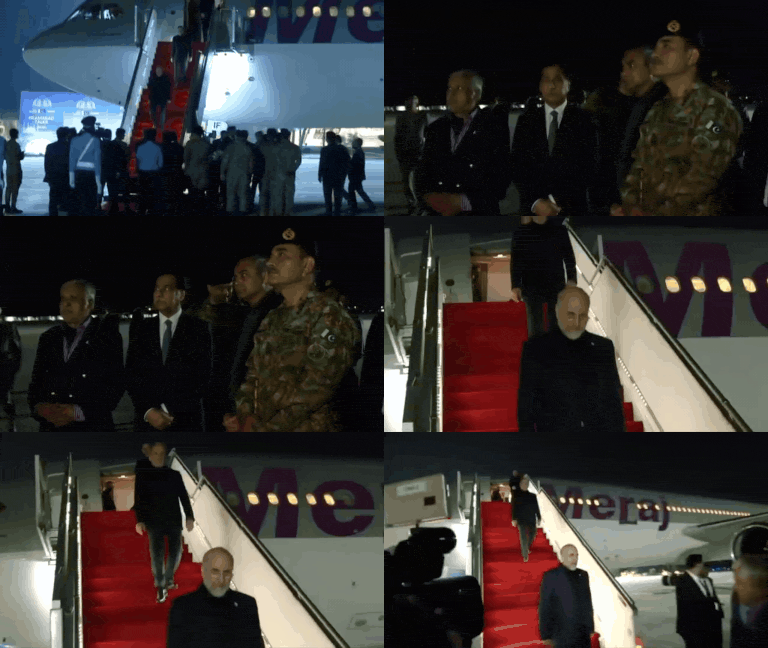
The arrival of an Iranian delegation in Islamabad this Saturday marks the most significant diplomatic opening since the start of the conflict on February 28. Led by Parliamentary Speaker Mohammad Bagher Ghalibaf and Foreign Minister Abbas Araghchi, the team landed in the Pakistani capital under a heavy security blanket to meet a high-level American contingent. U.S. Vice President JD Vance, accompanied by negotiators Steve Witkoff and Jared Kushner, represents a Washington administration testing whether a two-week ceasefire can be transformed into a durable settlement.
The stakes involve more than just a pause in aerial strikes. For the global economy, the immediate prize is the reopening of the Strait of Hormuz, a vital artery for 20% of the world’s oil supply. For Tehran, the mission is the recovery of frozen assets and a cessation of hostilities that have already claimed thousands of lives. However, the atmosphere in Islamabad is far from optimistic. If you liked this article, you should read: this related article.
Preconditions and the Lebanon Factor
Tehran has made its position clear even before the first formal handshake. Speaker Ghalibaf signaled that negotiations would remain stalled unless two specific conditions are met. First, the unfreezing of Iranian assets held abroad. Second, an immediate ceasefire in Lebanon.
The second demand proves the most volatile. While Washington and Tehran have agreed to a temporary bilateral pause, Israel continues its kinetic operations against Hezbollah targets. On Friday alone, Lebanese health officials reported hundreds of casualties from ongoing strikes. Iran views the American-Israeli military partnership as a single entity; if the U.S. cannot or will not restrain the Israeli air campaign in Lebanon, the Iranian delegation suggests the Islamabad talks may end before they truly begin. For another angle on this story, see the latest update from Al Jazeera.
Pakistan as the Pivot Point
Pakistan’s emergence as the primary mediator reflects a shift in regional power dynamics. Traditional intermediaries like Qatar and Oman have found themselves sidelined or compromised as the conflict expanded. Islamabad, however, maintains a delicate balance. It shares a border with Iran and a complex, decades-long security partnership with the United States.
Prime Minister Shehbaz Sharif and Army Chief Field Marshal Asim Munir have staked significant political capital on these talks. For Pakistan, the motivation is partly self-preservation. A full-scale regional war risks spilling across its western border, exacerbating its own internal economic and security challenges. By transforming Islamabad into a "Red Zone" of diplomacy—complete with shuttered schools, diverted traffic, and 10,000 security personnel—Pakistan is attempting to prove it is the only actor capable of hosting both sides without the room exploding.
The 10 Point Proposal and the Vance Doctrine
The basis for the discussion is a 10-point proposal submitted by Tehran. Key demands include:
- Total withdrawal of U.S. combat forces from regional bases.
- Iranian oversight and control of the Strait of Hormuz.
- Full compensation for war damages.
- A binding UN Security Council resolution to ratify any final agreement.
Vice President Vance has countered with a stance of "open hand but closed fist." Before boarding his flight, he warned that while Washington is ready to negotiate in good faith, it will not be "played." The American strategy appears focused on the immediate reopening of shipping lanes and a long-term guarantee against nuclear escalation, while the Iranian side remains laser-focused on economic relief and regional sovereignty.
The Shadow of Third Party Actors
Intelligence reports suggest the clock is ticking faster than the diplomats admit. Reports of impending Chinese weapon shipments to Iran, specifically advanced air defense systems, add a layer of urgency to the U.S. position. If the talks fail and Tehran bolsters its defensive capabilities with Chinese hardware, the military cost of resuming operations would skyrocket.
Meanwhile, Israel’s refusal to engage in the Lebanon ceasefire discussions creates a massive disconnect. The U.S. is negotiating a deal that its closest regional ally seems intent on ignoring. This creates a scenario where Vance might sign an agreement in Islamabad that is rendered moot by a single sortie over Beirut.
The city of Islamabad is quiet, its residents urged to stay indoors while the motorcades move through deserted streets. The silence in the capital reflects the global breath-holding. There is no middle ground left. Either these two delegations find a way to reconcile the 10-point proposal with the reality of the Vance doctrine, or the two-week ceasefire will go down in history as a mere refueling stop before a much larger fire.