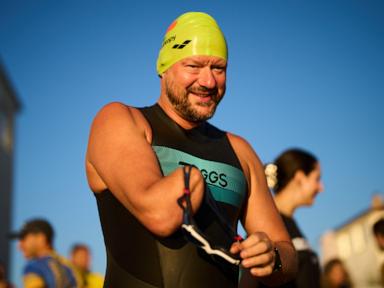
On the shores of a lake just outside Kyiv, beneath an overcast late-August sky, a group of men who have lost limbs to Russian artillery and landmines unstrapped their prosthetics, pulled on heavy rubber wetsuits, and prepared to close out a punishing 1,500-kilometer journey. This was the culmination of Iron Week, an extraordinary weeklong endurance circuit spanning swimming, cycling, and distance running across war-torn regions of Ukraine. Led by three-time Olympic triathlete Danylo Sapunov, the event coincided with the national commemoration of independence, offering a raw counter-narrative to standard geopolitical pageantry. Rather than functioning as a celebratory exhibition or a sanitized state-sponsored photo opportunity, the grueling contest exposed the physical grit, institutional gaps, and psychological survival mechanisms defining post-conflict rehabilitation in Eastern Europe today.
To understand the weight of these athletic trials, one must look past the superficial veneer of inspiration porn that global media outlets routinely project onto wounded soldiers. Amputee sports in an active war zone are not merely about triumph over adversity. They represent a desperate, self-directed reclamation of agency in a society where public infrastructure and medical systems remain stretched to their absolute breaking point. Meanwhile, you can find other developments here: Why the Eastern Pacific Strike Changes the Conversation on Naval Interceptions.
The Logistics Of Pain Behind The Iron Week Circuit
The numbers behind Iron Week defy standard athletic logic. Over seven consecutive days, participants navigated a punishing multi-discipline route through eastern and central sectors of the country, environments still shadowed by active air raids, infrastructure decay, and psychological trauma. Logistics required precise coordination among local volunteers, medical personnel, and sports clubs.
When participants transitioned from cycling and running to the open-water swimming finale at the Kyiv lake, the raw physical reality became impossible to ignore. Friends and handlers knelt in the mud to unbuckle carbon-fiber and titanium legs, hauling heavy carbon components onto the grass before carrying or assisting athletes into the chilly water. To understand the full picture, we recommend the excellent report by NBC News.
Yevhenii Lakhnenko, a forty-six-year-old serviceman who sustained devastating injuries resulting in the loss of his right arm and left leg, spoke candidly about the mechanics of his recovery.
"I am finishing my recovery and will get back in the ranks," Lakhnenko noted at the water's edge, embodying a mindset focused entirely on functional restitution rather than symbolic retirement.
His perspective highlights a crucial friction point within modern military sociology. While Western rehabilitation models often emphasize transition into civilian leisure, many Ukrainian combatants view physical conditioning as an intermediate step toward combat readiness or continued national defense service. The boundary between sport and survival blurs when the war is ongoing.
Adaptive Athletics As A Substitute For Failing State Infrastructure
The proliferation of high-intensity veteran athletic initiatives—ranging from Iron Week circuits to individual bids on the Bosphorus Strait and Everest Base Camp—reveals a structural vacuum. State-run medical bureaucracies, while scaling up prosthetic provisioning under immense financial strain, cannot match the rapid psychological rehabilitation achieved through community-led physical training.
In a hypothetical scenario, consider a soldier discharged after a double leg amputation who relies solely on clinical physical therapy within a traditional hospital setting. The clinical model addresses basic mobility, teaching the patient to walk short distances on mechanical legs within sterile corridors. Contrast that with the approach of Sapunov's training ecosystem, where veterans are immediately thrown into high-friction endurance cohorts, swimming alongside peers who share identical anatomical realities. The psychological yield of the latter approach is exponentially higher, yet it shifts the heavy burden of psychological healing onto civil society and private donations.
Maksym Yuzviak, a thirty-five-year-old former strike-drone operator who lost both legs, articulated this shift during the closing ceremonies.
"Independence is about the people," Yuzviak stated, cutting straight through official rhetoric. "People who are ready to take responsibility and who, as they say, are capable of taking action."
That emphasis on autonomous action exposes a quiet critique of international aid bottlenecks. Equipment delivery delays, bureaucratic red tape in procuring specialized athletic prosthetics, and uneven regional distribution of rehabilitation centers mean that injured personnel often have to drag themselves—literally and figuratively—back to active life through sheer willpower.
The Mental Toll Of Returning To A Society Remade By War
Athletic endurance events serve another critical function. They act as a public bridge in a country where the psychological chasm between active-duty troops, wounded veterans, and civilians who have managed to avoid direct frontline exposure threatens to widen over time.
When athletes like Yevhenii Lakhnenko or Oleksii Kozak plunge into open water without their assistive devices, they strip away the invisible armor that society constructs around disabled veterans. They refuse to be treated as passive objects of charity or tragic symbols of national suffering. By pushing their bodies past biological limits, they force observers to confront the physical cost of the conflict directly.
Yet, this hyper-focus on extreme resilience carries hidden risks. Industry analysts tracking post-war reintegration patterns point out a dangerous paradox. When society elevates extraordinary physical feats as the benchmark for successful recovery, it risks alienating the majority of veterans whose injuries or psychological trauma prevent them from completing triathlons or endurance swims.
Not every soldier can or wants to become an ironman. The vast majority require mundane, unglamorous accommodations: accessible housing, reliable psychological counseling, stable employment, and maintenance-free mechanical limbs that do not break down after a few weeks of heavy use. When media coverage hyper-focuses on the elite tier of amputee athletes conquering grueling 1,500-kilometer routes, the systemic struggles of the average wounded soldier risk slipping out of focus.
Navigating The Road Ahead For Wounded Warriors
The success of events like Iron Week demonstrates the indomitable spirit of individual participants, but it should not mask the heavy structural liabilities facing the country's medical ecosystem. Prosthetic technology evolves rapidly, yet the gap between high-end microprocessor knees available in research labs and the standard-issue mechanical components provided to rank-and-file soldiers remains wide.
Furthermore, the psychological toll of chronic pain management is an ongoing crisis. Endurance sports trigger massive endorphin releases and foster invaluable community solidarity, but they cannot replace clinical interventions for severe post-traumatic stress disorder. The athletes themselves are often the first to admit that the camaraderie of the training camp is a temporary sanctuary rather than a permanent cure for the invisible wounds carried from the trenches.
As the nation marks another year of hard-fought sovereignty, the image of veterans swimming across cold lakes and cycling across rugged terrain remains a powerful testament to human agency. It proves that physical boundaries can be redrawn through sheer grit. However, the true test of societal health will not be measured by how fast a handful of elite veterans can cross a finish line, but by how effectively the broader community supports every single individual who left a piece of their body on the battlefield. The race on the outskirts of Kyiv has ended, but the longer, quieter marathon of structural rebuilding continues across every town and city in the country.