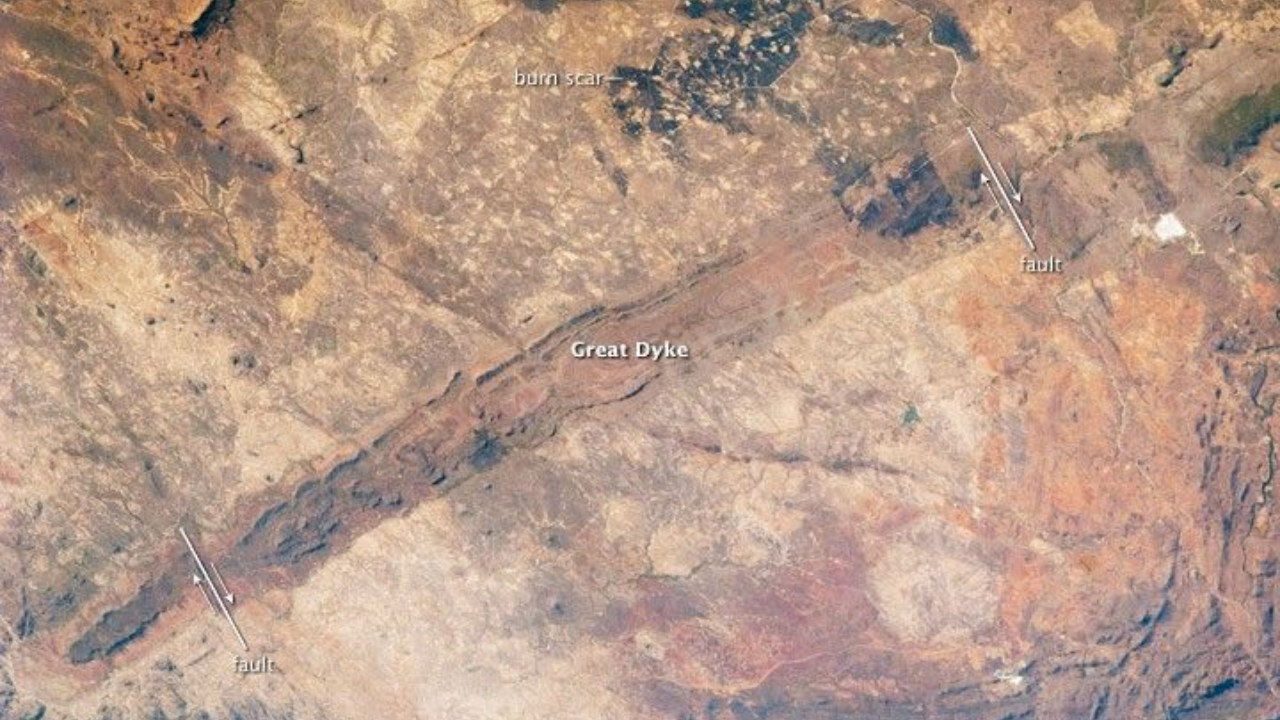
Dr. Farai Nyoni spent years walking the red, dusty earth of the Great Dyke. To a casual observer, this geological scar across Zimbabwe is just a ridge—a 340-mile-long stretch of mineral wealth that keeps the world’s catalytic converters and jewelry shops in business. But for scientists like Nyoni, the Dyke has always felt like a living thing. It hums with a history that predates the first lungfish, the first forest, and the first heartbeat.
For decades, we thought we knew the Dyke. We mapped its seams of platinum, its veins of chrome, and its jagged peaks. We treated it like a pantry. We took what we needed and assumed the shelves were shallow. We were wrong. NASA researchers, using gravity-sensing technology and subterranean imaging that peers through the crust like a medical X-ray, have just identified a massive, hidden structure cradled deep within the Dyke’s belly. It has been sitting there, silent and undisturbed, for 2.5 billion years. Learn more on a related topic: this related article.
The Ghost in the Machine
Think of the Earth's crust as a finished puzzle. We see the picture on top—the mountains, the oceans, the cities. But occasionally, we find a piece that was tucked underneath the cardboard long before the game even started. This hidden structure is that missing piece.
It isn't just a rock formation. It is a "progenitor" structure, a massive, dense anomaly that suggests the Great Dyke isn't just a surface feature caused by shifting plates. Instead, it appears to be the result of a violent, primordial surge from the Earth’s mantle that happened when the planet was barely middle-aged. At 2.5 billion years old, this structure dates back to the Neoarchean era. This was a time when the atmosphere was mostly methane and the first oxygen-producing bacteria were only just beginning to realize they could change the world. More journalism by Al Jazeera explores related views on this issue.
NASA’s discovery utilizes GRACE (Gravity Recovery and Climate Experiment) data and localized magnetic surveys. These tools don't look at what the ground is; they look at how much it weighs. Because this hidden mass is so much denser than the surrounding granite, it tugs at the equipment with a distinct, heavy signature. It is a gravitational thumbprint left by a ghost.
Why a Billion-Year-Old Rock Matters to Your Morning
It is easy to dismiss deep-time geology as something reserved for academics in dusty basements. But the Great Dyke is the backbone of the global economy in ways most people never realize. It contains one of the world's largest deposits of platinum-group metals (PGMs).
If you drove a car today, used a smartphone, or benefited from a hospital’s medical imaging, you interacted with the Dyke. These minerals are the unsung heroes of the modern age. They scrub toxins from exhaust, they conduct electricity in micro-circuitry, and they fuel the hydrogen cells that might just save our climate.
Finding a "hidden structure" at the root of this ridge changes the math. It suggests that the mineral wealth we’ve been mining is just the tip of a much deeper, more complex iceberg. If the Dyke was formed by a singular, massive magmatic event—guided by this hidden anchor—it means the distribution of resources isn't random. It’s an architectural plan. Understanding that plan means we stop guessing where the gold is and start knowing.
The Scale of the Invisible
To understand the scale of this, imagine a skyscraper. For a hundred years, we’ve been living in the penthouse, convinced that the floor beneath us is the bottom. NASA just pointed out that there are fifty basement levels we never knew existed.
This hidden structure is estimated to be dozens of miles deep. It acts as a sort of "plumbing system" for the Earth’s interior. Billions of years ago, the planet’s crust cracked open, and this heavy, metallic soup rose up from the depths. It hit this ancient, hidden barrier and was forced into the narrow, elongated shape we now call the Great Dyke.
Without this secret anchor, the minerals would have scattered. They would have been diluted into the vastness of the African plate, buried too deep or spread too thin to ever be reached. This structure is the reason Zimbabwe holds a literal fortune in its soil. It was a cosmic funnel, concentrating the riches of the deep Earth into a single, accessible line.
A Mirror to the Stars
There is a certain irony in NASA—an agency tasked with looking at the stars—finding the most important secrets beneath our boots. But the connection isn't as thin as it seems. By studying the Great Dyke’s hidden anatomy, scientists are learning how rocky planets form.
When we look at Mars or the moon, we see dead surfaces. We see the scars of ancient impacts and volcanic rifts. By mapping the interior of Zimbabwe’s Great Dyke, we are creating a blueprint for what to look for on other worlds. If we can understand how heavy metals settle into "plumbing systems" here, we know where to look for the resources needed to sustain a colony on the Red Planet.
The Dyke isn't just a mine. It’s a laboratory. It’s a time machine that takes us back to a period when the Earth was a hellscape of fire and cooling rock. Every piece of data pulled from that 2.5-billion-year-old mass is a page of the planet’s autobiography.
The Human Cost of the Deep Secret
Behind the satellite data and the gravitational maps are the people. In mining towns like Shurugwi and Zvishavane, the Great Dyke is more than a geological curiosity. It is the lifeblood of families. It is the reason schools are built and markets are filled.
The discovery of this hidden structure brings a mix of awe and anxiety. If the Dyke is deeper and more complex than we thought, the stakes for environmental stewardship and economic sovereignty become even higher. We aren't just managing a resource; we are the temporary guardians of a structure that was here long before us and will remain long after our cities are dust.
There is a humbling reality in realizing that our entire modern technological civilization—our 5G networks, our electric vehicles, our satellite constellations—is physically anchored to a subterranean "ghost" that formed when the Earth was still cooling.
A Quiet Persistence
We often think of discovery as a loud event. A flag planted on a peak. A rocket launch. But the most profound discoveries are often the ones that reveal what was always there, hiding in plain sight.
The Great Dyke has been waiting for us to develop the eyes to see it. We spent a century scratching at its skin, unaware that its heart was beating miles below the surface. Now, we know. The red dust of Zimbabwe isn't just dirt. It’s the shroud over a 2.5-billion-year-old masterpiece of planetary engineering.
We are finally starting to see the Earth for what it is: not a static rock, but a complex, layered story where the most important chapters are written in the densest, darkest places. As we move forward, fueled by the minerals pulled from this ancient spine, we carry a piece of the Neoarchean era with us. We are powered by the deep past, driving toward an uncertain future, held together by an iron spine we are only just beginning to understand.
Zimbabwe’s soil still holds its breath, guarding the rest of its secrets in the heavy silence of the deep.