Salt eats everything here. It crawls up the steel bulkheads in a crust of white crystals, strips the paint from the handrails, and tastes permanently on the back of the tongue.
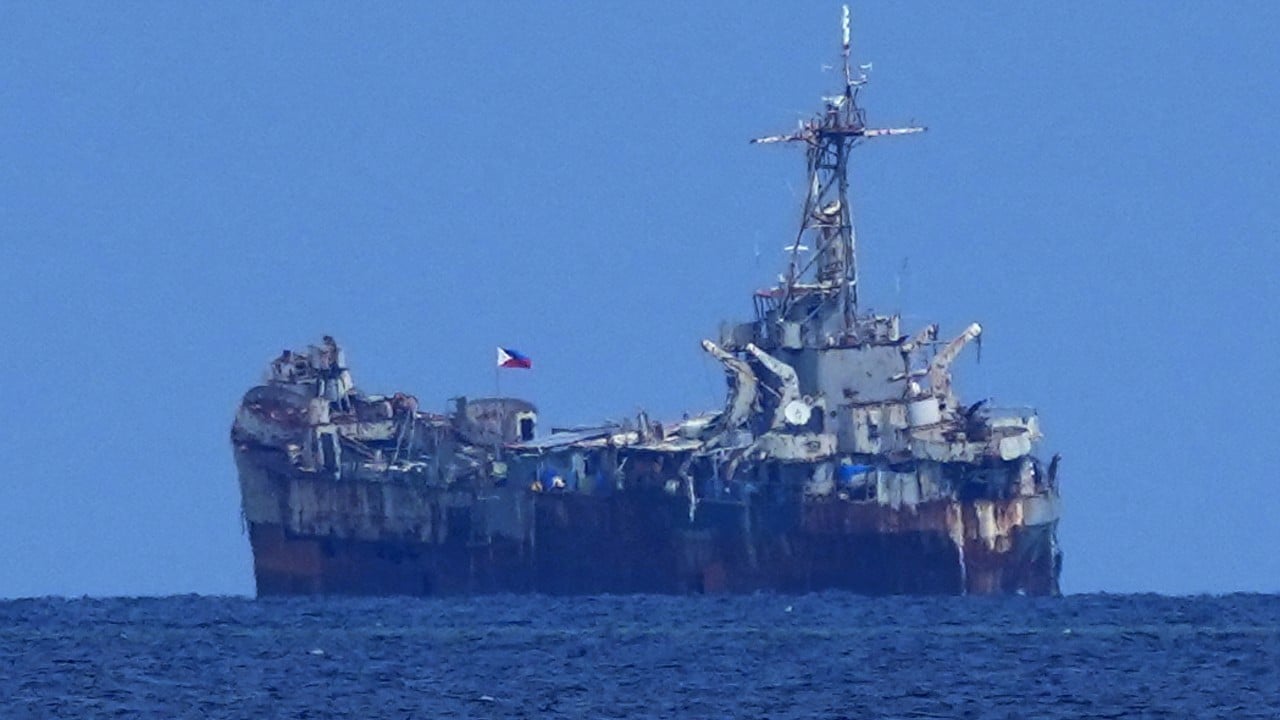
Imagine standing on a deck that feels less like a vessel and more like a cliff face suspended over a turquoise void. This is the BRP Sierra Madre, a World War II landing ship deliberately run aground on a patch of dead coral and shifting sand known as Second Thomas Shoal. It is a monument to stubbornness. Built in the United States, commissioned in 1944, it now serves as the most heavily contested scrap yard on Earth.
Inside its hollow belly, a small rotation of Philippine Marines lives in shadows. They sleep on camp cots, listen to the constant, rhythmic pounding of the South China Sea against the hull, and wait. They are stationed here not to conquer, but to occupy. Because under the strange geometry of modern geopolitics, a rusted hulk sitting on a submerged reef can prevent a superpower from claiming an entire maritime horizon.
To understand why embassies in Manila and Beijing trade blistering statements over a rusted shipwreck, you have to look past the cold vocabulary of territorial disputes and examine the friction of raw power. This is a story about lines drawn on water, and what happens when two unstoppable forces meet an immovable object that is literally rotting away.
The Architecture of Anticipation
In 1999, the Philippine Navy steered the Sierra Madre onto Ayungin Shoal, as the reef is known locally. The official line was mechanical failure. The unofficial reality was a calculated, desperate response to China’s creeping occupation of Mischief Reef a few years prior. Manila needed a permanent presence in the Spratly Islands, a sprawling archipelago rich in fish, oil, and strategic shipping lanes. They found their answer in a dying ship.
For a quarter of a century, the plan worked through sheer endurance. But time is an ally to entropy and an enemy to steel. The ship is disintegrating. Every monsoon season chips away at its structural integrity. The Philippine government faces a terrifying ticking clock: if the ship collapses into the sea, they lose their physical anchor on the shoal. If they try to reinforce it with heavy construction materials, Beijing cries foul, claiming it violates regional agreements.
Enter the white ships.
They belong to the China Coast Guard. Massive, heavily armed, and painted in a clean, intimidating snow-white, these vessels dwarf the wooden Philippine supply boats tasked with bringing fresh water, rations, and replacement personnel to the marines on the Sierra Madre.
Consider what a routine resupply mission looks like from the vantage point of a Filipino sailor. You are navigating a small, civilian-contracted boat across open water. Ahead of you looms a coast guard cutter three times your size. Suddenly, a wall of high-pressure water erupts from a deck cannon, smashing into your windshield, splintering wood, and sending crew members flying. Acoustic deterrent devices blast your ears. Dangerous blocking maneuvers force your rudder hard to port, threatening to capsize your craft in the middle of an open ocean.
This is not a war. Not yet. This is the gray zone. It is a terrifying space between peace and open conflict where nations test each other's pain thresholds with water cannons, lasers, and intimidation.
The Diplomatic Crossfire
When these clashes happen—when a hull cracks under a high-pressure stream or a sailor is blinded by a military-grade laser—the ripples travel instantly thousands of miles away to marble-columned embassies.
The exchange is predictable, ritualistic, and chillingly sharp.
In Manila, the Department of Foreign Affairs summons Chinese diplomats, handing over diplomatic protests that cite international law, the United Nations Convention on the Law of the Sea, and a landmark 2016 arbitral ruling that invalidated China's sweeping territorial claims in the region.
In Beijing, spokespersons turn the narrative on its head. They accuse the Philippines of trespassing, of illegally delivering construction materials to reinforce an illegal structure, and—most crucially—of acting as a proxy for outside powers.
That outside power is Washington.
The United States maintains a Mutual Defense Treaty with the Philippines, signed in 1951. Every time a Chinese coast guard ship rams a Philippine resupply boat, American officials issue sharp, unambiguous warnings. They declare that the mutual defense commitment extends to public vessels and armed forces anywhere in the South China Sea.
This creates a high-stakes geopolitical poker game. Beijing wants to push Manila off the shoal through attrition and exhaustion, betting that the United States will blink rather than risk a direct confrontation with a nuclear-armed rival. Washington wants to maintain deterrence, signaling that unilateral changes to international borders by force will trigger a cascading response.
Meanwhile, the marines on the Sierra Madre share a single can of sardines and watch the radar screens.
The Invisible Stakes
Why does a disputed patch of coral thousands of miles from the American mainland matter to a reader sitting in an office or a living room?
Because the South China Sea is the jugular vein of global commerce. Roughly one-third of all global shipping passes through these waters. Trillions of dollars in trade—from microchips and crude oil to consumer electronics and raw materials—traverse the very shipping lanes that Beijing claims as its historical domain.
If a single nation can rewrite the rules of maritime navigation through sheer intimidation at Second Thomas Shoal, the precedent echoes across the globe. It signals to smaller nations everywhere that international law belongs only to those with the largest navies. It turns the global commons into a medieval feudal estate where might makes right.
The dispute is also a crucible for the future of great power competition in the twenty-first century. It tests whether alliances like the US-Philippine partnership have teeth, or whether they are merely rhetorical flourishes designed to comfort allies while autocracies redraw the map piece by piece.
The Human Element in the Rust
Step back onto the deck of the Sierra Madre.
The sun is setting, painting the water in bruised shades of purple and gold. A young marine, no older than twenty-two, leans against a rusted winch. He is holding a cracked smartphone, trying desperately to catch a fading satellite signal to call his mother in Palawan. He hasn't seen her in six months. His skin is weathered by salt air; his uniform is stiff with dried spray.
He is not thinking about trade routes or the United Nations Convention on the Law of the Sea. He is thinking about whether tomorrow's supply boat will make it through the ring of white-hulled giants waiting beyond the reef. He is thinking about whether the hull beneath his combat boots will hold for another year, or if it will finally surrender to the sea, taking their fragile claim down into the dark water with it.
Out on the horizon, the silhouette of a Chinese cutter cuts a clean, modern line against the fading light. It does not fire its cannons tonight. It simply watches. A silent, unyielding presence waiting for the iron to give way.
The waves crash against the dead coral. The salt continues its slow, patient work of dissolution. And somewhere in the dark, the balance of the world hangs by a single, rusted thread.