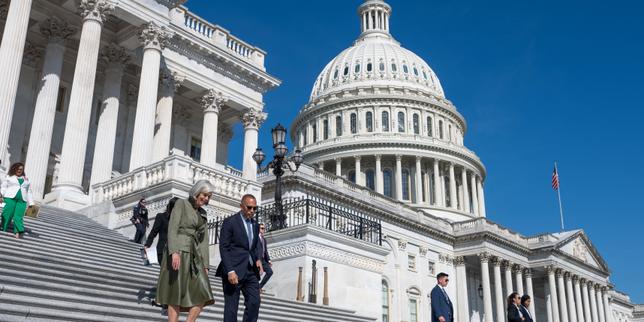
Power does not always announce itself with the roar of falling masonry or the sudden flash of a midnight raid. More often, it arrives in the quiet hum of a wood-paneled hearing room on Capitol Hill, carried on the rustle of heavy bond paper and the dry click of a ceremonial pen.
Consider what happens next when a vote is tallied three thousand miles away from the freezing banks of the Volga or the neon-lit trading desks of Moscow. A number changes on a ledger. A line is drawn across a digital manifest. And somewhere in a shipping yard, a crane stops swinging.
The United States Congress recently did what it has done with increasing frequency during moments of profound geopolitical fracture: it passed a sweeping new package of sanctions aimed squarely at Russia and its sprawling network of international allies. The headlines called it a legislative milestone. The analysts called it a tightening of the economic noose. But numbers on a ticker tape tell you nothing of the texture of the world they reshape. They tell you nothing of the quiet panic in a corporate compliance office in Frankfurt, or the sudden, cold realization of a supplier in Istanbul who thought their ledger books were safe from prying eyes.
To understand this new legislative salvo, one must abandon the comforting abstraction of maps and treaties. We must look at the human machinery of isolation.
For months, the architects of these restrictions watched a game of economic hide-and-seek. When primary channels freeze, water finds the cracks. Russian energy, high-grade metals, and dual-use microelectronics began flowing through circuitous detours—through ports in the Persian Gulf, through nominally neutral Central Asian republics, through front companies whose mailing addresses were little more than brass plates on doors in sun-drenched coastal havens. The new package is an attempt to nail down every loose floorboard in that global house.
Imagine a logistics coordinator sitting in a modest office in Almaty. For two years, his firm has brokered industrial machinery parts, moving them smoothly from European manufacturers to buyers in the Eurasian interior. He is not a warmonger. He has never fired a rifle, nor has he ever stepped foot inside a legislative chamber in Washington. He is simply a man who understands shipping lanes and customs declarations.
Yet, on a Tuesday morning in late autumn, an email arrives from his primary banking partner in Vienna. The account is frozen. No explanation is offered beyond a terse reference to secondary compliance protocols and the newly minted statutes signed into law overseas. His business, built over a decade of careful relationship-building, evaporates in the space of a single keystroke.
This is the invisible architecture of modern statecraft. It is fought not with infantry divisions, but with compliance software, jurisdictional reach, and the sheer gravitational pull of the American financial system.
When Congress acts with this kind of bipartisan unanimity—a rare alignment in an era of deep legislative paralysis—it signals a grim consensus. The political class has decided that the cost of inaction outweighs the collateral damage of economic disruption. Lawmakers look at the protracted conflict in Eastern Europe not as a distant regional dispute, but as a stress test for the entire postwar international order. If borders can be redrawn by force with impunity, the reasoning goes, then the global economy itself becomes a weapon pointed at every small nation that relies on sovereign stability.
Critics, of course, point to the law of unintended consequences. They argue that tightening the screws too fast risks splintering the global trading system entirely, driving rival powers to construct parallel financial rails that bypass Western oversight altogether. They whisper of a future where the dollar loses its primacy not through a sudden crash, but through a slow, quiet erosion, as nations weary of extraterritorial edicts seek shelter in alternative currencies and sovereign payment networks.
It is a valid fear. Every action has an equal and opposite reaction in the physics of global commerce. When you lock a door, you incentivize the invention of a better crowbar.
Yet the legislative authors of these measures operate with a different calculus. They are betting on the sheer inertia of the existing system. For all the talk of de-dollarization and alternative trade blocs, shifting the weight of global finance is like trying to turn an aircraft carrier in a bathtub. It takes time, immense capital, and a level of mutual trust among rival authoritarian states that rarely exists outside of temporary conveniences.
So the sanctions cascade downward. They target not just the primary architects of state policy, but the enablers—the maritime insurers who look the other way when a tanker turns off its transponder in the middle of the Black Sea, the shell-company directors who lend their names to anonymous balance sheets, the financial institutions that permit the laundering of petrodollars through opaque jurisdictions.
The human element remains buried beneath layers of legal terminology and trade statistics, but it pulses beneath every clause.
In a quiet suburb outside St. Petersburg, a biomedical researcher looks at a shipment of specialized laboratory reagents that has been stuck in customs limbo for three weeks. Her work on rare pediatric cancers depends on these specific enzymes, manufactured by a firm in Massachusetts. The politics of empires have never interested her; she wanted only to cure children. Now, her laboratory is dark, her equipment silent, her life's work paused because a legislature thousands of miles away drew a sharp, unyielding line through the map of human exchange.
This is the tragic symmetry of our era. The pursuit of geopolitical justice is rarely clean. It does not separate the guilty from the innocent with surgical precision; it falls like a heavy iron curtain, dimming the lights on the just and the unjust alike.
As these new measures take effect, the true test will not be found in the immediate drop in quarterly export figures or the celebratory press releases issued from Capitol Hill. It will be found in the long, grinding war of economic attrition. It will be measured by whether the targeted regime finds new reserves of resilience or whether the internal strain of isolation finally forces a fundamental reassessment of imperial ambition.
We are living through the rewriting of the rules that govern how humanity trades, communicates, and confronts power. The parchment is dry, the legislative language is dense, and the process is profoundly bureaucratic. But the outcome echoes across kitchen tables, empty laboratories, and silent shipping yards across the globe.
The pen scratches across the paper. The ink dries. And the world tilts just a fraction of a degree on its axis.