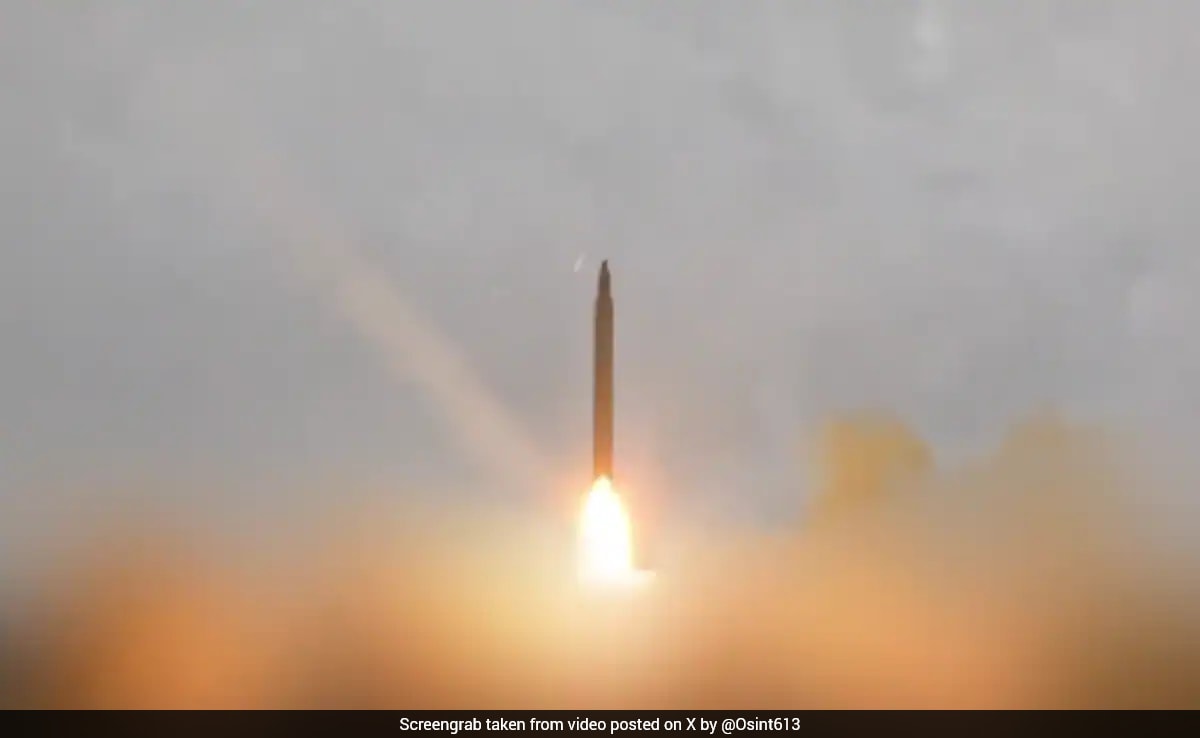
Iran just changed the math of aerial warfare. If you’ve been following the grainy footage coming out of the latest escalations, you probably saw something that looked like a glitch. A missile wasn't flying in a predictable arc. It was twitching, veering, and literally "dancing" through the sky. This isn't a mechanical failure. It’s a deliberate, high-tech nightmare for air defense systems that were built to hit targets moving in straight lines.
Military analysts are calling it the "dancing missile," but its technical reality is far more sobering. This is the first time we’ve seen this specific maneuverability used in active combat during this war. It marks a shift from "saturation" tactics—where you just fire a bunch of cheap drones and hope some get through—to "sophistication" tactics, where a single projectile can outthink a multi-million dollar interceptor.
The End of Predictable Ballistics
For decades, shooting down a missile was basically a high-speed game of geometry. If a missile launched from Point A toward Point B, an algorithm could calculate its trajectory in seconds. You fire an interceptor to meet it at the predicted "X" in the sky. Boom. Threat neutralized.
The dancing missile kills that logic. By using maneuverable re-entry vehicles (MaRVs) or side-thrust motors, the projectile changes its path mid-flight. It might shimmy left, then dive right, then pull an upward corkscrew. To a Patriot missile battery or an Iron Dome interceptor, this looks like a target that’s defying the laws of physics.
The Iranian military isn't just showing off. They're proving that they can penetrate some of the most advanced "bubble" defenses on the planet. When a missile dances, the interceptor has to constantly recalculate. Often, the interceptor runs out of fuel or kinetic energy trying to keep up with the erratic shifts. It’s a literal dance of death where the defender is always a step behind.
Why This Timing Matters
You have to look at the broader context of the current regional war to understand why Iran pulled this card now. Up until this point, we’ve seen a lot of quantity. Thousands of one-way attack drones. Older Katyusha rockets. Standard ballistic missiles. Most of those get swatted away by integrated defense networks.
By deploying a maneuvering missile now, Tehran is sending a loud message to its adversaries. It's saying, "We can hit your high-value targets whenever we want, and your expensive shields won't stop us." This isn't about hitting a random field. This is about precision strikes on airbases, command centers, and infrastructure that were previously thought to be "untouchable" due to heavy anti-missile coverage.
Breaking Down the Technology
We aren't just talking about a rocket with big fins. To make a missile "dance" at hypersonic or high-supersonic speeds, you need incredible heat shielding and onboard processing power.
The Vectoring Edge
Most of these weapons use thrust vector control. Instead of just pushing the missile forward, the engine nozzle pivots. This allows the missile to change direction even in the thin upper atmosphere where traditional fins don't have enough air to "grip."
Onboard Intelligence
The missile needs to know it’s being hunted. Modern versions carry sensors that detect incoming interceptor radar. When the missile "feels" a lock-on, it triggers a pre-programmed or autonomous evasive maneuver. It’s basically electronic warfare merged with kinetic power.
What This Means for Global Air Defense
The debut of this tech in a real war zone is a wake-up call for every defense department from Washington to Tel Aviv. If the "dancing" trend continues, the current generation of interceptors becomes obsolete overnight.
We’re likely going to see a massive shift toward directed-energy weapons—lasers. A laser moves at the speed of light. It doesn't care if a missile shimmies or shakes because there's no "travel time" to calculate. But laser tech isn't ready for prime time yet on a mass scale. For now, the advantage has swung back to the attacker.
The Strategy of Unpredictability
Honestly, the psychological impact is just as heavy as the physical damage. Imagine being an operator in a radar room. You see a dot. You fire. Usually, you see two dots merge and disappear. Now, you see the dot jump. You see your interceptor sail right past it into empty space.
That creates a sense of helplessness. It forces the defender to fire two, three, or four interceptors at a single target just to increase the statistical odds of a hit. That’s a losing game. You'll run out of $4 million interceptors long before they run out of "dancing" missiles.
How to Track the Next Escalation
Watch for the terminology used in official briefings. If you start hearing phrases like "terminal phase maneuvering" or "unpredictable flight paths," you know another one of these has been used. The footage usually tells the story—look for smoke trails that aren't straight.
If you're tracking this conflict, keep an eye on how defense contractors react. We’re about to see a gold rush for "counter-maneuver" tech. This is the new arms race. It’s not about who has the biggest bomb anymore. It’s about who has the most erratic one.
The move by Iran to field this tech now suggests they’re confident in their production lines. This wasn't a one-off prototype test. This was a combat debut. The era of the "predictable" battlefield is over. Get used to the dance. It’s going to be a long one.