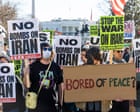
The headlines are screaming about protests in major U.S. cities, supposedly sparked by Iran’s latest strikes and the unverified reports of Supreme Leader Ali Khamenei’s demise. News anchors are breathless, framing this as a spontaneous eruption of civic engagement. They want you to believe that thousands of people suddenly took to the streets because they are deeply connected to the nuances of Tehran’s succession crisis.
They are lying to you.
What you are witnessing is not grassroots fervor. It is a orchestrated theatre of optics designed to mask the terminal decay of current diplomatic containment strategies. By obsessing over the protests, the media successfully redirects your gaze away from the absolute failure of the intelligence apparatus that allowed this escalation to reach a breaking point in the first place.
The Myth Of Spontaneous Outrage
The narrative insists that these protests are a natural reaction to international violence. Let’s apply some critical pressure to that premise.
When you see thousands of protesters suddenly materialized, fully formed with signage, chants, and coordination, you aren’t looking at a organic movement. You are looking at professionalized mobilization. Political scientists often distinguish between "authentic agitation" and "manufactured unrest." True organic movements have a messy, chaotic, and incoherent beginning. They lack branding. They lack symmetry.
What we see now is the digital age version of the Cold War proxy battle—only this time, the proxy isn't a jungle in Vietnam; it's the streets of New York, DC, and Los Angeles. Special interest groups and state-aligned actors understand that controlling the domestic narrative within the United States is more effective than controlling the physical territory in the Middle East. If you can paralyze the American executive branch with domestic noise, you neutralize its ability to act decisively abroad.
Why The Khamenei Story Is A Red Herring
The reports regarding Khamenei’s death are perfect fodder for the machine. It is a vacuum of information. No one—not the Pentagon, not the CIA, and certainly not the local news desk—has definitive confirmation.
But why does the truth of his death even matter to the average protester? It doesn't. The ambiguity is the feature, not the bug. In information warfare, the "fact" matters less than the "feeling." By keeping the world in a state of suspended uncertainty, bad actors can manufacture consent for whatever policy outcome they desire.
Imagine a scenario where the U.S. administration must decide between full-scale intervention or a tactical retreat. If the streets are full of people screaming for "action" based on unverified reports, the decision-making process is no longer guided by national interest or strategic calculation. It is guided by the fear of looking weak on CNN. Policy becomes a hostage of the trending topic.
The Institutional Failure Of Intelligence
I have spent years analyzing how government agencies track civil unrest. The incompetence on display regarding the current geopolitical instability is staggering.
The standard operating procedure for the intelligence community is to treat geopolitical events as linear progressions. A leads to B, which causes C. But reality in the Middle East is non-linear. The Iranian regime’s stability has always been built on a precarious balance of hardline military power and domestic repression. If the U.S. intelligence apparatus truly understood the fragility of that regime, they wouldn't be surprised by the protests. They would have anticipated them.
Instead, we are treated to the spectacle of "intelligence failures." We saw it with the fall of the Shah in 1979, and we see it now. The reality is that analysts are trapped in a feedback loop where they only see what their own models tell them to expect. When the world diverges from the model, they call it a "Black Swan event" to save their careers.
The Cost Of Obsessing Over Optics
Every hour a major network spends covering a protest in Times Square is an hour they are not covering the structural collapse of international trade routes, the weaponization of energy supplies, or the bankruptcy of current sanctions regimes.
Sanctions, in their current form, are a paper tiger. They punish the population while failing to impact the decision-makers who actually matter. Yet, we never hear this debated on the news. Why? Because the policy of "maximum pressure" is the only tool we have in the toolbox, and admitting it doesn't work would mean admitting we have no plan.
The protesters are being used as a human shield for these failed policies. If you criticize the current administration's handling of the Iran situation, you are attacked for not supporting the protesters. If you question the validity of the protest narratives, you are branded a contrarian or a sympathizer. It is a closed system designed to keep you in the dark.
The Real Power Shift
True power in this conflict isn't found on the streets of D.C. or in the offices of Tehran. It is found in the logistical chains that keep the modern world functioning.
The Iranian regime, regardless of who sits at the top, has spent decades diversifying its alliances, moving away from reliance on Western markets and toward an integrated bloc of non-aligned economies. This is the strategic shift that should be dominating the headlines. Instead, we are fixated on the theater of the absurd—the protests, the rumors, and the petty squabbles of diplomatic rhetoric.
If you want to understand what is happening, stop watching the news. Start tracking the movement of oil tankers. Watch the currency exchanges in non-Western hubs. Observe how the supply chains for dual-use technologies are being re-routed.
The protest movement is a sideshow. It is a distraction intended to keep the Western public distracted while the architecture of the post-WWII world is dismantled in real-time. By the time the dust settles and the real changes become undeniable, it will be too late to have a debate about them. The policy will be written. The resources will be committed. And you will be left wondering how you missed the shift while you were busy watching the noise.
Stop looking at the protest signs. Start looking at the balance sheets. The truth is never printed on a placard.