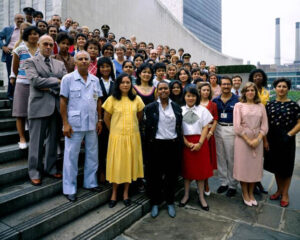
Glass gleams under the midday sun. Inside the halls of power, diplomats adjust their ties, translators whisper softly into headsets, and documents pass from hand to hand with quiet efficiency. To an observer standing behind the velvet ropes, this space represents the pinnacle of global cooperation. It looks orderly. It looks neutral.
Yet, machinery is only as sound as the elements that forge it. You might also find this similar article interesting: Why the Mecca Pact Leaves Pakistan and Turkey Trapped in Yemen.
Every institution carries an invisible climate—an unwritten set of rules about who belongs in the room and whose voice echoes down the corridor. For decades, international organizations have projected an image of absolute equity. After all, the charter speaks of universal rights and the dignity of every person. But ideals written on parchment do not automatically translate into the daily lived reality of a hallway conversation, a promotion committee, or a routine staff meeting.
Consider a hypothetical staff member—let us call her Amina. She arrives at her desk each morning carrying a wealth of experience, fluency in multiple languages, and a deep dedication to global public service. Yet, over months and years, she notices subtle patterns. Her proposals are often reframed by others. Her name is frequently omitted from key email chains. When she speaks up about institutional bias, she is advised to be patient, told that change takes time. As extensively documented in latest coverage by The Guardian, the results are worth noting.
Patience is a thin shield against systemic exclusion.
When bias hides in the fine print of organizational culture, standard observation fails to catch it. It operates in whispers, micro-exclusions, and the quiet steering of career trajectories based on unspoken comfort levels rather than merit. This is why the United Nations has taken a significant, necessary step inward.
A comprehensive survey is rolling out across the Secretariat. Its purpose is neither routine nor administrative; it is an effort to measure the unmeasurable. By tracking the direct experiences of personnel regarding racism, racial discrimination, and xenophobia, the administration aims to drag hidden inequities into the light.
Data strips away denial.
In any large bureaucratic structure, leadership often relies on comfort. If senior leaders do not experience exclusion, it is entirely too easy to assume that exclusion does not exist. A structured, anonymous assessment punctures that insulating bubble. It asks the difficult questions. Where do people feel undervalued? Which departments show patterns of stagnation for non-dominant groups? How often do subtle prejudices dictate who climbs the ladder?
Skepticism naturally follows announcements of internal reviews. Critics often ask whether surveys alone can alter entrenched institutional habits. Paper cannot force a shift in mindset. A questionnaire cannot rewrite decades of unconscious conditioning overnight.
Those doubts are valid. They remind us that gathering statistics is merely the diagnosis, not the cure.
Yet, healing cannot begin without an accurate diagnosis. For an organization dedicated to mediating global conflicts, confronting its internal dynamics requires courage. It means acknowledging that international diplomacy is practiced by human beings who bring their flaws, cultural blind spots, and historical biases into the workplace.
The process ahead will be uncomfortable. Numbers will reveal uncomfortable truths. Testimonies will challenge comfortable narratives of universal harmony. But within that discomfort lies the possibility of genuine transformation.
True equity is not achieved by proclamations carved in stone. It is built through the daily, tedious, and sometimes painful labor of listening to those who have long stood at the margins. When the results of this survey are tabulated, the real work begins: dismantling the invisible barriers that decide who gets to shape the future and who is merely expected to watch from the sidelines.