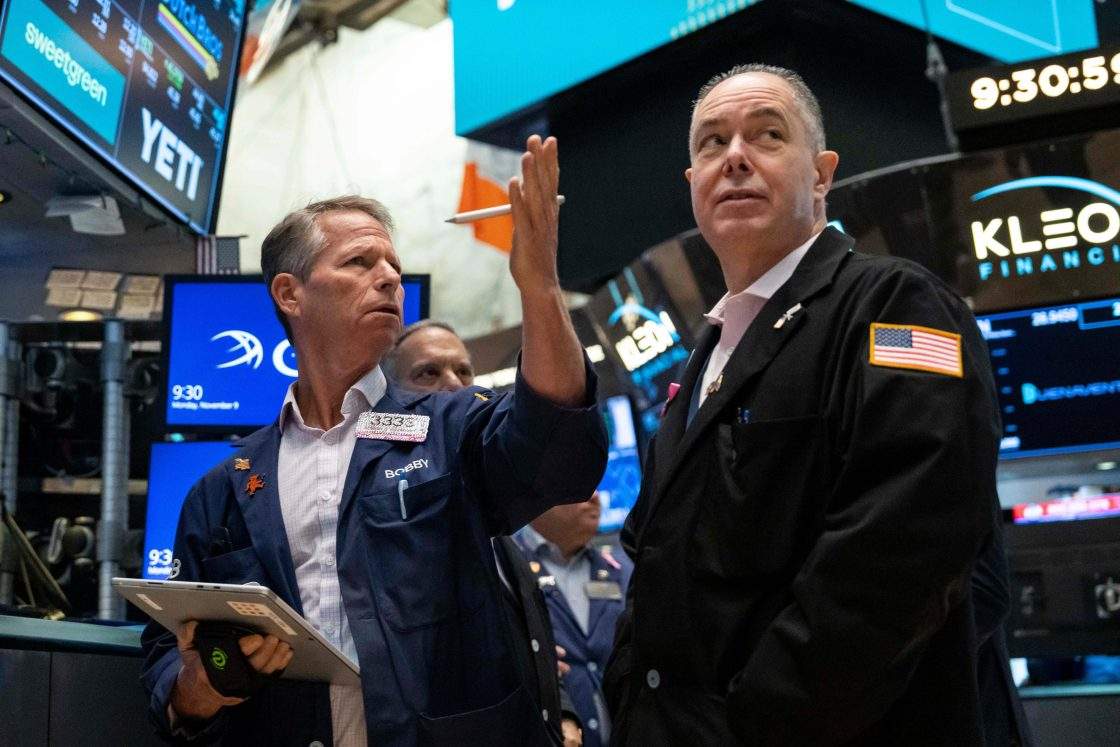
At 8:29 in the morning, the trading floors in lower Manhattan go dead quiet. You can hear the low hum of the fluorescent lights and the faint, nervous tapping of a thousand polished shoes against carpeted floors. Every eye is locked onto a blinking green cursor on a terminal screen.
At 8:30, the Bureau of Labor Statistics drops a single spreadsheet into the digital ether.
One number. Two decimal places. And in less than four hundred milliseconds, trillions of dollars in global wealth violently rearrange themselves.
When a "red hot" U.S. inflation reading hits the wire, the financial press immediately reaches for its favorite metaphors. Markets tumble. Bond yields spike. Rate cut hopes evaporate. To the average person drinking burnt coffee at their kitchen table two thousand miles away, this sounds like high-stakes theater performed by men in Patagonia vests. It feels distant, abstract, and frankly, a little boring.
Until you walk into the grocery store at 5:15 PM.
That spreadsheet dropped at 8:30 AM isn't just a scorecard for Wall Street algorithms. It is a quiet, relentless thief that just slipped into your kitchen, opened your pantry, and decided that your next five years are going to cost significantly more than you planned.
The Anatomy of a Two-Tenths Surprise
To understand why a fraction of a percentage point on a government report causes pension fund managers to sweat through their dress shirts, we have to look at what inflation actually is. Economists love to talk about the Consumer Price Index—a theoretical basket of goods meant to represent what the average urban household buys. Gasoline, eggs, rent, dental visits, a pair of running shoes.
When the report comes back "red hot," it means the price of that basket didn't just rise; it accelerated faster than the smartest minds on earth predicted. Maybe the consensus expected a 0.2% monthly increase, and the number came in at 0.4%.
Two-tenths of a percent. It sounds like lint in your pocket.
Compound that lint over twelve months, however, and you are looking at an annualized inflation rate creeping back toward four or five percent—more than double the Federal Reserve’s sacred two percent target.
Consider a hypothetical family living just outside Columbus, Ohio. Let’s call them Marcus and Elena. Marcus works as a logistics coordinator; Elena is a physical therapist. Together, they bring home a solid, middle-class income. They don't own a single share of individual tech stocks, and they couldn't care less about the yield curve on the ten-year Treasury note.
Yet, the moment that 8:30 AM inflation report flashes red, Marcus and Elena’s lives change.
They have been saving for eighteen months to replace their aging minivan and finally finish their basement so their two kids have a place to play during the brutal Ohio winters. They were waiting for mortgage rates and auto loan rates to drift downward, just like the television pundits promised they would six months ago.
Instead, that hot inflation print forces the central bank’s hand. The Federal Reserve has only one real tool to cool down an overheating economy, and it is a blunt instrument. They raise interest rates, or they keep them painfully high for much longer than anyone wants.
The Heavy Hand of the Central Bank
Think of the American economy as a massive, roaring freight train hurtling down a mountain pass. Inflation is the speed of that train. If it goes too fast, the wheels heat up, the tracks warp, and the whole thing flies off the cliffs into a catastrophic depression.
Federal Reserve Chair Jerome Powell and his colleagues are sitting in the locomotive with their hands on the brake lever. Interest rates are the brakes.
When they pull that lever—pushing the federal funds rate up—friction enters the system. Borrowing money becomes expensive. A business owner in Texas decides not to build that second warehouse because the bank wants nine percent interest on the loan. A young couple in Seattle puts their house hunt on pause because a seven percent mortgage turns a modest starter home into a financial anchor.
The goal is simple, even if the execution is agonizing: slow down spending so businesses stop raising prices.
I remember sitting in a small, crowded diner in 2022, watching an elderly man stare at a menu for ten full minutes. He wasn't confused by the choices. He was doing the math in his head, trying to figure out if ordering the side of bacon meant he had to skip buying his favorite brand of coffee at the supermarket down the street. You could see the quiet calculation of dignity happening behind his eyes. That is what inflation feels like on the ground. It isn't a chart. It is a series of tiny, exhausting compromises made in fluorescent-lit aisles.
When the latest data shows that prices are still stubbornly climbing—driven by sticky costs like auto insurance, rent, and medical care—the Fed cannot take its foot off the brake. In fact, they have to press harder.
And this is where the market panic begins.
Why Wall Street Speaks in Backward Tongues
If you watch financial news on a day when inflation runs hot, you will witness a bizarre phenomenon. Good news about the economy suddenly becomes terrible news for the stock market.
A report comes out showing that American companies hired 300,000 new workers last month and wages grew by four percent. Normally, you would throw a parade. People have jobs! People are getting raises!
Instead, the Dow Jones Industrial Average plunges six hundred points.
Why? Because Wall Street isn't trading on today; it is trading on six months from now. Traders look at strong hiring and rising wages and see fuel for the inflation fire. They realize that if workers have more money to spend, companies will keep hiking prices. And if companies keep hiking prices, the Federal Reserve will keep interest rates elevated, starving the stock market of cheap money.
It is a classic tug-of-war between the real economy and the financial markets.
When interest rates stay high, bonds—those boring, reliable IOUs issued by the U.S. government—suddenly start paying attractive, risk-free returns. If an investor can get five percent guaranteed from Uncle Sam without lifting a finger, why would they gamble their money on a volatile tech stock or a struggling retail chain? They wouldn't. So they sell their stocks, buy bonds, and the market drops.
For Marcus and Elena back in Ohio, this abstract tug-of-war has immediate, physical consequences. Because Treasury yields jumped at 8:31 AM, the local credit union updates its rate sheet by noon. The auto loan they were eyeing just jumped from 6.5% to 7.8%. Over five years, that invisible shift steals nearly two thousand dollars straight out of their checking account.
The basement renovation goes back into a drawer.
The Trap of "Sticky" Prices
There is a dangerous misconception that once inflation comes down, prices will go back to where they were in 2019.
Let’s be brutally honest: they won't.
When economists celebrate that inflation has dropped from nine percent to three percent, they are simply saying that prices are rising more slowly. A gallon of milk that cost three dollars a few years ago and now costs four dollars isn't going back to three. It is just going to cost four dollars and twelve cents next year instead of four dollars and forty cents. For prices to actually fall across the board, we would need deflation—a terrifying economic spiral usually accompanied by mass unemployment and shuttered factories. Nobody wants that cure.
What makes the current wave of inflation so maddening is where it is hiding.
During the initial supply chain shocks a few years ago, inflation was loud and obvious. Used cars cost more than new ones. Lumber prices tripled overnight. Shipping containers piled up outside California ports like brightly colored Lego bricks. Those problems were mechanical, and eventually, the global economy untangled them.
Today’s inflation is quieter, deeper, and far harder to eradicate. Economists call it "services inflation," and it is deeply tied to human labor and essential survival.
You can delay buying a new television when prices spike. You cannot delay paying your rent. You cannot negotiate with your electric utility. You cannot easily opt out of car insurance when the state requires it by law, even if your premium jumped twenty-two percent this year because modern bumpers are packed with expensive sensors and mechanics charge twice what they used to.
This is why the Federal Reserve looks so rattled when the numbers tick upward. Raising interest rates makes it harder to buy a house or a tractor, which cools down the goods economy. Raising interest rates does almost nothing to lower the cost of a hospital stay, a haircut, or a landlord's property tax bill.
The central bank is trying to perform brain surgery with a sledgehammer, and everyone in the operating room is holding their breath.
The Psychological Toll of the Drift
We rarely talk about the emotional exhaustion of prolonged inflation, yet it is the most potent force in modern politics and personal finance.
Money is supposed to be a measuring stick. An inch is always an inch. A pound is always a pound. When you work an hour, you trade a piece of your finite life for a certificate that represents a predictable amount of future security.
Inflation warps the ruler.
When the dollar loses purchasing power faster than your paycheck grows, you experience a subtle, creeping vertigo. You are running faster on the treadmill, sweating harder, optimizing your budget, clipping digital coupons, and cancelling streaming subscriptions—yet you are drifting backward toward the edge.
Historical patterns show us that when this drift lasts too long, human behavior shifts in dangerous ways. During the great inflation of the 1970s, Americans stopped saving altogether. Why put money in a bank account earning five percent when prices were rising at eleven percent? You were guaranteed to lose half your purchasing power in a decade. Instead, people rushed out to buy things—houses, gold, art, durable goods—anything that held physical value, which ironically poured even more gasoline on the inflationary fire.
We are not in the 1970s. Our banking system is different, our energy production is vastly stronger, and our central bank is far more aggressive.
Still, the psychological scar tissue is forming. Young adults entering the workforce today look at the price of a modest home and a tank of gas with a mixture of cynicism and quiet despair. When the headlines scream that inflation is heating up again, it confirms their darkest suspicion: the ladder is being pulled up while they are still reaching for the first rung.
Navigating the Storm Without Losing Your Mind
So, what do you actually do when the economy refuses to cool down and interest rates refuse to budge? You cannot control the Bureau of Labor Statistics, and you do not have a seat at the Federal Reserve’s mahogany table.
You have to stop playing the market’s game and start fortifying your own house.
First, recognize that high interest rates are a double-edged sword. Yes, borrowing money is painful right now. Carrying a balance on a credit card at twenty-four percent interest is no longer a minor financial mistake; it is an emergency. Aggressively eliminating variable-rate debt is the single highest-return investment available to any human being right now.
At the same time, look at the other side of that sword. For the first time in nearly twenty years, savers are actually being rewarded for their patience. Leaving your emergency fund sitting in a traditional big-bank checking account earning 0.01% interest while inflation runs at three or four percent is voluntarily setting your money on fire. High-yield savings accounts, money market funds, and short-term Treasury bills are paying real, tangible yields. Make the central bank's harsh medicine work in your favor.
Second, audit your fixed costs with ruthless clarity. Because services inflation is the main culprit right now, your biggest leaks aren't your morning lattes; they are your recurring bills. Shop your auto and homeowners insurance every single year. Loyalty to an insurance carrier in an inflationary environment is simply a tax on your own inertia.
Finally, resist the urge to panic-trade your retirement accounts based on an 8:30 AM news alert. The stock market is a manic-depressive machine in the short term, reacting violently to every decimal point and central bank whisper. Over decades, however, great businesses have a remarkable ability to adapt, raise their own prices, and outpace inflation. Trying to time the market around monthly economic reports is a fool's errand designed to enrich brokers and impoverish amateurs.
The Quiet Evening
By 4:00 PM in New York, the closing bell rings. The red numbers on the trading screens freeze in place. Pundits on television immediately begin drafting their narratives for tomorrow morning, dissecting every syllable of the latest economic release to predict what happens next month, next quarter, next year.
Five hundred miles west, Marcus pulls his aging minivan into the driveway.
He sits in the driver's seat for a moment after turning off the ignition, listening to the engine tick as it cools down. Inside the house, the kitchen light is warm and yellow against the gathering dusk. Elena is chopping vegetables at the counter; the kids are arguing over a board game in the living room.
Marcus pulls his phone from his pocket, glances at a news alert about surging bond yields and stubborn consumer prices, and locks the screen. He doesn't have a degree in macroeconomics. He can't explain the mechanics of quantitative tightening or the nuances of the core personal consumption expenditures index.
He just knows that tomorrow morning, he’s going to call the credit union, cancel the loan inquiry, and spend his Saturday morning watching YouTube tutorials on how to frame a basement wall himself.
The markets will keep screaming about the numbers. The economists will keep adjusting their models. And millions of ordinary people will quietly roll up their sleeves, adjust their budgets by two-tenths of a percent, and figure out how to build a life inside the margins.