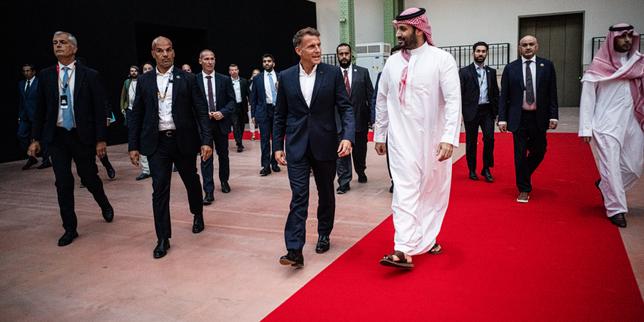
The room in Évian-les-Bains smells faintly of historic lakeside air, expensive cologne, and the crushing weight of global economic policy. World leaders are settling into their chairs for the G7 summit. There are briefings to memorize, shifting alliances to navigate, and a brutal itinerary that stretches deep into the night. It is a grueling test of endurance.
Then comes the question. It does not concern international trade or maritime security routes. It is a casual, hushed inquiry from German Chancellor Friedrich Merz, directed at Italian Prime Minister Giorgia Meloni.
"Did you have a cigarette this morning?"
Meloni looks up. The answer she gives is captured by a live microphone, a brief slice of raw humanity cutting through the thick layer of statecraft.
"No," she says. "Since the first of May."
A ripple of genuine, unscripted celebration breaks out among the nearby heads of state. British Prime Minister Keir Starmer and European Commission President Ursula von der Leyen offer enthusiastic congratulations. Canadian Prime Minister Mark Carney instantly reacts with a physical gesture, grabbing his own forearm in a universal sign language recognizable to millions of people worldwide.
"Do you have a patch?" Carney asks.
Meloni raises her hands in a small, triumphant gesture. It is a viral political moment, but underneath the lighthearted banter lies a profound, deeply relatable human struggle. Just months earlier, during a high-stakes diplomatic meeting, Turkish President Recep Tayyip Erdogan had pressed her to quit. Her response back then was a defense mechanism disguised as a joke: "I don't want to kill someone."
Anyone who has ever tried to separate themselves from a lifelong vice understands exactly what she meant.
The Chemistry of Irritability
To understand why a world leader would joke about violence while trying to improve her health, you have to look past simple willpower. Nicotine is a master manipulator of brain chemistry. When a person smokes, the chemical rushes to the brain, triggering a rapid release of dopamine, the neurotransmitter responsible for feelings of pleasure, reward, and calm.
Over time, the brain adjusts to this artificial influx. It stops producing dopamine effectively on its own, relying entirely on the next cigarette to maintain equilibrium.
Consider what happens next: the supply stops.
Suddenly, the brain is starved of its baseline comfort. The resulting drop-off does not just cause physical cravings; it induces a state of profound emotional bankruptcy. Irritability, short tempers, and unprovoked anxiety are not failures of character. They are the physiological symptoms of a brain desperately rewiring itself in the dark.
For an ordinary person, navigating this neural reconstruction is difficult enough during a standard workday. For a prime minister balancing domestic political pressure with international diplomacy, the stakes are exponentially higher. Every sentence spoken on the world stage is picked apart by analysts. Every facial expression is broadcast to millions. To willingly strip away a primary coping mechanism under that level of scrutiny is an act of quiet, agonizing bravery.
The Mirage of the Perfect Moment
We love to tell ourselves stories about the right time to change. We wait for a quiet week, a stress-free vacation, or a period of predictability that never actually arrives.
Metaphorically speaking, waiting for the perfect moment to quit an addiction is like waiting for the ocean to stop waving before you try to swim. Life does not pause its chaos so we can heal. If a woman running a major European economy cannot find a stress-free window to quit, then a stress-free window simply does not exist.
The human body begins its recovery almost immediately after the final puff. According to data from global health organizations, heart rate and blood pressure drop within twenty minutes. Within a few weeks, lung function begins to improve.
But the real problem lies elsewhere. The physical recovery is a linear path, while the psychological battle is a labyrinth. The temptation to reach for a cigarette during a high-pressure crisis is overwhelming because the mind remembers the immediate, deceptive calm it provides. It conveniently forgets the long-term cost.
Strategies in the Open
The G7 exchange revealed another truth about overcoming a deep-seated habit: nobody survives the process in isolation. When Carney reached for his arm to ask about a nicotine patch, he was highlighting the structural support required to sustain a lifestyle change.
Success rarely belongs to the lone hero relying purely on grit. It belongs to those who deploy a varied toolset. Behavioral experts consistently point to a few pillars that build a sustainable path away from tobacco:
- Public accountability: Announcing a change creates a social contract that is harder to break than a private promise.
- Acknowledging triggers: Recognizing that specific environments—like a stressful political summit—will demand alternative coping mechanisms.
- Medical support: Utilizing nicotine replacement therapies, such as patches or gum, to blunt the sharpest edges of chemical withdrawal.
Even World Health Organization Director-General Dr. Tedros Adhanom Ghebreyesus noticed the exchange, quickly sharing a public health toolkit online to capitalize on the moment.
The Final Chord
As the working lunch at Evian-les-Bains drew to a close, the conversation drifted back to familiar territory. There was talk of the ongoing World Cup matches in North America, a joke about Emmanuel Macron accidentally leaving his watch behind on the table, and the standard, structured pleasantries of international diplomacy.
The brief window into a personal battle slammed shut, replaced once again by the armor of leadership.
But for a few seconds, the grand theater of global politics dissolved. In its place stood a human being, six weeks into a quiet war against her own biology, standing before her peers, completely exhausted, completely clear-eyed, and completely free.