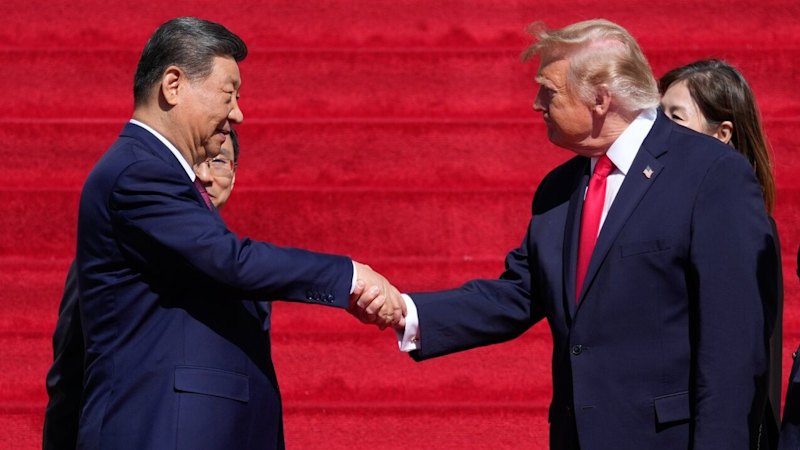
History rarely happens in the blinding glare of television lights. It gathers quietly in the spaces between words, in the deliberate omission of a paragraph from a press release, or in the specific weight given to a handshake at the White House.
Consider the quiet autumn air in Washington when two men who hold the levers of the global economy stepped into a room. Donald Trump and Xi Jinping met not just to sign paperwork, but to wage an invisible war of narratives. To the casual observer tracking the headlines, the summit produced remarkably little. No grand treaties materialized to halt the accelerating artificial intelligence arms race. No sweeping geopolitical knots were cleanly untied.
Yet, looking only at the lack of formal signatures is like judging a chess match by counting how many pieces remain on the board while ignoring the psychological pressure of every silent move.
Behind the polished mahogany tables, two entirely different playbooks were executed simultaneously. Picture a high-stakes negotiation room where the air conditioning hums quietly, drowning out the immense anxiety of two superpowers holding each other's economic future hostage. On one side sat a U.S. administration banking heavily on personal rapport, theatrical optics, and immediate transactional wins—a public-facing strategy designed to showcase strength through direct engagement. On the other side sat Beijing's delegation, operating with an ancient sense of tactical patience, carefully editing what would be spoken aloud and what would be struck entirely from their official summaries.
The divergence was stark. Look at the concrete economic pledges that emerged from the American side. Washington trumpeted agreements on future agricultural imports, targeted trade adjustments, and a newly minted bilateral board of investment. But scan the official readouts published across the Pacific, and a fascinating silence appears. Those specific commitments vanished entirely from Beijing's domestic messaging.
Why? Because sovereignty in modern statecraft is performed differently for different audiences.
To understand why this invisible summit matters, we have to strip away the diplomatic varnish and look at what ordinary citizens feel downstream of these closed doors. When superpowers agree to disagree on critical infrastructure boundaries, or when they politely sidestep the explosive reality of rare earth mineral chokepoints, the ripple effects eventually hit factory floors in Ohio and supply chains in Shenzhen.
Imagine a mid-level procurement manager sitting in a brightly lit office in Chicago, staring at a spreadsheet late at night. That manager does not care about the grand philosophical debates over governance models or historical timelines spanning two centuries versus six millennia. They care about whether the components for tomorrow's technology will clear customs, whether tariffs will spike overnight, and whether the fragile truce holding the international market together will survive the next diplomatic frost.
The summit was designed precisely to buy time for that manager, and millions like them, even if the underlying tensions remained completely unresolved.
Diplomacy is often theater, but good theater has real consequences. When President Trump praised the meeting as a triumph of personal chemistry while critics pointed out the absence of binding enforcement mechanisms on critical tech sectors, they were both right. The summit functioned as a pressure release valve. It prevented an immediate escalation, creating a temporary bubble of stability ahead of upcoming international forums.
Yet, stability built on unaddressed friction is fragile. By leaving the hardest questions—from advanced algorithmic safety to regional territorial pressures—dangling in the invisible space between their administrations, both leaders accepted a dangerous premise. They agreed to kick the structural reckoning down the road.
The true takeaway of the summit is not found in what was agreed upon in front of the cameras. It is found in the quiet realizations of what was intentionally left unsaid. Power is frequently expressed not by the treaties you sign, but by the storms you successfully choose to postpone. And as the world braces for the next inevitable collision of economic giants, those postponed storms are quietly gathering strength beneath the surface.