The neon sign above the checkout lane hums a low, relentless B-flat. It is 5:30 PM on a Tuesday, the hour when American supermarkets swallow millions of exhausted workers looking for something quick to feed their families. In lane four, a woman named Sarah—let us use her as our lens, a composite of the millions navigating today’s economy—stares at a small digital screen.
The screen reads $114.32. If you found value in this article, you should read: this related article.
She looks down at her cart. A gallon of milk. A carton of eggs. Some chicken breasts, two boxes of cereal, and a bag of apples. There is nothing luxurious here. No imported cheeses, no fine wines. Yet the total feels like a gut punch. Sarah works forty-five hours a week as an assistant manager at a logistics firm. Last month, her boss called her into the glass-walled office to deliver what he called good news: a 3.5% raise. He smiled, shook her hand, and spoke about rewarding loyalty.
But as Sarah swipes her debit card, she realizes the brutal truth of modern American economics. Her raise was a phantom. It exists on paper, but it vanished somewhere between the gas pump and the dairy aisle. For another look on this development, see the latest coverage from Reuters.
The cold data from the latest economic reports tells a story of a cooling market: US job growth is slowing down, and wage increases are failing to keep pace with the stubborn drag of inflation. Economists call this "cooling." They talk about "soft landings" and "market corrections."
Sarah calls it falling behind.
The Mirage of the Bigger Paycheck
For decades, we have been conditioned to believe that a bigger number on a paycheck equals progress. If you made $20 an hour last year and you make $21 this year, you are winning. Right?
Wrong.
To understand why, we have to look at the invisible thief hiding inside every dollar bill. Consider a simple metaphor. Imagine you are running a race on a treadmill. Every year, you train harder, your legs move faster, and your speed increases from level five to level six. You should be covering more ground. But what if someone is simultaneously tilting the treadmill upward and moving the track backward? You are sprinting, your chest is burning, but when you look to your left, you are still passing the exact same potted plant on the gym floor.
That is the current reality of the American wage earner.
The statistics show that while wages are technically ticking upward, the purchasing power of those wages is shrinking. Inflation acts as a regressive tax on existence. When rent climbs by 6%, electricity goes up by 8%, and a box of pasta doubles in price, a 3% or 4% raise is not a victory. It is a controlled descent.
The trouble with looking at economic data through the eyes of institutions is that institutions do not have to decide between paying the electric bill or buying fresh vegetables. They look at graphs. They see a line sloping downward from a terrifying peak and they breathe a sigh of relief. Inflation is cooling, they say.
But cooling inflation does not mean prices are dropping. It just means they are rising more slowly. The damage is already baked into the crust. The new, inflated baseline is here to stay, while the American paycheck is stuck in first gear.
When the Hiring Signs Come Down
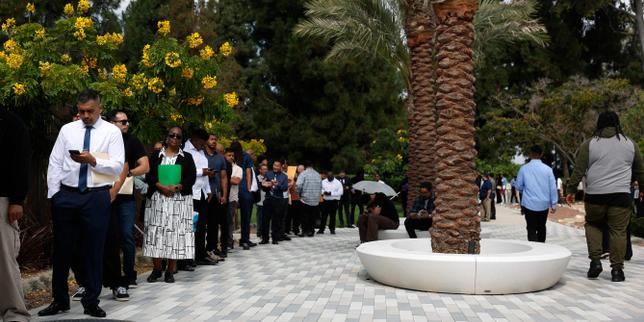
Step outside the grocery store and drive past the commercial strips that line the edges of our towns and cities. For the past few years, these streets were desperate for human capital. "Help Wanted" signs hung from every window, faded by the sun, offering signing bonuses for fast-food shifts and retail positions.
Now, look closer. Those signs are quietly disappearing.
The hiring frenzy that defined the immediate post-pandemic era has hit a wall. It is not a crash—not yet—but rather a collective hesitation. Companies that were hoarding workers a year ago are suddenly looking at their balance sheets with a colder eye. They are freezing open positions. They are letting natural attrition shrink their teams instead of firing people outright.
For someone trying to break into the job market, or for a worker trapped in a toxic corporate culture, this shift changes everything. Leverage has shifted across the table.
When jobs were plentiful, workers could walk away. They could demand better hours, higher starting pay, and remote flexibility. The threat of quitting was a powerful shield. But as the monthly job creation numbers soften, that shield cracks. Workers look at the news, notice the fewer job postings on LinkedIn, and decide to stay put. Even if they are miserable. Even if their pay is failing to keep up with the cost of a tank of gas.
Fear enters the equation. And fear is a powerful tool for suppressing wages.
The Human Friction of Macroeconomics
It is easy to get lost in the jargon of central banks and economic forecasting. We hear about interest rates, the consumer price index, and non-farm payrolls. These terms are designed to sound clinical, detached, and absolute. They make the economy sound like a complex machine that just needs a few clicks of a wrench from an expert technician.
The truth is much messier. The economy is not a machine; it is a massive, chaotic ecosystem driven by human psychology, panic, and survival.
When the Federal Reserve raises interest rates to fight inflation, their explicit goal is to slow down the economy. They want companies to spend less. They want hiring to cool off. They want you, the consumer, to stop buying things.
But consider what happens next in the real world. A small business owner in Ohio wants to expand her bakery. She needs a loan to buy a commercial oven. Because interest rates are high, that loan is now too expensive. She cancels the order. The oven manufacturer in Illinois sees a drop in demand, so they cancel their plan to hire three new assembly line workers. One of those potential workers, currently unemployed, can no longer afford to fix his car, meaning the local mechanic loses business.
The ripples expand outward, losing momentum but carrying real pain into quiet living rooms.
This is the friction of a slowing economy. It is the sound of thousands of quiet conversations around kitchen tables, late at night, after the kids have gone to sleep. It is the calculation of whether a child can participate in Little League this season when the registration fee is $150 and the utility bill just hit an all-time high.
The Long Road Ahead
We are living through a period of profound economic dissonance. On one hand, the stock market flashes green, corporate profits often break records, and the official unemployment rate remains historically low. On the other hand, consumer sentiment is sour, savings accounts are depleted, and credit card debt is surging to unprecedented heights.
Both of these realities are true at the same time. The macroeconomy can look stable while the microeconomy—the one lived by actual human beings—feels incredibly fragile.
The danger of this moment is the temptation to normalize the struggle. We adjust. We buy the store-brand cereal. We skip the weekend trip. We stretch the miles between oil changes. We internalize the stress, carrying it in the tight muscles of our shoulders and the interrupted sleep of the early morning hours.
Sarah finishes loading her groceries into the back of her sedan. One of the plastic bags rips, and an apple rolls across the asphalt, disappearing under the bumper of an adjacent truck. She watches it go for a second, tempted to crawl under the greasy metal to retrieve it. Instead, she closes the trunk, climbs into the driver's seat, and grips the steering wheel.
She takes a deep breath, turns the key, and watches the fuel gauge needle slowly rise, stopping just short of a full tank.