The coffee machine in the staff room of the Stockholm eldercare facility sputters and dies at precisely 5:45 AM. It is a small tragedy, entirely routine, but it sets the tone for the morning shift. Outside, the Nordic dawn is a reluctant bruise of grey light spreading over frost-rimed asphalt. Inside, the smell of floor disinfectant mixes with the bitter scent of instant granules.
Fatima is already moving down the corridor.
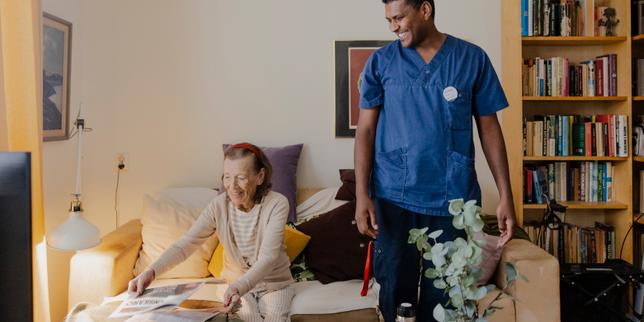
She has been awake since four. Her commute involves two buses and a crowded commuter train that smells of wet wool and damp newspapers, cutting through a city that still dreams behind double-glazed windows. When she reaches room 112, eighty-four-year-old Lars is already awake, staring at the ceiling with eyes that have watched a century shift its shape.
Fatima speaks Swedish, but it is not the Swedish of the textbooks sold in SFI classrooms. It is a working-language Swedish, accented and warm, punctuated by gentle reassurances that require no dictionary. She adjusts his blankets, checks his medication chart, and listens to a rambling story about a fishing trip in Norrland that happened fifty years ago. She has heard the story four times this week. She listens with total attention anyway. Because in this room, right now, she is the anchor holding a crumbling world in place.
We do not like to talk about Fatima. We prefer our political speeches clean, sharp, and neatly divided into camps.
On the evening news, politicians in crisply pressed suits stand behind polished oak podiums in the Riksdag, trading statistical ammunition about border controls, integration quotas, and cultural cohesion. They speak of numbers as if people were pawns on a chessboard, sliding across a map to suit an ideological endgame. The rhetoric is fierce. It is defensive. It warns of an unraveling national identity, of values under siege, of a society stretched to its absolute breaking point.
Yet, behind the grand theatre of parliamentary debates, a very different reality hums quietly along. It is a reality built on quiet desperation and profound demographic mathematics.
Sweden is growing older. The birth rate has dipped to historic lows, a quiet sliding curve that no political decree can easily reverse. The generation of the post-war boom is retiring, moving out of the offices and factories and into the very beds that Fatima tends. Who will empty the bedpans? Who will push the wheelchairs? Who will staff the neonatal wards, the night shifts at regional hospitals, the municipal sanitation trucks rolling through the freezing sleet before the city wakes?
The data tells a story that the stump speeches ignore.
Despite an entire political ecosystem built on the promise of strict limitation, the Swedish public sector remains deeply, inextricably reliant on foreign-born labor. It is not a marginal exception. It is the structural foundation. Take away the immigrant workforce from elderly care, public transport, cleaning services, and healthcare support, and the entire welfare model—that proud, egalitarian crown jewel of the Nordic social contract—would flatline within forty-eight hours.
Consider what happens next in an average municipal hospital in Malmö or Gothenburg.
The morning handover is a Babel of languages held together by a shared professional competence. Doctors trained in Syria, nurses from Poland, assistants from Somalia and Afghanistan. They are the ones holding the stethoscope to a nation’s chest while the pundits outside argue over the purity of the language spoken in the waiting room.
It creates a strange, jarring dissonance. You can walk out of a political rally demanding tighter borders and board a bus driven by a man who has lived in Uppsala for ten years, who pays his taxes, whose children play hockey, and whose labor is the literal reason the bus arrives at 7:12 AM to take you to your office job where you write papers about economic sustainability.
We are living a contradiction. We crave the security of a closed door while depending entirely on the hands that keep the windows open.
Fatima takes a brief pause at 9:00 AM. She pulls a thermos of spiced tea from her locker and sits on a worn plastic chair. Her phone buzzes. It is a text message from her daughter, who is studying law at university. The daughter’s Swedish is flawless, rapid, effortless. She represents the promise that brought Fatima across continents twenty years ago—the idea that sacrifice in the engine room of today buys a place on the deck tomorrow.
And yet, that promise feels increasingly fragile.
When public discourse is saturated with the constant insinuation that you are a burden, a guest who has overstayed their welcome, or a threat to the cultural fabric, something breaks inside the daily grace of the work. You can patch up an elderly man’s hip, you can wipe away the indignity of a failing body, you can smile through a twelve-hour shift on aching feet, but the background noise of hostility still seeps through the staff room walls.
It is an uncomfortable truth that requires a certain moral clarity to face. Sweden’s demographic winter cannot be solved by wishful thinking or by pretending that the labor shortage is a temporary glitch. The birth rates will not magically bounce back tomorrow. The aging curve is a steep, unyielding mountain. Without a steady influx of working-age adults from abroad, the math simply does not close.
Every time a policy is passed that makes it harder for foreign workers to stay, or signals to them that their presence is merely tolerated until politically convenient, a tremor shakes the foundations of the public services we all rely on. The nurses leave for Norway, where the pay is higher and the political climate less punishing. The care assistants burn out, replaced by temporary agency staff who cost municipalities twice as much, draining budgets that are already stretched to the bone.
We pretend that we can separate the worker from the human being. We want the labor without the life. We want the night shift covered, the elderly cared for, the streets swept, but we want the people doing those jobs to remain invisible, silent, and temporary.
Human beings do not work that way.
Fatima looks at her watch. The break is over. Lars will be waiting for his mid-morning walk down the linoleum corridor, leaning on a metal walker with wheels that squeak in a rhythmic, predictable beat. She stands up, stretches her back, and puts her thermos away.
Outside the window, the snow has begun to fall again, turning the Stockholm streets into a monochrome sketch of white and grey. Somewhere across town, a politician is stepping up to a microphone to speak of borders, belonging, and preservation. But inside room 112, the only sound that matters is the soft click of a door opening, and a warm voice saying, Good morning, Lars. Ready for our walk?