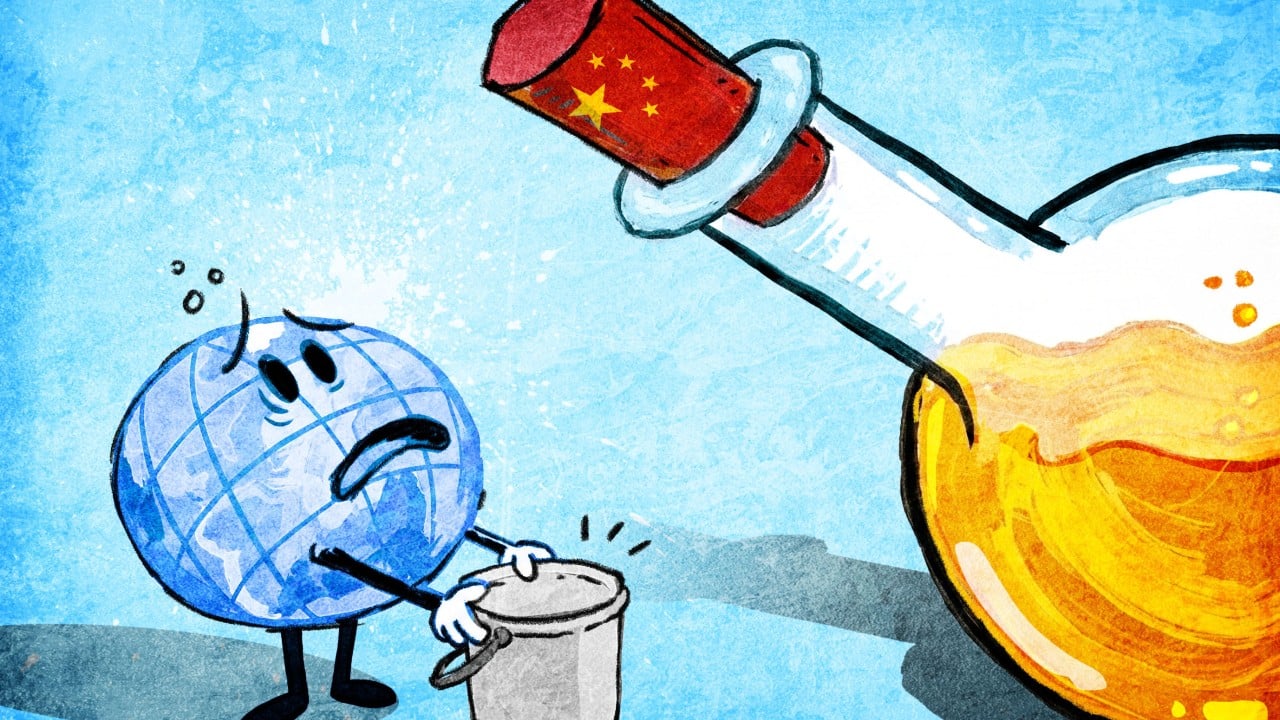
While the world fixates on the high-drama chess match of semiconductor chips and rare earth minerals, a far more primitive and vital liquid is being quietly pulled from the global board. Sulfuric acid, the "oil of the chemical industry," is currently the subject of a de facto export ban by Beijing that will leave overseas buyers in a state of paralysis starting May 1, 2026. This is not a speculative ripple; it is a systemic severance of a supply chain that underpins everything from the copper in electric vehicle batteries to the phosphorus in global food supplies.
China has signaled a comprehensive suspension of by-product sulfuric acid exports through the end of 2026. This move effectively removes approximately 4.6 million tons of annual supply from the seaborne market. To understand the gravity, one must look at the math of industrial dependency. Chile, the world’s copper powerhouse, imports over 1 million tons of this acid from China annually to feed its leaching operations. Without it, the "green transition" becomes a theoretical exercise rather than an industrial reality.
The Perfect Storm of Sulfur and Scarcity
The timing of Beijing’s move suggests a calculated insulation against external volatility rather than a sudden whim. The global sulfur market—the primary feedstock for acid—has been in a tailspin since the closure of the Strait of Hormuz in late February 2026. With nearly a third of the world's sulfur production effectively trapped in the Middle East, prices have spiked by over 400% in some regions.
China, which relies on imported sulfur for more than 50% of its production needs, found itself facing a choice: allow domestic prices to follow the global vertical climb or shut the gates. They chose the gates. By halting exports, the National Development and Reform Commission (NDRC) is attempting to create a domestic "price oasis," ensuring that Chinese phosphate fertilizer producers can keep costs low for the spring planting season while the rest of the world grapples with imported inflation.
The Copper Crunch and the African Corridor
The impact on the global mining sector is immediate and brutal. In the Democratic Republic of the Congo (DRC) and Zambia, copper and cobalt operations are notoriously "acid-short." These mines rely on a precarious logistics tail of trucks and rail to bring in the acid required to dissolve metals from ore.
Chile is the most exposed. Nearly 20% of Chilean copper output depends on acid-dependent processing. With Chinese supply vanishing, Chilean spot prices for sulfuric acid have already surged 44% in a single month. This creates a margin squeeze that high-cost operators cannot survive. When the acid stops flowing, the pumps stop turning. There is no "just-in-time" alternative for a substance so corrosive and dangerous that it cannot be easily stockpiled in massive quantities.
Why Smelters Are Losing Their Safety Valve
For years, Chinese copper and zinc smelters treated sulfuric acid as a burdensome by-product—something to be exported at a near-loss just to keep their storage tanks from overflowing. In 2025, China’s acid exports actually surged by 73% as domestic smelters ramped up production.
That surplus has now vanished. The NDRC’s new mandate forces these smelters to prioritize domestic fertilizer and new-energy sectors. Inside China, the move is a stabilizer; outside, it is a wrecking ball. The "by-product revenue" that international smelters once relied on to offset low treatment charges is being erased, while Chinese firms are being directed to feed a burgeoning domestic demand for lithium iron phosphate (LFP) batteries and high-purity electronic-grade acid.
A Fragmented Seaborne Market
The global deficit is now estimated to reach at least 2.8 million tons for the remainder of 2026. While Japan and South Korea are the logical secondary sources, their spare capacity is a drop in the bucket. They might contribute an additional 500,000 tons, but the logistics of shifting specialized chemical tankers to cover the Chinese shortfall are a nightmare of maritime insurance and skyrocketing freight rates.
The industry is now witnessing a structural shift where "merchant acid"—acid bought on the open market—is becoming a luxury. Regions with captive smelters that produce their own acid will weather this. Regions like the US Gulf Coast or Southeast Asian nickel hubs that rely on spot cargoes are staring at a production wall.
The Food Security Gambit
Agriculture is perhaps the most sensitive lever in this crisis. Sulfuric acid is the primary reagent used to transform phosphate rock into the phosphoric acid found in fertilizers like DAP and MAP. By restricting both the acid and the finished fertilizer, Beijing has effectively locked down the entire phosphate value chain.
Countries like India and Morocco, which sit at the heart of the global fertilizer trade, are now forced to compete for a dwindling pool of expensive sulfur. The result is a direct hit to the global food supply’s cost basis. It is a masterclass in resource nationalism: secure the domestic farmer at the expense of the international competitor.
Strategic Chips in a Chemical Bottle
This is no longer a "niche" chemical story. It is a warning that the foundations of modern industry are more fragile than the final products they create. We have spent a decade worrying about the availability of lithium, but we forgot that you cannot process the lithium—or the nickel, or the copper, or the grain—without the "universal solvent."
The ban on Chinese sulfuric acid exports is a clear signal that the era of cheap, globalized industrial intermediates is over. Companies are now being forced to invest in closed-loop recycling systems or domestic sulfur-burning plants that take years to build. In the meantime, the global supply chain is about to find out exactly how much it hurts when the world's primary digestive system stops working.
The May 1 deadline is not a suggestion. It is the date the chemical floor falls out.


