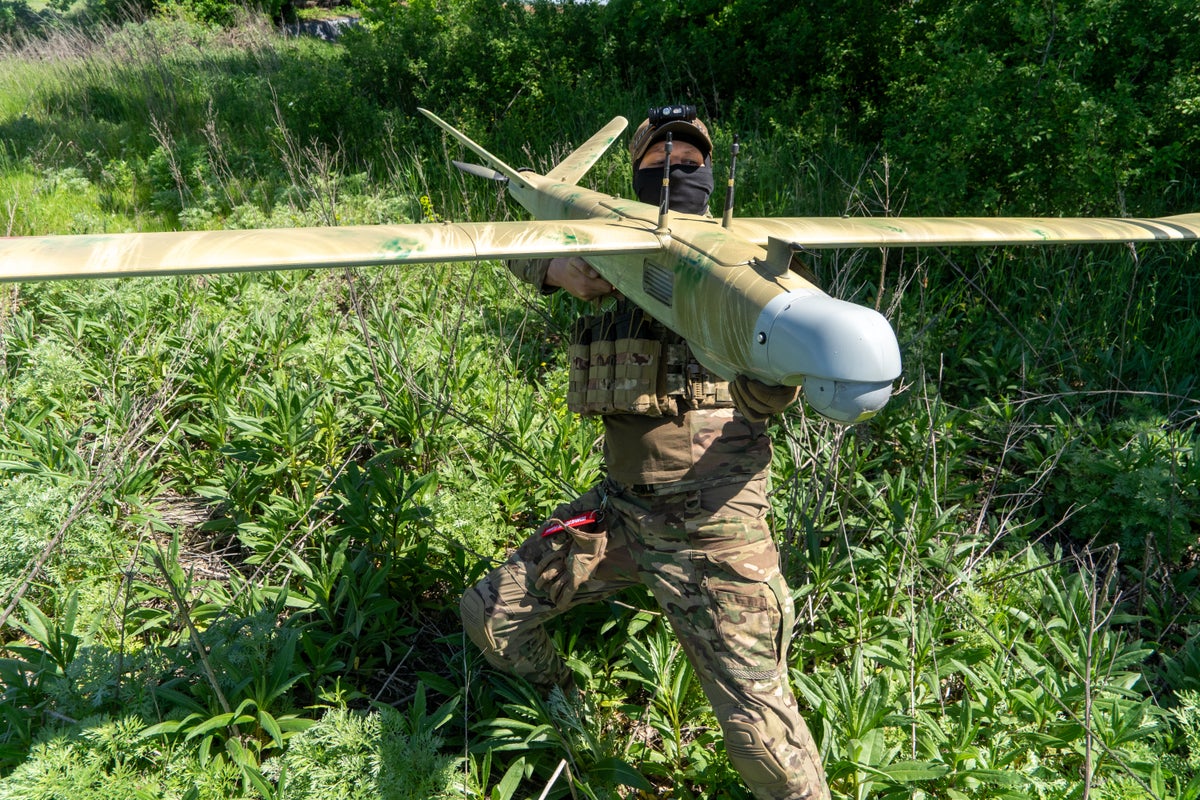
A Romanian F-16 fighter jet roaring over Estonia blasted a rogue Ukrainian long-range attack drone out of the sky. The strike occurred near the village of Kablakula, leaving fragments of the wreckage smoking just 30 meters from a residential home. The incident is not an isolated malfunction. It represents a dangerous, systemic failure point on NATO’s eastern flank.
As Ukraine ramps up long-range drone strikes against Russia’s Baltic Sea energy ports to choking points, the Kremlin is hitting back with an invisible weapon. Russian electronic warfare units are deploying high-powered jamming and spoofing technologies that strip these weapons of their guidance systems. Blinded and confused, the drones are drifting entirely off course, transforming into uncontrolled, flying hazards over sovereign European airspace.
The immediate crisis is clear. Rogue drones have struck empty fuel tanks in Latvia, clipped an Estonian power plant chimney, and forced the civilian population of Vilnius, Lithuania, to flee into underground parking garages amid air raid warnings. While European leaders project public solidarity with Kyiv, behind closed doors, a furious bureaucratic panic is unfolding. The Baltic states are discovering that their multimillion-dollar air defense architectures are utterly ill-equipped to handle the fallout of a low-cost, electronic proxy war happening right above their heads.
The Anatomy of the Blind Flight
To understand how a drone aimed at a Russian refinery in Primorsk ends up over a village in Estonia, you have to look at the mechanics of modern electronic warfare. Long-range strike drones rely on the Global Navigation Satellite System to cross hundreds of miles of hostile territory. They calculate their coordinates by comparing precision time signals sent from satellites thousands of miles away in space.
Russia has turned the Baltic region into a giant Bermuda Triangle for radio frequencies. From heavily fortified enclaves like Kaliningrad and the 841st Separate Electronic Warfare Center, Russian units project two distinct types of interference.
- Jamming: This is pure electronic brute force. High-powered transmitters drown out legitimate satellite frequencies with a wall of static. When a Ukrainian drone encounters this wall, its receiver is overwhelmed. It loses its connection to navigation satellites instantly, leaving it unable to fix its location or track time.
- Spoofing: This is a far more insidious tactic. Instead of blocking the signal, Russian transmitters broadcast counterfeit data that mimics authentic GPS coordinates. The drone’s onboard computer believes the lie. It alters its flight path to correct for a fictional drift, actively steering itself away from its Russian target and directly into European skies.
When a drone is stripped of its satellite navigation, it falls back on its Inertial Measurement Unit. These internal gyroscopes and accelerometers estimate position by calculating speed and direction from the last known coordinate. The mechanism is imperfect. Over long distances, tiny mathematical errors accumulate, causing the drone to drift miles away from its intended trajectory.
The Fiction of Flawless Shielding
NATO leadership has publically characterized the response to these incursions as calm, decisive, and proportionate. That political rhetoric masks a harsh operational reality. Scrambling supersonic fighter jets to intercept slow-moving, low-altitude composite drones is an unsustainable, financially ruinous strategy.
Traditional air defense networks were built to track and destroy fast-moving cruise missiles and fighter aircraft. A long-range drone built from fiberglass and powered by a basic internal combustion engine has a radar signature no larger than a migratory bird. They glide beneath the coverage blankets of traditional radar networks. In multiple recent Baltic incursions, the rogue aircraft were completely undetected by ground radar systems until they had already crossed deep into alliance territory or physically crashed into civilian infrastructure.
+--------------------------------------------------------------+
|            THE ASYMMETRIC AIR DEFENSE DILEMMA                |
+------------------------------------+-------------------------+
| WEAPON SYSTEM                      | ESTIMATED UNIT COST     |
+------------------------------------+-------------------------+
| Ukrainian Long-Range Strike Drone  | $20,000 - $50,000       |
+------------------------------------+-------------------------+
| NATO Air Police Fighter Jet Scramble| $40,000 (Per Flight Hour)|
+------------------------------------+-------------------------+
| Advanced Air Defense Missile       | $1,000,000+ (Per Shot)  |
+------------------------------------+-------------------------+
The math does not work. Western defense contractors spent decades optimizing high-end kinetic missile systems. They did not prepare for a reality where the primary threat to domestic stability is an unguided, 50-mile-per-hour flying lawnmower pushed off course by a Russian radio tower.
The Political Weaponization of Stray Metal
The physical danger of a drone crash is only a secondary objective for Moscow. The primary goal of Russian electronic interference is the fragmentation of Western political alignment. The Kremlin is executing a deliberate strategy to redirect the domestic political costs of Ukraine’s drone campaign away from its own burning refineries and onto the civilian populations of Europe's border states.
Russian state security services have launched massive disinformation campaigns across the Baltics. The narrative is simple but effective: they claim that Latvia, Lithuania, and Estonia are actively permitting Ukraine to use their sovereign territory as a launchpad for strikes deep inside Russia. Moscow pairs these lies with overt threats of military retaliation against the Baltic states.
The strategy targets the psychological resilience of Western citizens. By forcing Baltic residents into bomb shelters because of stray Ukrainian hardware, Russia hopes to spark intense domestic backlash. They want the voter in Tallinn or Riga to question why their personal safety is being compromised to sustain Kyiv’s war economy. It has already yielded political casualties; internal friction over national security preparedness and drone incursions recently contributed directly to the collapse of the Latvian coalition government.
The Localized Countermeasures Gap
While the European Union has responded by slapping new sanctions on Russian military units overseeing electronic warfare in Kaliningrad, economic restrictions do nothing to stop a physical drone moving through the air. Western European nations have deployed point-defense anti-drone systems to areas like Poland and Romania, but these technologies have not been uniformly distributed across the northern Baltic rim.
A comprehensive counter-drone grid requires an integrated, layered infrastructure.
[Low-Altitude Passive Radar] ---> [Automated Frequency Jammers] ---> [Kinetic Interceptor Drones]
Acoustic sensors and specialized optical tracking units must detect the unique signature of small engines. Once localized, defensive systems can use localized, targeted jamming to drop the rogue drone harmlessly into unpopulated fields, rather than relying on fighter pilots to blow them apart with explosive ordnance over residential zones.
The most effective tools to solve this crisis are not found in Western defense boardrooms. They are currently being iterated on daily in the mud of the Donbas. Ukraine has built the most sophisticated, combat-tested electronic warfare and counter-drone ecosystem in human history. To secure their own skies, European defense ministries must strip away peacetime bureaucratic procurement rules and integrate Ukrainian technical expertise directly into their domestic defense networks.
Estonian Defense Minister Hanno Pevkur has issued blunt warnings to Kyiv, demanding that flight trajectories remain as far from NATO territory as humanly possible. Yet, as long as Russia employs theater-wide signal corruption, structural safety zones on a map are an illusion. The border between the theater of war and the zone of peace has been entirely blurred by the invisible realities of the radio frequency spectrum.