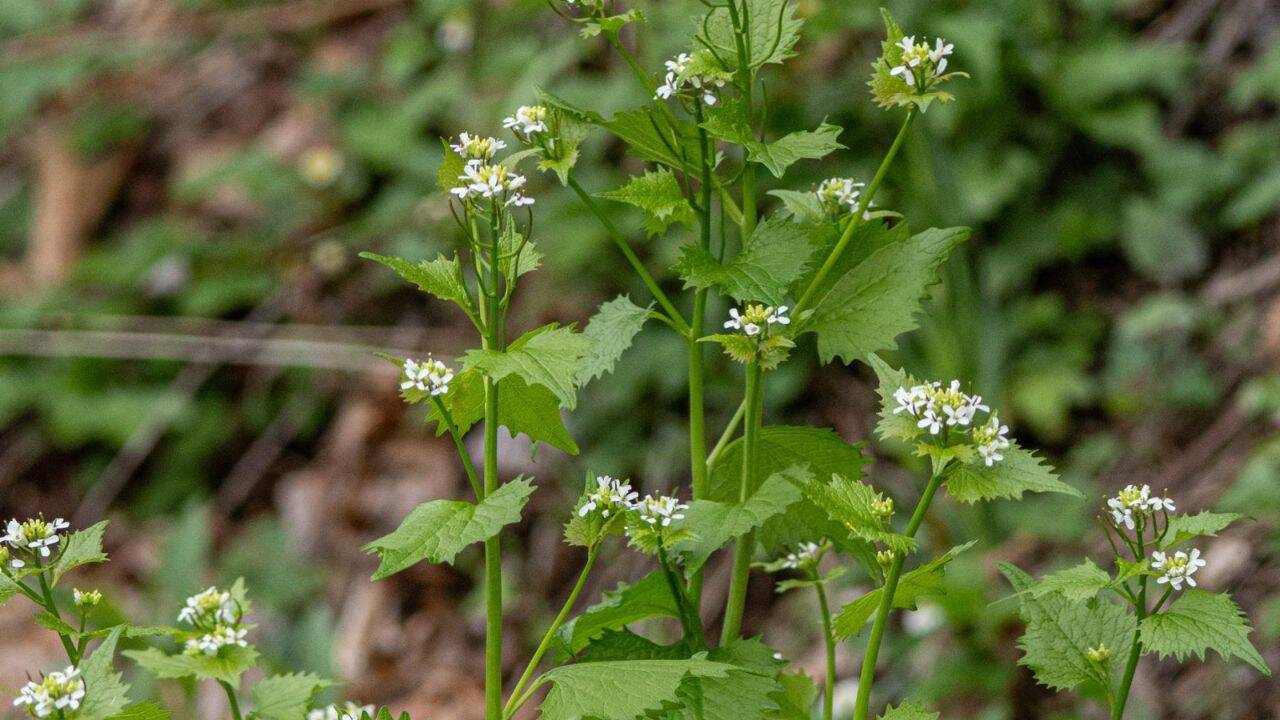
Walk into almost any eastern or midwestern woodland in early May, and you'll see a sea of knee-high green stalks topped with tiny white four-petaled flowers. Crush a leaf between your fingers. It smells unmistakably like garlic.
Most hikers assume it's a harmless wild herb. They're wrong.
That innocent-looking plant is Alliaria petiolata—invasive garlic mustard—and it has quietly marched across 37 U.S. states and at least six Canadian provinces (with newer sightings pushing that count to seven in Canada, including Alberta). Eight U.S. states legally classify it as a noxious weed. Unlike sun-loving weeds that stick to highway medians and abandoned lots, garlic mustard thrives in deep, shaded forest understories. Once it gets a foothold, it wipes out native wildflowers, starves mature trees of underground nutrients, and triggers a chain reaction that empties forests of native insects and wildlife.
How a 19th-Century Culinary Herb Became an Ecological Nightmare
European settlers brought garlic mustard to North America in the 1860s for two practical reasons: food and medicine. Early botanists first documented it growing outside cultivation on Long Island, New York, in 1868. People planted it in kitchen gardens for winter greens, used it as an herbal remedy, and occasionally sowed it for erosion control.
It escaped almost immediately.
In its native Europe and western Asia, dozens of specialized insects and fungi feed on garlic mustard, keeping its population in check. North America didn't have those natural predators. Local deer won't touch it because of its sharp, pungent oils. In fact, heavy deer browsing actually helps garlic mustard spread—deer eat the native trilliums, trout lilies, and tree saplings around it, leaving the garlic mustard completely untouched to claim the newly cleared forest floor.
Within just five to seven years of arriving in a healthy woodland, garlic mustard can completely dominate the understory. Worse yet, it doesn't even need a logging road or storm damage to invade. It walks straight into undisturbed, mature forests and takes over.
Underground Chemical Warfare and the Mycorrhizal Collapse
Most invasive plants win by growing faster or taller than their neighbors. Garlic mustard fights dirty underground.
Native North American trees—oaks, maples, beeches, and pines—rely on an underground network of mycorrhizal fungi attached to their roots. These fungi act like microscopic extensions of the tree's root system, trading water and essential soil minerals for sugars produced by the tree's leaves. Native woodland wildflowers depend on this exact same fungal network to survive.
Garlic mustard doesn't need mycorrhizal fungi at all. Instead, its roots pump toxic compounds called allelochemicals (specifically glucosinolates and cyanide-producing compounds) directly into the dirt. These chemicals poison the soil fungi.
Research published by biologists including Benjamin Wolfe and Kristina Stinson demonstrated that garlic mustard actively suppresses ectomycorrhizal and arbuscular mycorrhizal fungi in North American soils. When the fungi die, native tree seedlings stall out and die off. Even after you pull every single garlic mustard plant out of a patch of woods, that chemical residue lingers in the soil for years, making it brutally difficult for native wildflowers to bounce back.
The Hidden Casualty You Never Notice
The damage doesn't stop with plants. Garlic mustard sets fatal traps for native wildlife, starting with the West Virginia white butterfly (Pieris virginiensis), a rare forest-dwelling species already in steep decline.
Normally, female West Virginia white butterflies lay their eggs on native toothworts (Cardamine species), which belong to the mustard family. Garlic mustard belongs to the same plant family and emits similar chemical cues. Tricked by the scent, female butterflies lay their eggs on invasive garlic mustard leaves instead.
It's a death sentence. Chemicals inside garlic mustard foliage are toxic to the developing larvae—either the eggs fail to hatch altogether, or the caterpillars die shortly after taking their first bite. By crowding out native toothworts and poisoning the next generation of caterpillars, garlic mustard has caused local extinctions of this butterfly across parts of the Northeast and Midwest.
On the forest floor, the fallout continues. Garlic mustard alters the chemistry and thickness of the leaf litter layer, driving away woodland salamanders, ground-nesting birds, and soil invertebrates that require damp, diverse native leaf mold to survive.
Why It's So Hard to Eradicate Once It Arrives
If you've ever tried clearing an acre of garlic mustard by hand, you know how relentless it is. Its biology is practically engineered to defeat lazy removal efforts.
Garlic mustard is a biennial plant with a two-year life cycle:
- Year One: Seeds sprout early in spring and form low, ground-hugging clusters of dark green, kidney-shaped leaves with scalloped edges. These rosettes stay green right under the winter snow, allowing them to start photosynthesizing in March before native spring ephemerals even wake up.
- Year Two: As soon as temperatures warm up, the rosette shoots up a hairy flowering stalk reaching two to four feet tall. The leaves change shape, becoming triangular and sharply toothed. By late April or May, clusters of small white four-petaled flowers open.
A single healthy second-year plant produces anywhere from several hundred to over 7,000 tiny black seeds. In dense infestations, researchers have measured more than 60,000 seeds per square meter. Garlic mustard doesn't even need pollinators—it can self-fertilize, meaning one isolated plant carried in on a hiker's muddy boot can start a brand-new colony.
Those seeds drop into the soil and form a dormant seed bank that stays viable for up to 30 years (with most germinating within the first five to ten years). When you yank a plant out of the ground, disturbing the dirt actually wakes up buried seeds from previous decades, triggering a fresh wave of sprouts the following spring.
How to Positively Identify Garlic Mustard Before Pulling
People frequently confuse first-year garlic mustard rosettes with harmless native woodland plants like wild violets (Viola), golden ragwort (Packera aurea), or white avens (Geum canadense). Pulling native violets by mistake only creates bare soil for real garlic mustard to invade.
Use three quick checks before you pull anything:
- The Smell Test: Pinch a leaf and rub it between your thumb and forefinger. True garlic mustard releases a sharp, unmistakable odor of garlic or onion. Native lookalikes smell like plain grass or crushed leaves. (Note: the garlic scent fades late in the season once the plant turns brown and woody.)
- The Root Test: Gently loosen the soil and pull one plant. Garlic mustard has a slender, white taproot with a distinct "S" or "J" curve right near the crown where the root meets the stem.
- The Flower Test: In spring, count the petals on second-year stalks. Garlic mustard flowers always have four small white petals arranged in a cross shape, followed by long, skinny, upright seed pods (siliques) that look like green needles.
What Actually Works to Control It on Your Property
Forget quick fixes. Because of the long-lived seed bank, managing garlic mustard requires a five-to-ten-year commitment. Half-measures waste your time.
Hand-Pulling (Best for Small Patches)
Wait until the soil is damp right after a spring rain. Grab the plant as close to the ground as possible and pull straight up slowly so the entire S-shaped taproot comes out. If the root snaps off and leaves the upper crown behind, it will just send up new flowering stems.
Time your pulling for late April through May, right when the white flowers open but before the green seed pods mature.
The Biggest Mistake People Make With Pulled Plants
Never toss pulled garlic mustard into your backyard compost pile, and never leave it lying in a brush pile in the woods. Even after being yanked out of the dirt, flowering garlic mustard stalks have enough stored energy in their stems to finish maturing and popping open viable seeds.
Stuff every single pulled plant into heavy-duty black contractor bags. Tie them shut, leave them sitting in direct sunlight for at least a week to bake and kill the seeds (a process called solarization), and send the bags to a municipal landfill.
Cutting and Herbicide for Large Infestations
If you're dealing with half an acre or more, hand-pulling will break your back and stir up too much soil. Instead, use a string trimmer or brush cutter to mow flowering stalks down to ground level right as they peak in bloom. Cutting too early lets the plant resprout from the base; cutting too late scatters ripe seeds.
For heavy infestations where native spring wildflowers have already been wiped out, land managers often apply a targeted foliar spray of glyphosate or triclopyr in late fall or very early spring. Because garlic mustard rosettes stay green through winter while native perennials are dormant underground, spraying on a mild day above 50°F kills the invader without harming sleeping native plants. Always check local regulations before using herbicides, and never use standard formulations near wetlands or streams.
Yes, You Can Eat It—With One Caveat
Foragers love promoting "eat the invasives" campaigns, and garlic mustard actually makes a decent wild green. Young first-year leaves harvested in early spring taste like a cross between baby spinach, arugula, and roasted garlic. You can blend the tender leaves into pesto with walnuts and parmesan, chop them into chimichurri, or sauté them with olive oil.
Just don't eat older, tough leaves raw in huge quantities. Like many members of the mustard family, mature garlic mustard foliage contains trace amounts of cyanogenic glycosides, which release low levels of cyanide when chewed raw. Blanching or cooking older leaves neutralizes the compounds, while young spring leaves are safe raw in normal culinary amounts. And remember: foraging alone won't save a forest unless you pull the roots and bag what you don't eat.
Your Next Steps Before Next Spring
If you spend time in the woods or own wooded acreage, start with three immediate habits:
- Brush your boots and check your dog at the trailhead before getting back into your car. Tiny garlic mustard seeds hitch rides in boot treads, pant cuffs, and pet fur, which is the primary way the plant jumps miles between parks.
- Walk your property lines this week and look for low, kidney-shaped green rosettes poking through the fallen leaves. Marking those spots now tells you exactly where to focus your pulling next April before the plants bolt and flower.
- Report new sightings in areas where garlic mustard isn't yet widespread (especially in western states, northern forests, and Canadian provinces like Alberta or British Columbia) using free tracking apps like EDDMapS or your local invasive species hotline. Early detection is the only time eradication is actually cheap and easy.