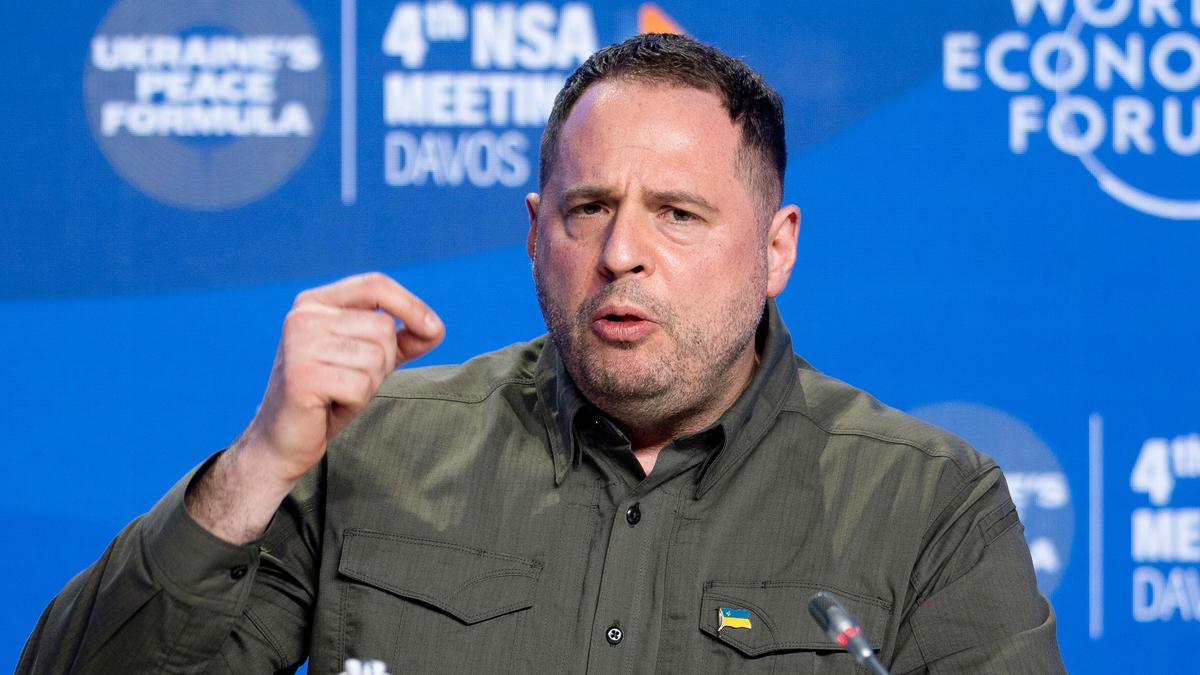
The indictment of a former Chief of Staff to the Ukrainian President on money-laundering charges serves as a critical stress test for the country’s bifurcated judicial architecture. While media narratives focus on the political theater of high-profile arrests, the structural reality involves a complex friction between the National Anti-Corruption Bureau of Ukraine (NABU) and the entrenched informal networks that have historically dictated capital flows within the state. This case is not a singular event but a data point in the broader systemic realignment required for Western institutional integration.
The core of the investigation rests on the Vulnerability of State-Led Procurement. When a high-ranking official is named as a suspect, the legal mechanism triggered is not merely a criminal proceeding; it is an attempt to recalibrate the risk-reward ratio for administrative "gatekeeping." To understand the gravity of these charges, one must analyze the three distinct vectors of systemic corruption that the Ukrainian Specialized Anti-Corruption Prosecutor's Office (SAPO) is currently attempting to close.
The Mechanism of Shadow Intermediation
Money laundering in a wartime economy operates through a specific sequence of obfuscation. The suspect’s alleged involvement centers on the conversion of "administrative rent"—the premium charged for access to state resources—into legitimate assets. This process typically follows a three-stage structural model:
- Placement: The illicit accumulation of cash or digital assets via inflated government contracts or the diversion of state-owned enterprise (SOE) profits.
- Layering: The movement of these funds through a series of shell companies, often located in jurisdictions with limited transparency, to distance the asset from its source.
- Integration: The reentry of the laundered funds into the Ukrainian or European economy through real estate, luxury goods, or "clean" business investments.
The failure of previous administrations to prosecute such cases was a function of Institutional Capture, where the judiciary and investigative bodies were under the direct influence of the executive branch. The current proceedings against a former insider suggest a shift in the independence of the NABU/SAPO vertical, though the true measure of success is the conviction rate, not the arrest record.
The Conflict of Jurisdictional Oversights
A primary bottleneck in Ukrainian anti-corruption efforts is the overlapping and often contradictory mandates of various law enforcement agencies. The Security Service of Ukraine (SBU) frequently clashes with NABU over jurisdictional boundaries. This friction creates a "dilution of accountability" where evidence gathered by one agency may be deemed inadmissible or compromised by the procedural interference of another.
The specific charges against the former Chief of Staff highlight a reliance on the Law on Prevention of Corruption, which mandates asset declarations. When a suspect’s lifestyle or physical assets exceed their declared income, the burden of proof shifts toward the "unjust enrichment" framework. This is a potent legal tool, but it is vulnerable to defense strategies that exploit the lack of international financial tracking—specifically in regions where Ukrainian investigators have limited reach.
The Macroeconomic Cost of Administrative Rent-Seeking
Corruption is not just a moral failure; it is a profound economic inefficiency that acts as a tax on national development. In the context of the Zelenskyy administration’s "de-oligarchization" platform, the prosecution of a former Chief of Staff represents an attempt to reduce the Country Risk Premium.
High levels of corruption lead to:
- Capital Flight: Domestic investors move assets abroad to avoid seizure or the costs of extortion.
- FDI Stagnation: Foreign direct investment is deterred by the lack of a predictable legal environment.
- Deadweight Loss: Resources that should be allocated to defense or infrastructure are diverted into unproductive private wealth.
The "Three Pillars of Institutional Integrity" required to counter this involve autonomous investigative powers, a specialized anti-corruption court, and a public registry of beneficial ownership. While Ukraine has established all three, the operational efficiency of the High Anti-Corruption Court (HACC) remains the final gatekeeper. If the court cannot withstand political pressure during the trial of a former high-ranking official, the entire anti-corruption vertical loses its deterrent value.
Strategic Variables in Post-Maidan Governance
The transition from a patronage-based system to a rule-of-law system is non-linear. The suspect in this money-laundering probe occupied a position that, by definition, sits at the nexus of political power and economic distribution. This role, often referred to in post-Soviet states as the "manager of the system," provides unparalleled access to the mechanisms of state influence.
The prosecution’s strategy appears to be built on Financial Intelligence Units (FIUs) data. Modern money laundering investigations no longer rely on physical evidence of cash transfers; they rely on the digital breadcrumbs of SWIFT data, crypto-ledger analysis, and the discrepancies in corporate filings across EU borders. The bottleneck here is the "Mutual Legal Assistance" (MLA) process. Ukrainian prosecutors must coordinate with foreign counterparts to freeze assets, a process that is often slower than the speed at which funds can be moved electronically.
The Risk of Performative Accountability
There is a significant difference between Rule of Law and Rule by Law. The former implies a neutral application of justice; the latter suggests the use of the legal system as a political weapon to purge rivals or appease international donors. To distinguish between the two in this case, observers must monitor the transparency of the evidence.
A purely political prosecution typically lacks a granular "money trail" and relies instead on witness testimony from disgruntled former associates. A data-driven, structural prosecution—the kind that signals genuine reform—will focus on the UBO (Ultimate Beneficial Owner) chains and the specific legislative loopholes used to bypass procurement audits.
The credibility of the current administration’s anti-corruption stance hinges on the removal of the "Immunity of Proximity." Historically, the closer an official was to the presidency, the more shielded they were from the prosecutor general. Breaking this shield is a prerequisite for Ukraine’s EU accession bid.
The Structural Path Forward
The resolution of this case will dictate the future of Ukrainian governance. If the legal process is rigorous and the verdict is based on documented financial flows, it establishes a precedent that the "cost of corruption" has officially increased.
Strategic priorities for the anti-corruption vertical now include:
- Automation of Asset Monitoring: Reducing the human element in detecting declaration discrepancies.
- Expansion of HACC Capacity: Increasing the number of judges to prevent a backlog of cases from stalling momentum.
- Strengthening Whistleblower Protections: Incentivizing insiders within the state bureaucracy to report the initial "placement" phase of money laundering.
The investigation of Zelenskyy’s former Chief of Staff is the tip of a spear aimed at the very heart of the old guard’s operational methodology. It is a necessary, albeit painful, surgical intervention into the state’s administrative core. The success of this intervention is measured not in the volume of the headlines it generates, but in the silence of the backroom deals it successfully prevents.
Ensuring that this probe leads to a definitive legal outcome—rather than a quiet dismissal once international attention wanes—is the only way to transform Ukraine from a state struggling with its past into a credible European partner. The focus must remain on the hard data of the financial trail and the procedural integrity of the HACC.