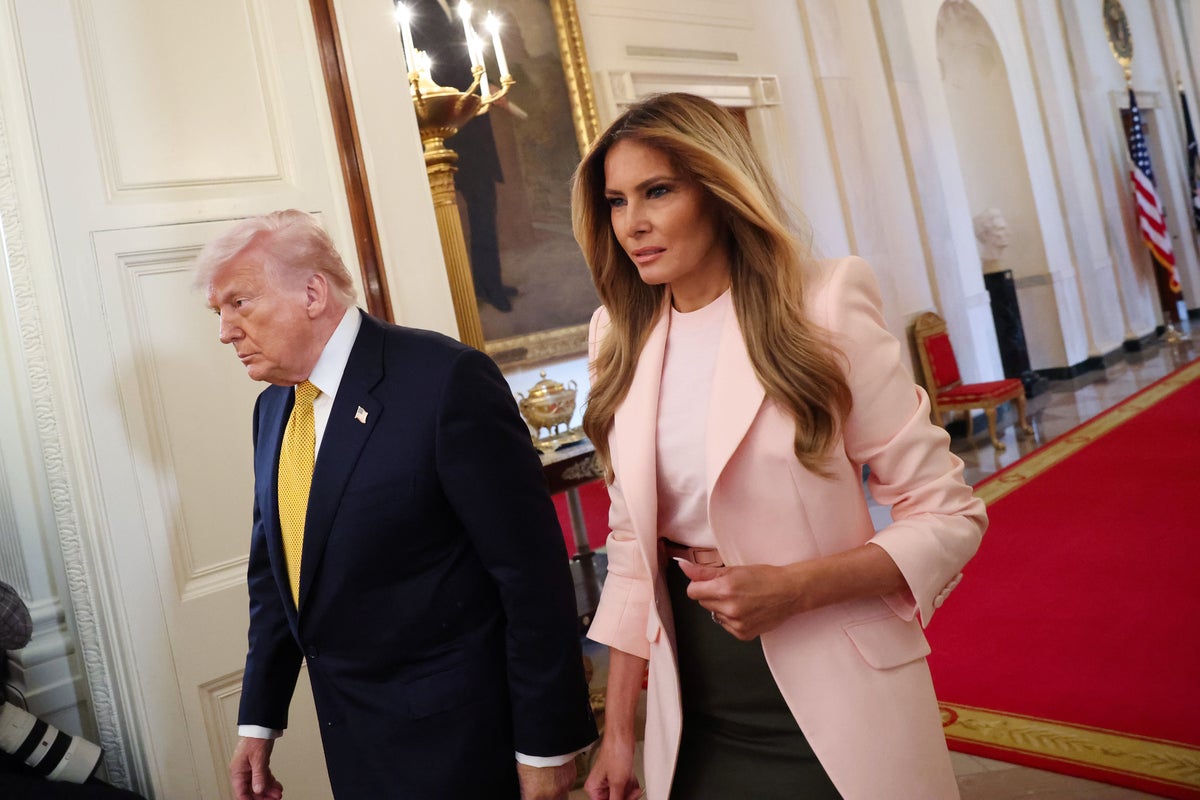
The domestic friction between Donald and Melania Trump has spilled over into the historic rooms of the White House executive residence, mutating from a standard marital disagreement into an unprecedented aesthetic war over the nation's most famous interior. Recent reporting exposes a presidency where the traditional roles of First Lady as keeper of the home and President as global executive dissolved into a petty, room-by-room redecorating contest.
This domestic battleground is not merely a collection of elite interior design squabbles. It uncovers a profound, systemic disruption of institutional norms. While public attention remains fixated on executive orders and legislative stalemates, the real tension has quieted down into the private quarters, where a gold-leaf mirror and the survival of the historic Rose Garden lawn became proxies for a larger battle of control.
The Battle of the Second Floor
For generations, the second-floor executive residence operated under an unwritten rule. The First Lady directed the domestic environment, curating the living spaces to balance historic preservation with family comfort. Melania Trump approached this responsibility with a distinct, minimalist aesthetic, seeking to impose clean lines and restrained curation upon the drafty, museum-like halls of the private quarters.
Donald Trump rejected this vision. Driven by an obsessive focus on interior presentation, he began a campaign of stealth redecoration whenever his wife left the building.
The physical mechanics of this power struggle were shockingly direct. Residence staff watched as the President personally carried items out of the Center Hall, spirituous redesigns shifting overnight.
- The Golden Mirror: Melania Trump had meticulously sourced a rare gold-leaf mirror to anchor her redesign of the historic Queen’s Bedroom. Trump intercepted the piece, moving it directly into his personal quarters to adorn his own "Presidential Walk of Fame."
- The Staff Dilemma: Household staff, bound by strict protocols of presidential deference, found themselves caught in a domestic crossfire. When ushers gently reminded the President that he was dismantling arrangements his wife had personally selected, his response was flat denial of her authority over the space.
- The Absentee Vulnerability: Because Melania Trump famously split her schedule between Washington, New York, and Palm Beach, her absences created a vacuum. Staff routinely hoped for her return simply to establish boundaries against the President's sudden structural whims.
A House Divided by Design and Broadcast
This architectural friction extended far beyond furniture placement. The fundamental daily routine within the private quarters reflected two entirely separate operations running under one roof.
The media environment inside the residence became a literal manifestation of a divided house. Melania Trump preferred to monitor mainstream news via CNN in her adjacent suite. Her husband, furious at the coverage, issued a strict directive to White House communications staff that every television set aboard Air Force One and inside their travel quarters must be permanently locked onto Fox News. This small, daily logistical battle illustrated how even the consumption of information became a localized turf war.
The divergence of philosophy culminated in the physical alteration of the White House grounds. The Rose Garden, heavily shaped in the 1960s under the watchful eye of Jackie Kennedy, became the ultimate point of friction. Trump actively pushed plans to pave over major portions of the historic lawn to create a concrete, patio-style space reminiscent of a commercial resort. The First Lady fought to preserve its historical footprint, though the resulting stark, heavily manicured redesign still drew sharp public scrutiny.
The Real Power Mechanics of First Family Friction
To understand why this matters, one must look at how past administrations handled the stress of the fishbowl environment. In a standard administration, the private quarters serve as a sanctuary from the relentless pressures of the West Wing. When that sanctuary becomes a theater of competitive dominance, the institutional machinery suffers.
Consider a hypothetical scenario where a president instructs military aides or administrative staff to assist in relocating historic artifacts within the residence solely to spite a spouse's curation. The result is a direct misdirection of public resources toward personal grievances. It forces career staff to choose sides between the Chief Executive and the First Lady, eroding the professional neutrality required to run the executive mansion smoothly.
Ultimately, the competitive redecorating of the White House residence reveals a deeper truth about the Trump presidency. It demonstrates that the impulse to dominate, to reshape surroundings by force of will, and to disregard established boundaries was not a strategy reserved strictly for geopolitical adversaries or political opponents. It was an operational reality that dictated the very layout of the rooms where the first couple slept.