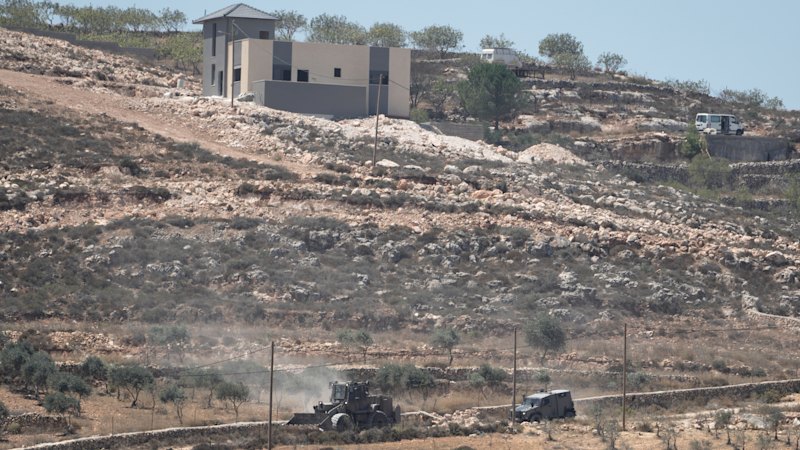
Israeli Prime Minister Benjamin Netanyahu recently condemned the actions of a small group of rioters after armed settlers stormed the Palestinian villages of Qusra and Jalud, assaulting residents and attacking an international news team. Yet this rhetorical distancing masks a structural reality on the ground across the occupied West Bank. Decades of institutional protection, ideological alignment within the governing coalition, and an undermanned military apparatus have created an environment where political statements carry zero weight. When state leadership blames a handful of fringe actors while simultaneously expanding the infrastructure that shelters them, the condemnation becomes part of the conflict management strategy rather than a genuine effort to stop the violence.
The immediate trigger for the latest rhetorical outbreak involved coordinated incursions into flashpoint Palestinian towns. Masked groups descended on property, torched vehicles, and barricaded themselves inside local homes while residents cowered. Netanyahu quickly released a statement labeling the participants lawbreakers who damage international standing and interfere with military operations. Similar language has emerged after high-profile raids over the past year, often framed as damage control for Washington and European capitals. But seasoned analysts who track the mechanics of the occupation recognize the script. Condemnations serve as diplomatic insulation while the daily conditions enabling the violence remain entirely untouched.
To understand why these speeches fail to alter realities on the ground, one must examine the transformation of the West Bank security architecture. The Israel Defense Forces operates under immense strain, juggling active fronts and multi-theater readiness. Security units stationed in the territories find themselves increasingly pulled into administrative tasks or forced to choose between confronting ideologically driven citizens or prioritizing regional defense. When settlers establish unauthorized outposts or move en masse into Palestinian agricultural lands, local commanders frequently arrive late, respond passively, or view their primary role as preventing escalation rather than enforcing criminal law against Israeli citizens.
Political cover from senior government ministries compounds the paralysis. The current governing coalition includes prominent figures who built their careers championing the expansion of unauthorized settlements and openly opposing the evacuation of illegal outposts. Key ministerial portfolios hold direct authority over civil administration in the territory, ensuring that enforcement mechanisms targeting radical factions face bureaucratic starvation. Administrative detention, a tool applied extensively against suspected Palestinian militants, is rarely utilized against Israeli extremists. When arrests do occur, suspects frequently cycle through lenient judicial processes that release them back to the hills within days.
International pressure forces periodic public relations cleanups, but foreign capitals are growing weary of the cycle. Washington has escalated its rhetoric, with senior diplomats explicitly naming extreme elements within the settler movement and applying targeted visa restrictions. These measures sting, yet they fail to shift the calculus inside the West Bank because the domestic political cost of confronting the movement remains too high for the ruling coalition. Prime ministers survive by maintaining the loyalty of right-wing factions, making a serious crackdown on ideological neighborhoods politically fatal.
Consider a typical village on the southern slopes of Nablus. Local farmers watch from their olive groves as young men from nearby outposts descend with stones and clubs, knowing that security forces stationed half a mile away will take upwards of forty minutes to mobilize a response. Even if arrests are made, victims rarely see indictments filed, let alone convictions secured. This systemic impunity breeds permanence. What begins as a temporary tent encampment on a hill eventually receives water lines, electricity, and military protection, transforming illegal vigilantism into established geographic fact.
Condemning the outliers allows official channels to preserve plausible deniability while the broader enterprise of demographic expansion continues uninterrupted. Until governance structure shifts from rhetorical pushback to structural dismantling of illegal outposts and rigorous prosecution without political interference, statements issued from Jerusalem will remain empty exercises in public relations. The violence is not an aberration managed by a rogue fringe; it functions as an organic pressure valve within a system designed to displace communities while keeping international partners placated with words.
Netanyahu says accounts of settler violence in the West Bank is 'much bloated'
This clip captures the recurring public defense strategy, where political leadership minimizes systemic trends by framing widespread attacks as the isolated mischief of a few teenagers.