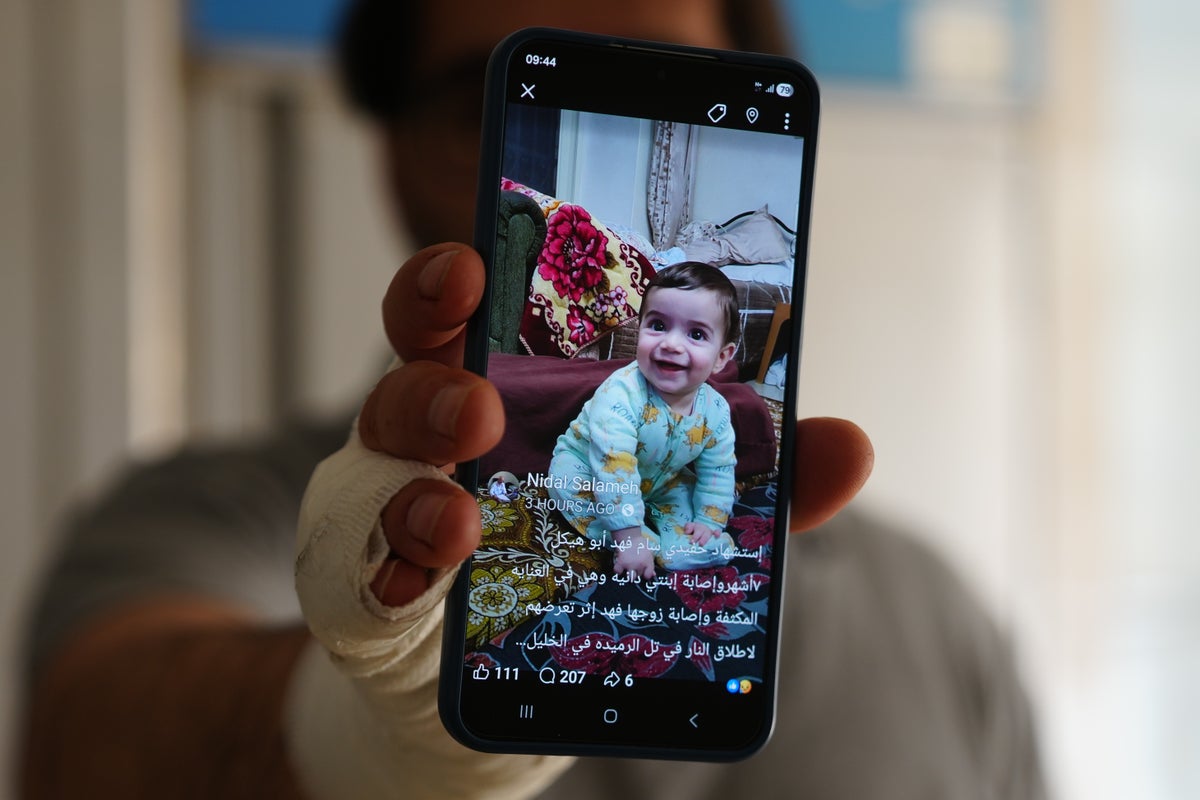
The death of seven-month-old Sam Fahd Abu Haikal, shot in the face by Israeli forces while strapped into his car seat in the West Bank city of Hebron, marks a grim escalation in a systemic pattern of civilian casualties at military checkpoints. This tragedy is not an isolated tactical error, but the direct result of increasingly permissive rules of engagement and structural impunity within the Israel Defense Forces (IDF). While the military routinely attributes these incidents to split-second perceptions of threat, a deeper analysis reveals that the breakdown of operational discipline and the lack of independent oversight have turned routine civilian transit into a lethal gamble.
The fatal shooting occurred in Tel Rumeida, a heavily fortified enclave in Hebron where Palestinian residential areas directly overlap with heavily guarded Israeli settler compounds. Fahd Abu Haikal, a lecturer at Bethlehem University, was driving his family from Bethlehem to visit relatives when their vehicle came under fire near an IDF position.
According to the family, they spotted military vehicles in the distance and stopped the car completely.
Then the windshield shattered. A single round pierced Fahd’s hand, passed through the jaw of seven-month-old Sam, and struck his mother in the face, leaving shrapnel lodged near her heart.
The official military explanation followed a highly familiar protocol. In an initial statement, the IDF noted that soldiers "perceived a vehicle accelerating toward them" and responded with single shots. Hours later, the military updated its assessment, acknowledging that a preliminary inquiry found the occupants were "uninvolved civilians" and stating the incident remained under review.
The Illusion of the Perceived Threat
To understand how a family sedan transforms into a perceived weapon in the eyes of a soldier, one must examine the psychological conditioning and operational mandate governing West Bank checkpoints. Soldiers deployed to these positions operate under a state of chronic hyper-vigilance, exacerbated by a dramatic scaling up of military operations across the territory over the past three years.
When an army prioritizes absolute threat elimination over civilian protection, the threshold for opening fire plummets. A driver tapping the brakes too late, a sudden lane change to avoid a pothole, or simple geographical disorientation can be interpreted as a hostile ramming attempt.
The structural flaw in this approach is the total reliance on subjective perception. Under current operational norms, a soldier does not need to confirm the presence of a weapon or a definitive hostile intent. The mere feeling of danger is frequently treated as sufficient legal and tactical justification to discharge live ammunition into a vehicle’s passenger cabin.
The Rule of Engagement Paradox
The escalation of lethal force against civilians is deeply rooted in the evolution of the IDF’s open-fire regulations. Historically, soldiers were bound by strict escalation-of-force protocols: shouting verbal warnings, firing warning shots into the air, targeting a vehicle’s tires, and only using lethal force as a last resort when facing an imminent, identifiable threat to life.
In recent years, those boundaries have blurred significantly. Field commanders possess wide latitude to interpret rules based on the immediate security environment, leading to a dangerous variance in how threat levels are assessed on the ground.
| Phase of Escalation | Standard International Protocol | Common West Bank Reality |
|---|---|---|
| Identification | Visually confirm hostile intent or weapon | Subjective interpretation of vehicle speed or movement |
| Deterrence | Verbal warnings, hand signals, visible barriers | Immediate weapon readiness, lack of clear physical signage |
| Kinetic Response | Warning shots or non-lethal disabling of vehicle | Direct live fire aimed at the windshield or passenger cabin |
This operational shift has effectively reversed the burden of safety. The responsibility to avoid being shot no longer rests on the soldier’s discipline to identify a target correctly; instead, it rests entirely on the civilian’s ability to predict and flawlessly conform to the unwritten, shifting expectations of a heavily armed, anxious teenager at a checkpoint.
The Geography of Friction in Hebron
Tel Rumeida represents the most volatile manifestation of this dynamic. Unlike other areas of the West Bank where Palestinian towns and Israeli settlements are physically separated, Hebron features an urban layout where hundreds of nationalist Israeli settlers live inside the heart of a Palestinian city of over 200,000 residents.
This proximity necessitates a dense web of concrete barriers, watchtowers, and checkpoints known collectively as the H2 zone. Within this zone, Palestinian movement is severely restricted, while military presence is omnipresent.
The sheer density of these friction points creates a statistical certainty of tragedy. When civilians must navigate dozens of checkpoints daily, the probability of a catastrophic misunderstanding increases exponentially. The physical infrastructure itself contributes to the danger; many checkpoints lack clear, multilingual signage or standardized lighting, making it incredibly difficult for drivers to discern exactly where they are expected to stop, especially after dusk.
The Machinery of Systematic Impunity
The recurring nature of these shootings points directly to a total absence of accountability within the military justice system. When an "uninvolved civilian" is killed or maimed at a checkpoint, the standard institutional response follows a predictable timeline: an initial justification, a subsequent expression of regret coupled with a promise of an internal inquiry, and eventually, a quiet closing of the file without charges.
Human rights organizations have thoroughly documented this pattern. Investigations conducted by the military are rarely independent. They rely almost exclusively on the testimony of the soldiers involved and their immediate commanders, who have a vested interest in framing their actions as compliant with operational regulations.
"The military justice system functions less as a mechanism for uncovering the truth and more as an organizational shield," says a veteran human rights researcher specializing in West Bank documentation. "By treating these deaths as tragic errors rather than criminal negligence, the command structure signals to soldiers that their subjective fear will always outrank civilian lives in a court of law."
This reality was starkly illustrated in previous incidents, such as the 2023 killing of two-year-old Mohammed al-Tamimi in Nabi Saleh. In that instance, an internal military probe concluded that a soldier had opened fire due to a mistaken belief that the toddler and his father were fleeing gunmen. The sole institutional consequence was a formal reprimand for a soldier who had fired into the air against orders. The soldier who actually fired the lethal rounds into the car faced no criminal prosecution.
The Deeper Cost of Regional Escalation
The killing of Sam Abu Haikal occurs against the backdrop of an unprecedented surge in violence across the West Bank. According to United Nations data, more than 1,000 Palestinians have been killed in the West Bank and East Jerusalem since late 2023, including at least 240 children.
This broader intensification of military pressure has eroded the remaining guardrails governing civilian interaction. The influx of reserve units, often less disciplined and less familiar with the specific dynamics of civilian policing than regular forces, has further compromised operational safety at checkpoints.
Furthermore, the complete breakdown of political dialogue and the entrenchment of the settlement enterprise mean that these military installations are no longer viewed as temporary security measures. They are permanent instruments of control. When soldiers are deployed to maintain a permanent regime of segregation, the civilian population is inevitably viewed not as residents to be protected, but as a collective threat to be managed through overwhelming force.
The physical trauma inflicted on the Abu Haikal family is absolute. While Fahd Abu Haikal attempts to process the death of his infant son from a hospital bed, his wife remains in critical condition with metal fragments lodged near her heart, completely unaware that her child is dead.
The institutional response will likely yield another internal review, a handful of tactical adjustments, and a continuation of the status quo. Until international legal bodies or domestic political shifts force a fundamental rewrite of the rules of engagement and establish a genuinely independent mechanism for prosecuting military negligence, the checkpoints of the West Bank will remain places where an infant in a car seat can be transformed into a lethal threat by the mere pull of a trigger.