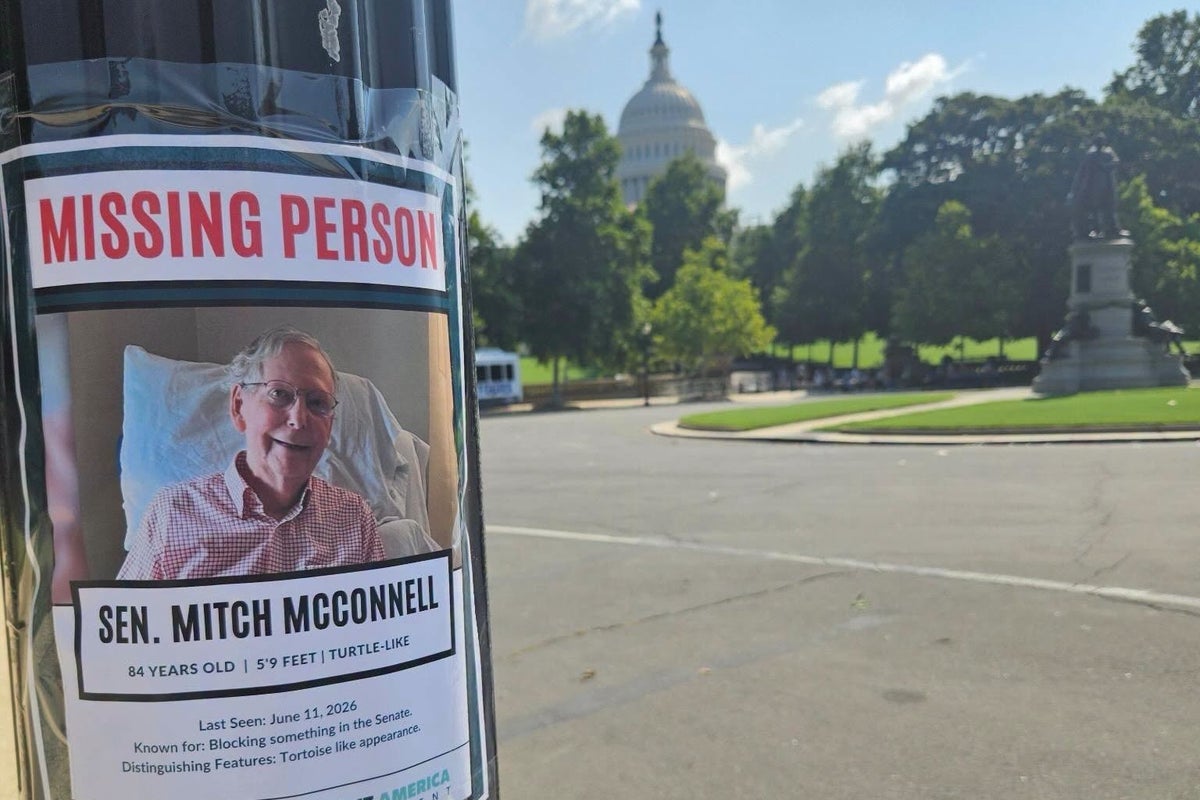
Washington thrives on information control, but when an entire legislative office seals its doors and goes completely dark for weeks, the vacuum inevitably pulls in street theater and public mockery. Pranksters recently plastered Washington, D.C. with satirical missing person posters targeting 84-year-old Senator Mitch McConnell, highlighting a bizarre month-long communications blackout following his unannounced hospitalization. The flyers, featuring a hospital bed snapshot and tongue-in-cheek physical descriptions, captured a deeper systemic rot inside modern American governance. Officials can vanish from public view, rely on vague written dispatches, and insulate themselves from accountability while their offices maintain a facade of operational continuity.
The Anatomy of a Institutional Disappearance
The timeline of McConnell’s absence reveals a calculated strategy of evasion. Public emergency services records showed that paramedics responded to a Washington address on June 14, administering CPR to an unconscious individual suffering an apparent cardiac emergency. Days bled into weeks. The Senate floor carried on without its longest-serving Republican leader, yet his office issued only sparse, repetitive statements insisting he was receiving care.
In any corporate environment, an executive officer missing for a month without direct communication triggers immediate board intervention, mandatory disclosures, and shareholder panic. In the federal government, however, institutional inertia protects the incumbent. Staffers continued to push out generic press releases, while allied lawmakers offered contradictory assurances that they had spoken to him, all while refusing to provide audio, video, or independent verification.
This opacity created a fertile breeding ground for rampant speculation. Without transparent updates, political commentators, fringe influencers, and ordinary citizens filled the void with wild theories. The information vacuum proved that when public servants treat their health status as a classified state secret, they invite public mockery and erode what little trust remains in democratic institutions.
The Staged Proof of Life and Its Skeptics
The silence finally broke when McConnell’s team released a photograph showing the senator sitting upright next to his wife, former Transportation Secretary Elaine Chao, holding a copy of a local newspaper. The imagery was designed to put rumors to rest. Instead, it accelerated them.
Skeptics across the political spectrum immediately scrutinized the frame. Critics noted the absence of medical monitoring equipment or intravenous lines, while digital investigators questioned whether the scene had been digitally manipulated. Prominent media figures and political operatives demanded unedited video footage or metadata, arguing that a static photograph is too easily staged in an era of advanced digital fakery.
The demand for live video is not merely about satisfying idle curiosity. It represents a fundamental demand for institutional honesty. When a lawmaker representing millions of constituents spends weeks sequestered from public oversight, a polished snapshot with a newspaper feels less like transparency and more like public relations management designed to protect a legacy rather than inform the public.
Gerontocracy and the Accountability Vacuum
The posters taped to lampposts outside the Capitol are symptoms of a wider systemic frustration. Voters are increasingly exhausted by a political class that treats lifelong tenure as an unalienable right, clinging to power long past the point of physical and mental stamina.
When leaders become physically incapable of performing their duties yet refuse to step aside, the machinery of government grinds to a halt or operates purely through unelected proxy aides. The reliance on staff-written essays and curated photographs exposes an uncomfortable truth. The American political apparatus is engineered to protect the officeholder, not the institution or the electorate.
As long as incumbents face zero professional consequences for prolonged disappearances and opaque health recoveries, street-level satire will remain one of the few effective tools left for a public demanding basic accountability from its leaders.
The Mitch McConnell mystery is solved. But it doesn't look good for America
This video provides additional context and expert commentary on the broader debate surrounding aging leadership and transparency within American politics.