Volkswagen is preparing to eliminate up to 100,000 jobs worldwide and shutter four major German factories. This staggering figure, which represents roughly 15% of the company's global workforce, marks the most aggressive restructuring in the automaker's 89-year history. CEO Oliver Blume and Chief Financial Officer Arno Antlitz are mapping out a survival strategy that includes spinning off the core Volkswagen brand and cutting planned investment by 15% down to just over €130 billion. The primary casualty of this retreat is not the internal combustion engine. It is the very electric future the company spent billions to build.
The proposed closures target high-profile manufacturing hubs: Emden, Hanover, Zwickau, and Audi’s historic Neckarsulm facility. For decades, these plants represented the crown jewels of German industrial engineering. Today, they run at less than 50% capacity. This industrial collapse is the direct result of a catastrophic misalignment between corporate strategy, shifting government policy, and aggressive foreign competition.
The Electric Bet That Failed to Launch
The crisis at Volkswagen is fundamentally a demand problem masquerading as a cost problem. The company retooled its manufacturing footprint to prepare for an exponential surge in battery-electric vehicle (BEV) adoption. The Zwickau plant, for instance, underwent a €1.2 billion conversion to become an exclusive EV hub.
The strategy failed. European EV demand cooled dramatically after the German government abruptly terminated consumer EV subsidies. Just as the assembly lines peaked in capacity, the buyers disappeared. The factories engineered for high-volume, low-margin electric production are now bleeding cash.
Compounding this domestic slowdown is an unprecedented collapse in China, historically Volkswagen's primary profit center. Non-Chinese automakers saw their share of the Chinese passenger vehicle market drop from 57% in 2020 to just 32%. Volkswagen, which long enjoyed the top spot in China, was overtaken by BYD and has now fallen behind Geely. The company is losing a price and technology war against more nimble domestic players who can design, build, and iterate software-heavy vehicles in half the time it takes Wolfsburg.
The Utilization Trap
The mathematical reality confronting management is stark. The four targeted factories possess a combined annual capacity of roughly 1.3 million vehicles. They are currently producing between 600,000 and 650,000.
Operating a capital-intensive automotive plant at 50% capacity is financial suicide. Fixed costs—ranging from tooling depreciation to specialized energy infrastructure—remain constant regardless of volume. When production halves, the fixed cost allocated to every individual vehicle doubles. This structural inefficiency has crushed Volkswagen’s margins, making it impossible to price its electric cars competitively against Chinese imports or Tesla.
The proposed solution is brutal. Management intends to phase out production at the four sites as current vehicle lifecycles end.
- Emden: Retooled to build the ID.4 and ID.7, this plant employs over 7,700 workers in a city of just 50,000 people. Its closure would devastate the regional economy.
- Zwickau: The poster child for the EV transition, building the ID.3, Audi Q4 e-tron, and Cupra Born.
- Hanover: Home to Volkswagen Commercial Vehicles and the battery-powered ID. Buzz.
- Neckarsulm: Audi's high-tech facility employing over 15,000 people, producing flagship sedans and the e-tron GT.
The Iron Triangle of German Labor
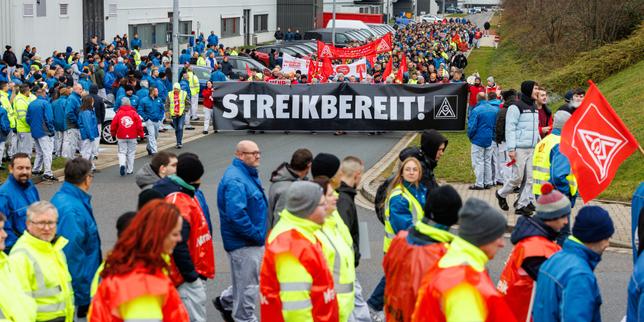
Executing a layoff of 100,000 workers in Germany is not a standard corporate downsizing. It is a political war. Volkswagen operates under a unique corporate governance structure where the powerful IG Metall trade union and the German state of Lower Saxony hold a combined veto power over major structural changes. Lower Saxony holds a 20% voting stake in the company and historically votes aligned with labor interests to protect local employment.
A December 2024 agreement with unions explicitly banned plant closures and mandatory layoffs through the end of the decade. By putting these four factories on the chopping block, Blume is tearing up that treaty. The response from the works council and IG Metall has been immediate, with leadership promising unprecedented resistance and industrial action.
Independent automotive analysts have long noted that Volkswagen suffered from years of artificial overstaffing due to this political arrangement. The company maintained a larger workforce than its global peers to satisfy regional political stakeholders. Now, the market reality of globalized EV competition has broken that political compromise.
A Fragmented Legacy
The deeper systemic issue is that Volkswagen is attempting to transition to a new technology era while weighed down by legacy infrastructure. The company’s current business model—developing highly engineered cars in Germany, manufacturing them across Europe, and exporting them globally—is economically obsolete in an era of localized supply chains, regional battery cartels, and shifting geopolitical tariffs.
As the supervisory board prepares to debate these cuts at a crucial July 9 meeting, the financial markets remain profoundly skeptical. Volkswagen shares fell to a 16-year low following the leaks, signaling that investors realize cutting capacity is merely defensive. Eliminating 100,000 jobs removes excess cost, but it does nothing to fix the core vulnerability: Volkswagen still lacks a high-demand, high-margin software platform that can compete with modern digital vehicles. The company is shrinking to survive, but it has yet to prove it knows how to grow.