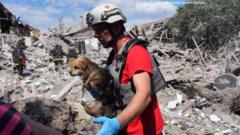
Russia has systematically shifted its air campaign toward targeting municipal infrastructure, public transit networks, and educational facilities in front-line Ukrainian cities like Kharkiv, Zaporizhzhia, and Kherson. This deliberate strategy aims to depopulate key urban centers by rendering daily civilian life untenable. While international attention often focuses on the front lines or major energy grids, the localized destruction of schools, offices, and bus networks presents a distinct humanitarian and logistical crisis. By dismantling the micro-infrastructure that allows a city to function, Moscow seeks to trigger massive internal displacement and break the economic resilience of Ukraine’s urban hubs.
The reality on the ground reveals a calculated shift in doctrine. In the earlier stages of the conflict, missile and drone strikes primarily targeted large-scale electrical substations and military logistics. Today, the focus has narrowed to the civilian fabric.
The Anatomy of Localized Terror
Striking a bus terminal or a school during morning hours achieves a specific psychological outcome. It signals to the population that no space is safe. This is not collateral damage. It is a deliberate targeting mechanism designed to maximize disruption to civilian routines. When a municipal bus route is destroyed, workers cannot reach factories, emergency personnel face delays, and the local economy grinds to a halt.
Consider the mechanics of urban survival. A city relies on a predictable flow of people and goods. By interdicting this flow, the campaign forces municipal authorities to divert scarce resources from defense and long-term stabilization to constant emergency repair.
The strategy relies heavily on precision-guided munitions and cheap loitering drones. These assets are deployed not against hardened military installations, but against soft targets where the human toll is guaranteed to be high. It is a war of attrition waged against the patience and endurance of the civilian population.
The Economic Drain of Constant Reconstruction
Rebuilding a struck office building or replacing a fleet of municipal buses costs millions. For cities operating on war-depleted budgets, these expenses are catastrophic. Local governments are forced to choose between fixing a shattered school roof or repairing water mains.
Foreign aid frequently prioritizes macro-level support, such as national air defense systems and macro-economic stabilization funds. However, the immediate financial bleeding occurs at the municipal level.
- Vehicle replacement: Procurement pipelines for public transit vehicles are severely constrained.
- Labor shortages: Skilled maintenance workers and engineers are frequently drafted or have fled, leaving fewer hands to repair municipal grids.
- Material scarcity: Specialized glass, structural steel, and concrete are in constant short supply, driving up local inflation.
This creates a compounding crisis. As the physical environment degrades, businesses that managed to survive the initial years of the war finally close their doors. The tax base evaporates. The city becomes a financial black hole, reliant entirely on subsidies from Kyiv, which is itself stretched to the limit.
Logistics Under Fire
Maintaining an operational transit network under daily bombardment requires a radical overhaul of traditional logistics. Standard schedules become liabilities. When transit routes are predictable, they become easier to target. Municipal agencies have responded by decentralizing their operations, parking buses in scattered, non-traditional locations rather than central depots, and altering routes on short notice.
This fragmentation keeps the system alive, but it severely reduces efficiency. Commute times double. Maintenance becomes a logistical nightmare because spare parts must be distributed across dozens of hidden sites rather than one central warehouse.
Furthermore, the physical destruction of roads and bridges complicates emergency responses. When a strike hits an office complex, first responders must navigate debris-strewn streets that may have been damaged by previous attacks. The delay of even a few minutes directly impacts survival rates.
The Problem with Short-Term Fixes
Plywood patches and temporary generators are stopgap measures that cannot sustain a city indefinitely. A school with boarded-up windows and an erratic power supply cannot provide a viable learning environment. Parents face a stark choice: keep their children in a hazardous environment or relocate to the western regions of the country or abroad.
This demographic drain is exactly what the bombardment aims to achieve. A city without children is a city without a future. When families leave, the social fabric dissolves, leaving behind an aging population that requires high levels of social support but contributes little to economic productivity.
Air Defense Tradeoffs
The intensification of strikes on local infrastructure exposes a brutal calculus for Ukrainian commanders. Air defense assets are finite. Protecting a major thermal power plant or a military airfield often means leaving a regional transit hub or a residential district exposed.
[National Air Defense Shield]
       │
       ├──► Priority 1: Military Logistics & Command Centers
       ├──► Priority 2: Macro-Energy Grid (Power Plants)
       └──► Priority 3: Municipal Infrastructure (Schools, Buses, Offices)
As long as the national grid and military sites remain under threat, local municipal infrastructure will likely receive secondary coverage. This structural vulnerability is exploited by Russian forces, who monitor air defense gaps and redirect drone strikes toward the least protected urban sectors.
The Long-Term Urban Vacuum
The consequences of this campaign will be felt for decades. Even if hostilities cease tomorrow, the structural integrity of dozens of cities has been fundamentally compromised. The combination of unexploded ordnance, weakened foundations, and ruined utility networks makes large-scale reconstruction an incredibly complex puzzle.
Urban planning in these regions cannot simply be about rebuilding what was lost. It requires designing cities that are inherently more resilient to kinetic threats. This means burying utilities deeper underground, decentralizing power and water networks, and constructing public buildings with reinforced concrete structures capable of serving as shelters.
This transformation requires capital that Ukraine currently does not possess. Relying solely on Western promises of reconstruction funds is a risky gamble, given the shifting political tides in donor nations. The immediate focus must remain on survival, adaptation, and the stabilization of the population centers that remain on the front line of this municipal war.