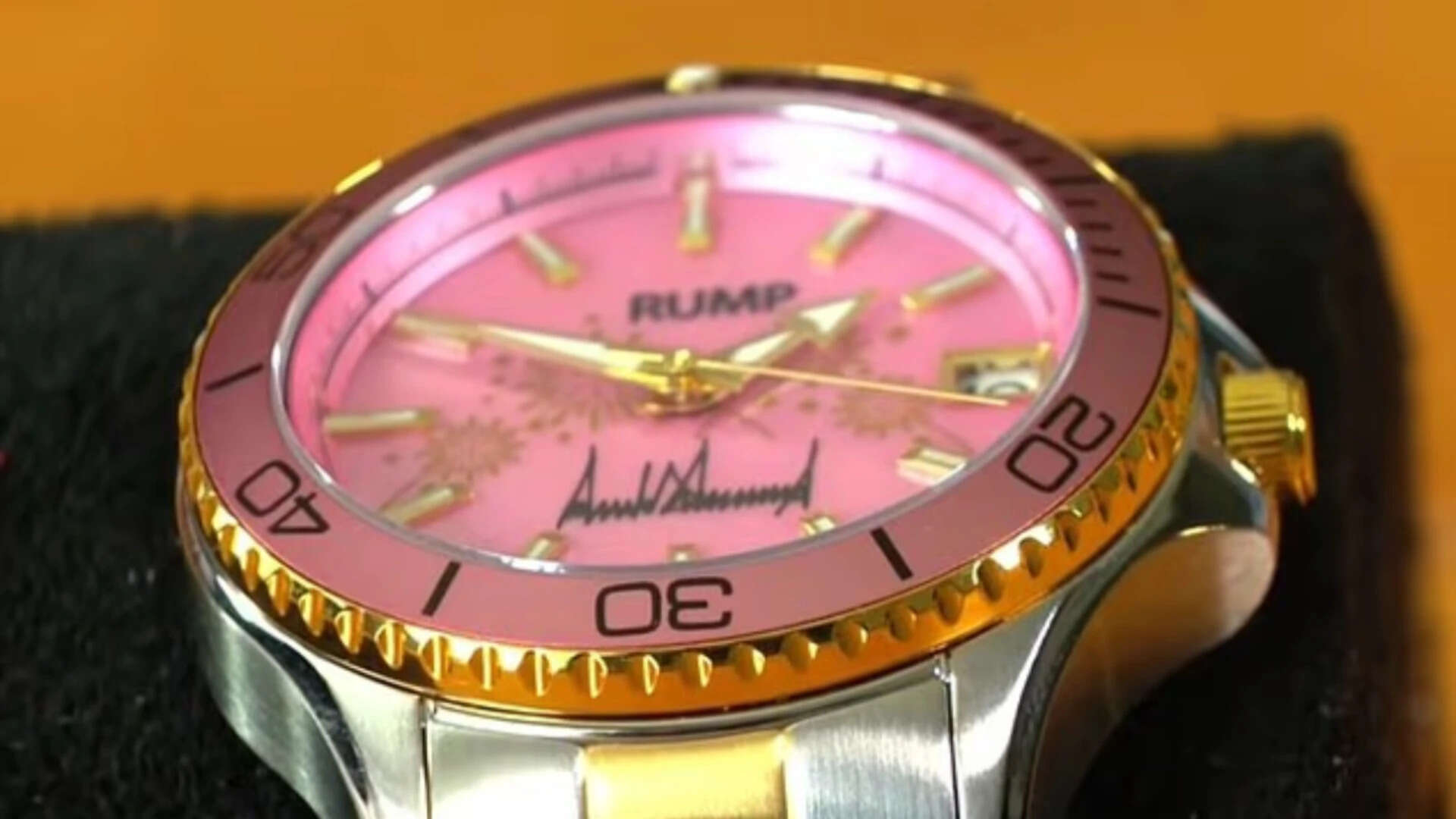
A Rhode Island couple recently spent $640 on what they believed was a premium piece of political history, only to receive a wrist-bound punchline. Tim Petit bought a silver-and-pink "Inauguration First Lady" watch as a gift for his wife, Melanie, after hearing a radio advertisement featuring Donald Trump’s distinct voice. When the package arrived, the critical first letter of the brand name was entirely absent. The dial proudly read "Rump."
The incident highlights a fundamental misunderstanding among buyers of political merchandise. Many consumers believe they are buying goods crafted under the direct supervision of a political figure. The reality is far colder. This is a story of shell companies, strict "all sales final" policies, and the transactional world of third-party licensing where the product itself is often an afterthought.
The Disconnect Between Value and Execution
For the premium price of $640, a consumer typically expects rigorous quality control. Watches in this price bracket usually undergo multi-stage inspections to ensure alignment, print integrity, and mechanical accuracy. Yet, the Petit family watch managed to bypass whatever vetting system was in place, shipping with a glaring aesthetic defect right in the center of the pink face.
When Melanie Petit opened the box, the sentimentality of the gift evaporated. Initial attempts by the couple to contact the vendor went unanswered. It was only after a local television station intervened that the company adjusted its stance, offering an $800 gift card and a corrected replacement watch.
The silence that consumers encounter when things go wrong is a structural feature of these operations, not a bug. Traditional luxury brands spend decades building a reputation for customer service because they rely on lifetime customer value. White-label political merchandise operations function on urgency and immediate conversions. They capitalise on a specific moment in time, meaning long-term consumer satisfaction is rarely the primary metric of success.
The Shell Game of Political Licensing
The promotional videos on the watch website feature Donald Trump stating that it is "Trump Time" and urging supporters to buy. To the average shopper, this looks like a direct endorsement of manufacturing quality. A look into the fine print reveals a completely different corporate structure.
The watch company explicitly notes in its terms that the products are not designed, owned, managed, or controlled by Donald Trump, the Trump Organisation, or any of their affiliates. Instead, the venture operates via a complex licensing matrix involving an entity called CIC Digital LLC.
[Consumer Cash] ➔ [White-Label Vendor] ➔ [Licensing Fees via CIC Digital LLC] ➔ [The Brand Figure]
                                       ↳ (Strict "All Sales Final" Risk)
Under this arrangement, the political figure provides the name and likeness in exchange for a licensing fee or a cut of the revenue. The actual sourcing, manufacturing, shipping, and customer service are outsourced to third-party operators whose identities remain obscured behind generic corporate structures.
This creates a protective buffer for the brand. If a product turns out to be defective, humorous, or sub-standard, the political figure maintains plausible deniability. The vendor bears the operational blame, while the licensing fees have already changed hands.
Why the White Label Model is Flooding the Market
Political campaigns and associated entities have realized that traditional fundraising has its limits. Donating to a campaign yields no physical reward. Selling highly priced lifestyle goods, however, taps into consumer identity while bypassing the psychological barriers of standard political donations.
The business model relies heavily on high margins. A standard quartz watch with custom dial printing can be sourced from international contract manufacturers for a fraction of the $640 retail price. The remaining balance represents pure premium charged for the brand association. When margins are this wide, the operational focus shifts entirely toward marketing and customer acquisition rather than perfecting the manufacturing pipeline.
The risk of this model falls entirely on the consumer. The strict "all sales final" policies plastered across these storefronts ensure that once cash moves from a supporter's bank account to the vendor's payment processor, reversing the transaction is nearly impossible without public pressure or media involvement.
The Illusion of Integrity in Commemorative Goods
Tim Petit noted that he expected the product to reflect the integrity of the office of the presidency. That expectation exposes the gap between political rhetoric and modern e-commerce reality.
In the digital marketplace, sentimentality is an exploitable data point. For the vendors running these operations, a watch face is merely a canvas for whatever logo will generate the highest click-through rate on a radio or social media advertisement. Whether that logo reads "Trump" or accidentally drops a letter to read "Rump" is a detail that the automated assembly line simply does not care about.
The $800 gift card offered to the Petit family might quiet a local news story, but it does not change the mechanics of the industry. Thousands of similar high-margin, low-oversight products continue to ship from fulfillment centres daily, leaving consumers to find out exactly what kind of quality their loyalty has purchased.

,webp/026/307/615/v2/2560x1440.202.webp)