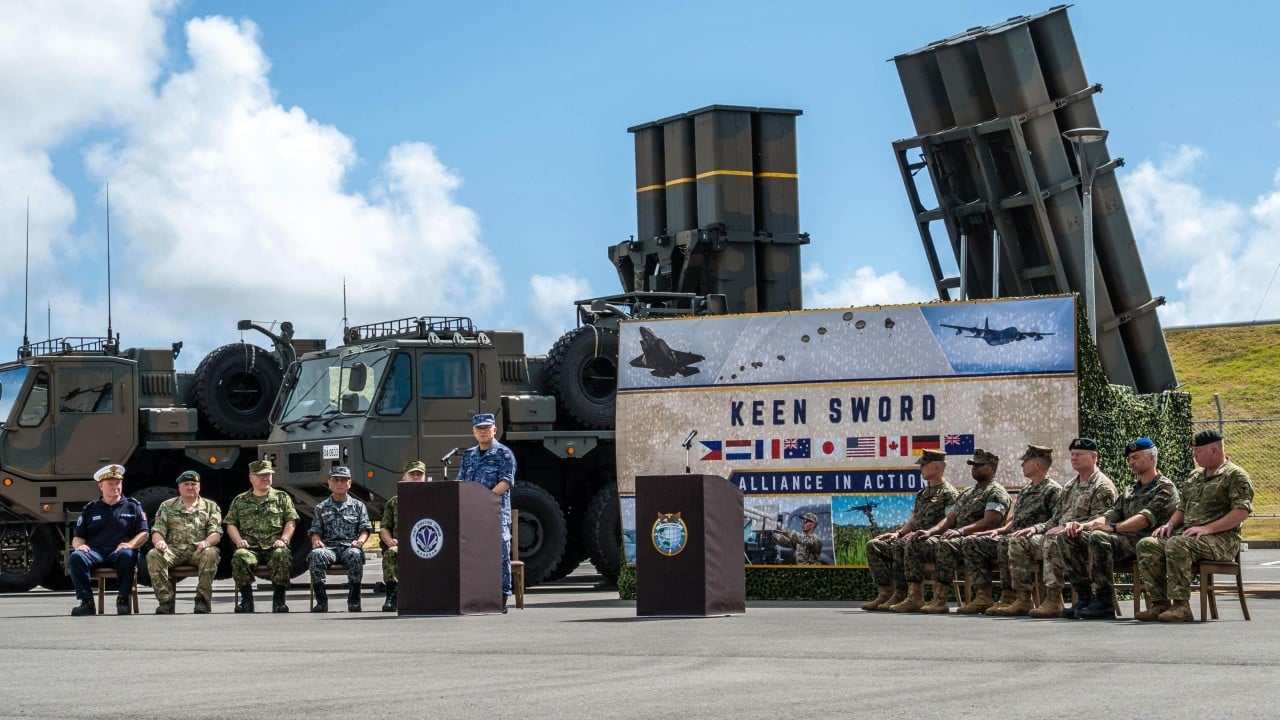
Washington and Tokyo are rehearsing coordinated strikes aimed at contesting People's Liberation Army control over waters near Taiwan. Headlines love a neat binary. Fleet versus fleet, missile against missile, flag waving over disputed blue water. Spend enough time around defense planners, maritime logistics chiefs, and Indo-Pacific shipping desks, though, and you stop looking at the hull numbers first. You look at the fuel barges, the radar blind spots, the port crane queues, and the quiet legal knots tying a Japanese destroyer to an American strike package.
Rehearsals near Taiwan do not happen in a vacuum. They happen inside a compressed, hyper-monitored piece of ocean where commercial tankers thread past coast guard vessels and coastal missile batteries sit tucked beneath rugged hills. When U.S. and Japanese forces practice coordinated strikes to challenge PLA maritime control, they are testing a far harder proposition than firing live rounds at a target drone. They are testing whether two distinct military bureaucracies, operating under different constitutional constraints and industrial supply chains, can compress decision cycles into minutes without triggering an escalation neither capital is ready to absorb.
Why Maritime Control Near Taiwan Is an Equation of Geometry and Time
Geography does most of the heavy lifting in the Western Pacific. Taiwan sits roughly a hundred miles off the Chinese mainland across the Taiwan Strait, with much narrower stretches in places and deep water dropping off sharply to the east into the Philippine Sea. That layout creates a classic double squeeze. From mainland shores, rocket artillery, anti-ship cruise missiles, and land-based aviation cover wide swaths of the strait and adjacent approaches. Out toward the First Island Chain, where the Ryukyu archipelago stretches from Kyushu down past Okinawa toward Taiwan and the Philippines, narrow straits like the Miyako Strait and Bashi Channel act as natural funnels for surface ships and submarines.
When analysts talk about challenging PLA control of waters near Taiwan, they often picture a dramatic surface duel. Real maritime contestation looks more like denial and friction. Beijing has spent years building an integrated anti-access/area denial architecture designed to raise the cost of approaching within range of mainland sensors and shooters, while expanding blue-water surface combatants, amphibious forces, and coast guard patrols to normalize presence around the island.
A coordinated U.S.-Japan strike rehearsal pushes back against that sea-control effort from multiple angles. Instead of relying on a single carrier strike group to punch through a dense sensor envelope, planners look at distributed fires. Land-based launchers, maritime patrol aircraft, surface combatants, and carrier air wings can share targeting data across a wider arc. If an adversary has to divide attention between an air threat from the south, a surface group to the east, and mobile coastal launchers tucked along island chains, its defensive math gets messy fast.
Numbers on a slide deck rarely capture how thin the margin is. A missile battery that stays mobile can roll out of a tunnel, fire, and displace before counter-battery strikes arrive. A surface ship that lingers too long inside a dense engagement zone burns through defensive interceptors that take months or years to replace. Rehearsing coordinated strikes is really a stress test on timing: who spots the target first, whose shooter has the cleanest geometry, and how fast a targeting track crosses from one service or nation to another without getting mangled by translation or authorization rules.
The Quiet Mechanics of Allied Strike Coordination
Coordinating strikes between the United States and Japan sounds straightforward until you trace the actual wires. Two militaries can train together for decades and still discover friction when tactics shift from peacetime freedom-of-navigation patrols to simulated combat targeting.
Command and control sits at the center of that challenge. Historically, U.S. forces and the Japan Self-Defense Forces have operated largely side by side rather than under a single unified wartime command structure, leaning on liaison cells, shared operational plans, and bilateral coordination mechanisms. Over recent years, both governments have moved to tighten operational alignment, including upgrades to command arrangements and expanded bilateral planning around contingencies near Taiwan and the Nansei Islands. Yet moving from peacetime coordination to wartime strike execution requires razor-sharp clarity on authorities. Who clears a strike against a dual-use radar site on a disputed feature? How quickly can a request move through political and military channels when flight times are measured in single-digit minutes?
Then comes the sensor-to-shooter chain. Modern maritime strikes depend less on a single platform seeing everything and more on stitching together data from satellites, airborne early warning planes, surface radars, and electronic intelligence collectors. If a Japanese patrol aircraft or ground sensor detects a mobile missile transporter, and an American or Japanese strike asset has the weapon in range, the data has to move across networks with low latency and high security. Any gap in encryption, data formatting, or rules of engagement turns a promising track into stale coordinates.
Logistics is the unglamorous twin of strike planning. A coordinated strike rehearsal is only as credible as the ammunition and fuel behind it. Precision strike munitions, surface-to-air interceptors, and naval fuel are heavy, bulky, and finite. Moving them across vast Pacific distances under contested conditions requires hardened bases, dispersed airfields, resilient fuel pipelines, and commercial shipping arrangements that might face steep insurance or routing hurdles the moment tensions spike.
Consider a hypothetical example to see how quickly a strike scenario complicates. Suppose a simulated exercise models a coastal radar and missile node threatening allied sea lanes near the southern Ryukyus. In a hypothetical rehearsal, a maritime patrol platform tracks radar emissions, passes initial cueing to a networked command node, and a coordinated package of standoff weapons and electronic warfare support is slated to suppress the site while surface units reposition. Even on paper, planners have to account for decoys, weather over open water, communications jamming, and the risk that striking a node on shore crosses a threshold that invites retaliatory strikes against ports or airbases hundreds of miles away.
What Competitors Miss About Risk, Escalation, and Restraint
Standard coverage of U.S.-Japan drills tends to read like a scorecard: more ships, longer range missiles, tougher joint statements. That framing misses the central tension driving both capitals. Neither Washington nor Tokyo treats a rehearsal near Taiwan as a dress rehearsal for an inevitable war. Both treat it as an effort to shape peacetime and crisis calculations without handing Beijing a pretext or losing control of the ladder.
Escalation management is where neat war-game assumptions collide with political reality. Hitting a naval vessel at sea carries different escalatory weight than striking a radar or missile battery ashore on territory claimed or defended by a nuclear-armed rival. Even in simulated exercises, planners wrestle with horizontal escalation and vertical escalation. Does a strike on one target invite retaliation against a logistics hub in Japan or a space/cyber asset elsewhere? How do you signal restraint while still demonstrating capability?
There is also a domestic political ledger in Tokyo that outside commentators sometimes flatten. Japan's post-war security evolution has been substantial—shifting toward active defense capabilities, counterstrike concepts, and deeper bilateral integration—yet public opinion, constitutional interpretations, and local sensitivities in places like Okinawa remain real constraints. A Japanese government can endorse stronger deterrence and deeper interoperability while still drawing sharp lines around what its forces will do, where they will operate, and under what legal trigger.
Beijing, for its part, reads these coordinated drills through its own strategic lens. From the perspective of Chinese defense planners, joint U.S.-Japan strike rehearsals look like an effort to encircle or bottle up PLA operations in nearby waters and harden an alliance ring around Taiwan. Every drill intended to deter coercion can also be cited inside Beijing to justify faster missile production, tighter patrols, and more aggressive gray-zone pressure—creating a security spiral where each side sees its own moves as defensive and the other's as provocative.
The Supply Chain and Industrial Bottlenecks Behind the Headlines
Watching warships maneuver on a screen tells you almost nothing about magazine depth. Defense analysts who spend time on industrial base issues keep coming back to a sobering reality: modern precision warfare consumes high-tech hardware faster than peacetime factories are built to replace it.
Anti-ship missiles, land-attack cruise missiles, air-defense interceptors, and electronic warfare pods rely on specialized propulsion, seekers, microelectronics, and energetics. Scaling production takes years of capital investment, workforce training, and sub-tier supplier qualification. If a coordinated strike campaign requires salvos of expensive standoff weapons to defeat layered air and missile defenses, stock levels and replenishment timelines become strategic variables just as important as platform speed or stealth.
Shipyard capacity and maintenance backlogs add another layer of friction. Keeping surface combatants, submarines, and amphibious ships ready for high-tempo operations in the Indo-Pacific demands predictable dry-dock schedules and spare parts pipelines. When ships deploy longer or surge more frequently, maintenance queues lengthen, quietly trimming available hull days across the fleet.
Even commercial infrastructure matters more than many defense briefs admit. Dual-use ports, commercial telecommunications cables, energy terminals, and civilian shipping lanes run right through the same maritime neighborhood. A crisis near Taiwan would hit global trade flows—semiconductors, shipping containers, liquefied natural gas, and manufactured goods—long before every military engagement plays out. Rehearsing military strikes without accounting for economic shockwaves and civilian maritime safety leaves half the picture on the cutting room floor.
How to Read Future Drills Without Falling for Hype
When the next round of U.S.-Japan exercises is announced, skip the loudest soundbites and look for quieter indicators of real capability. Watch whether forces are practicing dispersed operations from austere or non-traditional locations rather than clustering at familiar bases. Look at whether logistics and sustainment units are integrated into the exercise timeline, not bolted onto the end as an afterthought.
Pay attention to multinational and cross-service integration that goes beyond presence. Sailing in formation makes for great photographs; passing real-time targeting data across different command systems and executing coordinated suppression under simulated jamming is much harder work. Notice, too, what is left unsaid in official readouts—ambiguity around exact operating boxes, rules of engagement, and crisis thresholds is often deliberate.
Credible deterrence in the waters near Taiwan rests on a delicate balance: convincing an adversary that seizing control by force will be costly and uncertain, while keeping crisis channels open enough that miscalculation does not turn a tense standoff into catastrophe. Rehearsing coordinated strikes sharpens the military edge of that equation, yet the hardest work still happens in the quiet spaces between maneuvers—in factories, command rooms, and capitals trying to keep a volatile sea from boiling over.


