The United States military broke a month-long operational lull in the Persian Gulf with a targeted series of airstrikes on Larak Island, destroying Iranian rocket launchers primed to seed the Strait of Hormuz with naval mines. This kinetic intervention shattered weeks of diplomatic quiet, dragging Washington and Tehran back into open military friction six months after hostilities officially erupted. Yet behind the official Pentagon readouts of preemptive self-defense lies a stubborn, grinding reality. Washington's strategy of alternating between economic strangulation and sudden bursts of air power has failed to reopen the maritime corridor.
Commerce through the world's most critical oil transit artery remains severely crippled, exposing the hard limits of modern naval coercion.
The Anatomy of a Frozen Chokepoint
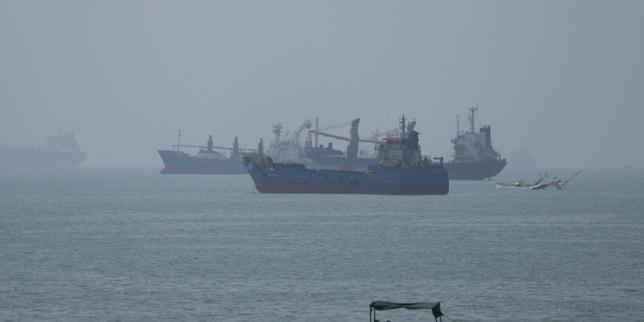
Before the first wave of coalition air raids began in late February, roughly twenty percent of the global petroleum supply flowed through the narrow waters separating Oman and Iran. Daily traffic routinely hovered around one hundred and thirty commercial vessels. Today, that number has collapsed to a fraction of its historical baseline, despite repeated White House assertions that the international waterway is open for business.
The mechanics of this closure rely on asymmetric denial. Iran does not need to maintain a blue-water navy to choke global trade; it relies on decentralized coastal batteries, fast-attack craft, and improvised sea mines deployed covertly under the cover of darkness. When United States Central Command announced it had finished clearing international shipping lanes of explosive devices, operational planners knew the reprieve would be temporary.
Marine assets cannot patrol every square mile of the Persian Gulf simultaneously. The Larak Island strike occurred precisely because surveillance assets caught Islamic Revolutionary Guard Corps units positioning systems designed to re-contaminate the cleared paths. It is a game of maritime whack-a-mole, and the strategic initiative keeps slipping back to Tehran's asymmetric operators.
The Cost of Exhausted Arsenals
The return to kinetic strikes after a thirty-day hiatus also highlights an unspoken vulnerability inside the Pentagon. Months of high-intensity operations have drained specialized precision-guided munitions stockpiles. Defense analysts inside the beltway have watched inventory levels drop with growing unease, raising uncomfortable questions about strategic readiness in other vital theaters like the Indo-Pacific.
When a superpower has to ration high-end interceptors and air-to-surface missiles, its operational tempo changes. The shift toward economic warfare—threats of secondary sanctions against any nation daring to trade with Iran—was never just a diplomatic pivot. It was a mathematical necessity born from dwindling inventory charts.
Yet economic blockades take months, sometimes years, to bite hard enough to force behavioral change in an entrenched autocracy. Meanwhile, the daily cost accumulates. Brent crude breached the ninety-dollar threshold immediately following the Larak Island operation, proving that global energy markets remain hyper-sensitive to any hint of renewed escalation in the Gulf. Every floating barrel delayed or rerouted adds friction to a global economy already bruised by half a year of supply chain fragmentation.
The Illusion of Decisive Victory
Political rhetoric in Washington often treats military campaigns as linear narratives with neat resolution markers. Months ago, declarations of sweeping success echoed through political briefings, claiming that Iran's offensive capabilities had been permanently degraded.
Reality is far messier. The Islamic Revolutionary Guard Corps has absorbed the initial air campaigns by dispersing its assets into hardened underground bunkers and civilian infrastructure. They absorb the blows, count their casualties, and wait for the moment coalition surveillance lapses. When the Americans pull back to rest and re-arm, the coastal launchers emerge from their shelters.
Retaliation came swiftly after the Larak Island operation, with state media reporting Iranian counter-strikes targeting American military positions in the region. This cycle demonstrates that neither side possesses the leverage to deliver a knockout blow without triggering a catastrophic regional conflagration that neither Washington nor Tehran truly wants.
Diplomacy remains stranded in a bureaucratic purgatory. An interim ceasefire brought a temporary hush earlier in the year, and a framework for a final settlement was briefly glimpsed in June. Both withered under the weight of mutual distrust and conflicting demands. Washington wants a permanent surrender of Iran's regional proxy network and an unconditional reopening of the strait. Tehran wants the complete lifting of crippling financial blockades before it yields its only strategic card.
Until one side blinks or structural exhaustion forces a genuine compromise, the Persian Gulf will remain an armed camp. The airstrikes on Larak Island were not the turning point of a winning campaign. They were a reminder that the crisis in the Strait of Hormuz is permanent, structural, and entirely unresolved.